The Sri Lanka Ports Authority (SLPA) is preparing to establish a comprehensive logistics hub within a free zone at the Port of Colombo, with the project expected to be launched within the next two to three months with foreign direct investment (FDI).
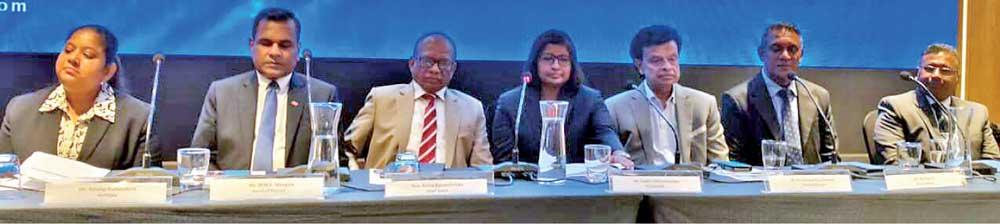
The announcement was made at the 9th Annual General Meeting of the Sri Lanka Association of NVOCC Agents (SLANA), held in Colombo last week, where the future direction of Sri Lanka’s maritime and logistics sector was discussed.
Addressing the gathering, SLPA Chairman Dr. Parakrama Dissanayake said the proposed logistics hub represented a significant policy shift aimed at strengthening Sri Lanka’s position as a regional logistics centre.
“Over the last 40 years, while handling millions of TEUs, we never fully became a logistics hub because a logistics hub requires establishments outside the Port of Colombo. We never had that,” Dr. Dissanayake said.
“On the advice of the minister, within the next two to three months, we will be truly launching a logistics hub, ideally in a free zone in the Port of Colombo. So from a policy end, changing altogether, SLPA will be launching this with FDI,” he added.
The initiative is expected to expand the role of the Port of Colombo beyond cargo handling by creating an integrated logistics ecosystem capable of supporting wider supply chain activities.
New committee to address maritime industry concerns
Minister of Ports and Civil Aviation Anura Karunathilaka, who attended the AGM as Chief Guest, said the government was also taking steps to address concerns raised by the local shipping community regarding the industry’s regulatory framework.
He announced that a new committee would be established to examine these concerns, with Cabinet approval expected during the week.
“We have already prepared a cabinet paper; maybe next week or within next week you will get the cabinet approval to appoint a committee,” the Minister said.
He also assured industry stakeholders that NVOCCs would have an active role in the committee’s deliberations, with their views to be considered in developing a fair and sustainable regulatory environment for local businesses.
Both the Minister and Dr. Dissanayake highlighted the contribution of NVOCCs, or Non-Vessel Operating Common Carriers, to Sri Lanka’s maritime and logistics sector.
Minister Karunathilaka described SLANA members as an important component of the country’s logistics framework and acknowledged their contribution to the wider economy.
Dr. Dissanayake noted that NVOCCs operate between ship operators and cargo owners, making them an important part of the operational ecosystem supporting the Port of Colombo.
Shipping consolidation creates new challenges
While recognising the importance of NVOCCs, Dr. Dissanayake warned that increasing consolidation within the global shipping industry was creating new challenges for ports, terminal operators and NVOCCs.
He highlighted the growing dominance of the world’s largest shipping lines, noting that global container ship capacity currently stands at 34.6 million TEUs, with the 10 largest shipping lines controlling 84.5 percent of that capacity. The top five carriers alone control 65.2 percent.
The five largest carriers by capacity are MSC, Maersk, CMA CGM, COSCO and Hapag-Lloyd.
“The bottom line is that ports, terminal operators, NVOCCs, are at the mercy of these five shipping lines,” Dr. Dissanayake said.
He noted that the leading carriers have evolved beyond traditional ship operations to become comprehensive supply chain service providers, supported by significant physical and technological resources.
Against this backdrop, he urged SLANA and its members to reconsider their role within the evolving logistics landscape.
“SLANA’s role should change from representing NVOCC agents, to supply chain orchestrators enabling Sri Lanka’s next-generation logistics,” he said.
Three pillars for future competitiveness
Dr. Dissanayake identified resilience, digitalisation and sustainability, and human capital and agility as three key pillars that should shape the industry’s future strategy.
The first pillar, resilience, requires businesses to develop alternative routes and contingency plans to withstand disruptions in global trade.
“Pillar number one is resilience. Always have another route,” he said, referring to the Sri Lankan tea industry’s ability to overcome previous disruptions by redirecting shipments through alternative routes.
He identified digitalisation and sustainability as the second pillar, warning that environmental requirements would increasingly influence international trade. In particular, he noted that cargo shipments to Europe would face growing demands for accountability and transparency regarding carbon footprints.
The third pillar is human capital and proactive agility. Dr. Dissanayake stressed that people remain central to organisational success and encouraged industry stakeholders to engage more proactively in policy discussions and anticipate changes rather than simply respond to them.
He concluded that the future of the industry would not necessarily belong to the largest or cheapest operators, but to those capable of adapting quickly to an increasingly complex global logistics environment.
Image Disclaimer: Images used in this article are the property of their respective copyright holders and rightful owners. No ownership is claimed over the images.