President Anura Kumara Dissanayake has said the Government intends to build on Sri Lanka’s hard-won economic stability to achieve stronger economic growth and improve living standards, as an International Monetary Fund (IMF) delegation assesses the country’s progress under its US$3 billion bailout programme.
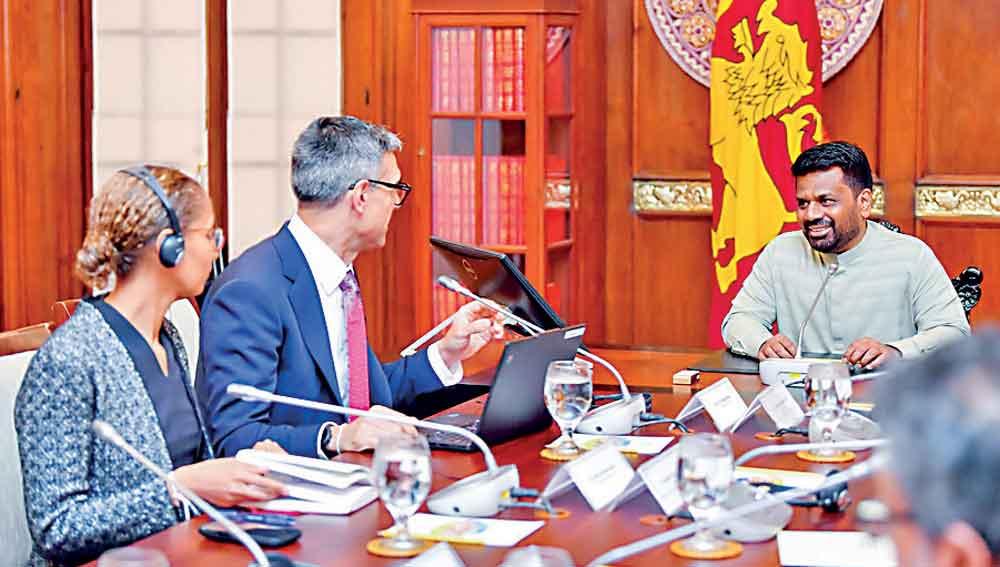
The President made the remarks during a meeting with an IMF delegation led by Mission Chief Evan Papageorgiou at the Presidential Secretariat yesterday. He said recent economic indicators pointed to a move towards greater stability, creating a foundation for broader economic transformation.
“Our objective is to use this stability as a strong foundation to take the country towards a transformative era,” the President was quoted as saying.
He stressed that the benefits of the economic recovery must translate into tangible improvements in household living standards, particularly as higher energy costs and other economic pressures continue to affect the public.
The IMF delegation is currently in Sri Lanka for the seventh review of the country’s Extended Fund Facility (EFF) programme and the 2026 Article IV Consultation. The mission began on September 10 and is scheduled to conclude on September 23.
According to the President’s Media Division, Papageorgiou acknowledged Sri Lanka’s progress in areas including fiscal discipline, stronger government revenue collection and efforts to attract foreign investment. He also emphasised the importance of preserving the economic stability achieved so far as Sri Lanka moves into 2027 and beyond.
President Dissanayake said the IMF-supported programme had played an important role in restoring economic stability following Sri Lanka’s worst economic crisis in decades. He noted that the country’s improved economic position had also strengthened its ability to absorb the effects of Cyclone Ditwah and the ongoing conflict in the Middle East.
The President pointed to Sri Lanka’s 4.2 percent year-on-year economic growth recorded in the second quarter of 2026 as an indication that the recovery remained on track. However, the latest growth figures have also highlighted an uneven recovery, with stronger performance in certain productive sectors yet to translate fully into improvements in household welfare.
Against this backdrop, President Dissanayake reiterated that safeguarding economic stability remained a key priority. He pointed to the Government’s tax revenue performance over the past two years as part of the progress made in strengthening public finances.
The IMF delegation also reviewed progress in implementing Sri Lanka’s social welfare benefit programme, which remains a key commitment under the EFF programme. Discussions also covered the impact of higher energy costs arising from the conflict in the Middle East and the resulting pressures on the economy and households.
Central Bank Governor Dr. P. Nandalal Weerasinghe, Finance Ministry Secretary Dr. Harshana Suriyapperuma and Senior Economic Advisor to the President Duminda Hulangamuwa were among the Sri Lankan officials who participated in the discussions.
The ongoing IMF review comes as Sri Lanka seeks to consolidate the economic gains achieved through its recovery programme while addressing the challenge of ensuring that macroeconomic stability translates into broader economic opportunities and improved living standards for households.
Image Disclaimer: Images used in this article are the property of their respective copyright holders and rightful owners. No ownership is claimed over the images.