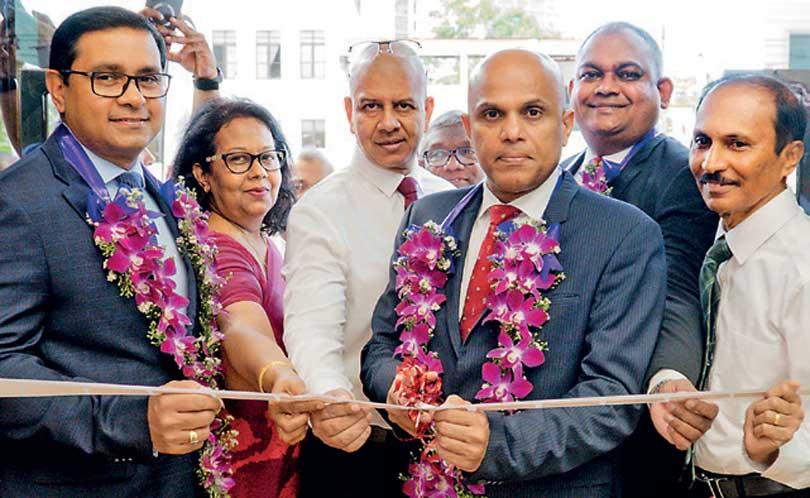
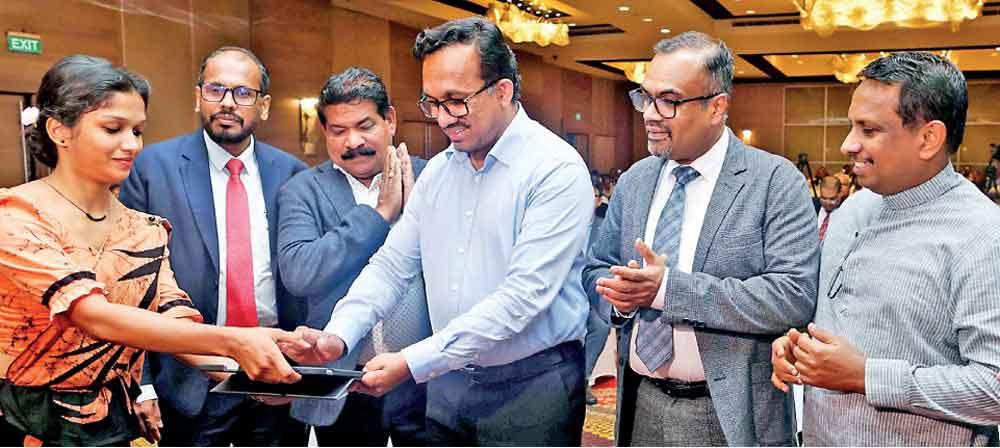
Minister of Industry and Entrepreneurship Development Sunil Handunnetti marking the launch of the National Export Development Plan 2026 – 2030 while government and EDB officials look on
- Plan identifies eight priority sectors
- Aims to tackle structural barriers to competitiveness
- Designed to move beyond export promotion alone by systematically addressing cross-sector bottlenecks, including trade logistics, market access, quality standards and the development of export-ready small and medium enterprises
Sri Lanka has launched an ambitious five-year export development strategy aimed at increasing annual export earnings to US$36 billion by 2030, marking a significant step in the country’s efforts to strengthen its post-crisis economic recovery through export-led growth.
The National Export Development Plan (NEDP) 2026-2030, prepared by the Export Development Board (EDB) with technical support from the Asian Development Bank (ADB), outlines a comprehensive framework designed to diversify the nation’s export portfolio, improve market access, and address structural challenges that have historically constrained competitiveness.
The strategy identifies eight high-potential sectors for expansion, including digital services, electronics, boatbuilding, processed food products, and marine industries. In addition to sector-specific initiatives, the plan places strong emphasis on trade facilitation, logistics enhancement, innovation, workforce development, and sustainability standards.
The roadmap comes as Sri Lanka seeks to translate the macroeconomic stability achieved under its IMF-backed reform programme into sustained economic growth, despite ongoing challenges such as rising fuel import costs and uncertainty within the global trading environment.
Speaking at the launch ceremony in Colombo, EDB Chairman and Chief Executive Officer Mangala Wijesinghe described the initiative as a national commitment to building a more competitive and export-oriented economy.
“The plan is ready, and collective effort will be crucial to its success,” he said, noting that the strategy extends beyond conventional export promotion by addressing long-standing obstacles affecting multiple industries.
According to Wijesinghe, the roadmap focuses on overcoming barriers related to logistics, market access, quality standards, and the development of export-ready small and medium-sized enterprises.
“Exports are far more than a source of foreign exchange. They serve as a catalyst for investment, innovation, productivity, economic transformation, and quality employment opportunities,” he stated.
The NEDP was introduced as a key national priority under the 2025 Budget and supports the Government’s broader vision of creating a prosperous and sustainable future for the country.
ADB Country Director for Sri Lanka Shannon Cowlin highlighted the importance of the initiative at a time when the country’s recovery, while encouraging, remains vulnerable to external economic shocks.
She noted that a stronger and more diversified export sector would generate valuable non-debt foreign exchange earnings, strengthen reserve buffers, reduce dependence on external borrowing, and improve Sri Lanka’s resilience against future economic disruptions.
Cowlin also pointed out that Sri Lanka’s current export basket remains relatively concentrated, with significant untapped opportunities available through greater participation in regional and global value chains.
“The launch of the NEDP represents an important milestone. However, the true measure of success will be effective implementation. Export development is a long-term journey that requires consistent reform and sustained commitment,” she said.
The strategy forms part of a wider reform programme supported through ADB’s Trade, Investment and Industry Development Programme, which includes initiatives aimed at modernising trade facilitation systems, strengthening SME competitiveness, enhancing economic zones, and simplifying regulatory processes.
Deputy Minister of Finance and Planning Dr. Anil Jayantha Fernando stated that the export roadmap aligns closely with the Government’s broader economic transformation agenda, which seeks to move beyond economic stabilisation towards long-term growth and development.
He acknowledged that Sri Lanka possesses considerable resources, talent, and technological capabilities that remain underutilised, emphasising the need for greater product diversification and stronger alignment with evolving global market trends.
Fernando noted that Sri Lanka’s economic recovery has exceeded many expectations, with the economy expanding by 5 percent in 2025 and recording growth of 5.1 percent during the first quarter of 2026 despite adverse weather conditions and geopolitical challenges.
Alongside export-focused initiatives, the Government is pursuing reforms in digitalisation, human capital development, and labour market modernisation to improve productivity and enhance the country’s overall competitiveness.
Built around two key pillars, the NEDP combines targeted interventions for high-growth export sectors with broad-based reforms designed to reduce trade costs, strengthen logistics networks, improve compliance with international standards, and deepen market connectivity.
The Government also plans to place greater emphasis on environmental, social, and governance (ESG) standards, innovation, entrepreneurship, and integration into global value chains as Sri Lanka positions itself for stronger export performance and sustainable economic growth over the coming decade.