
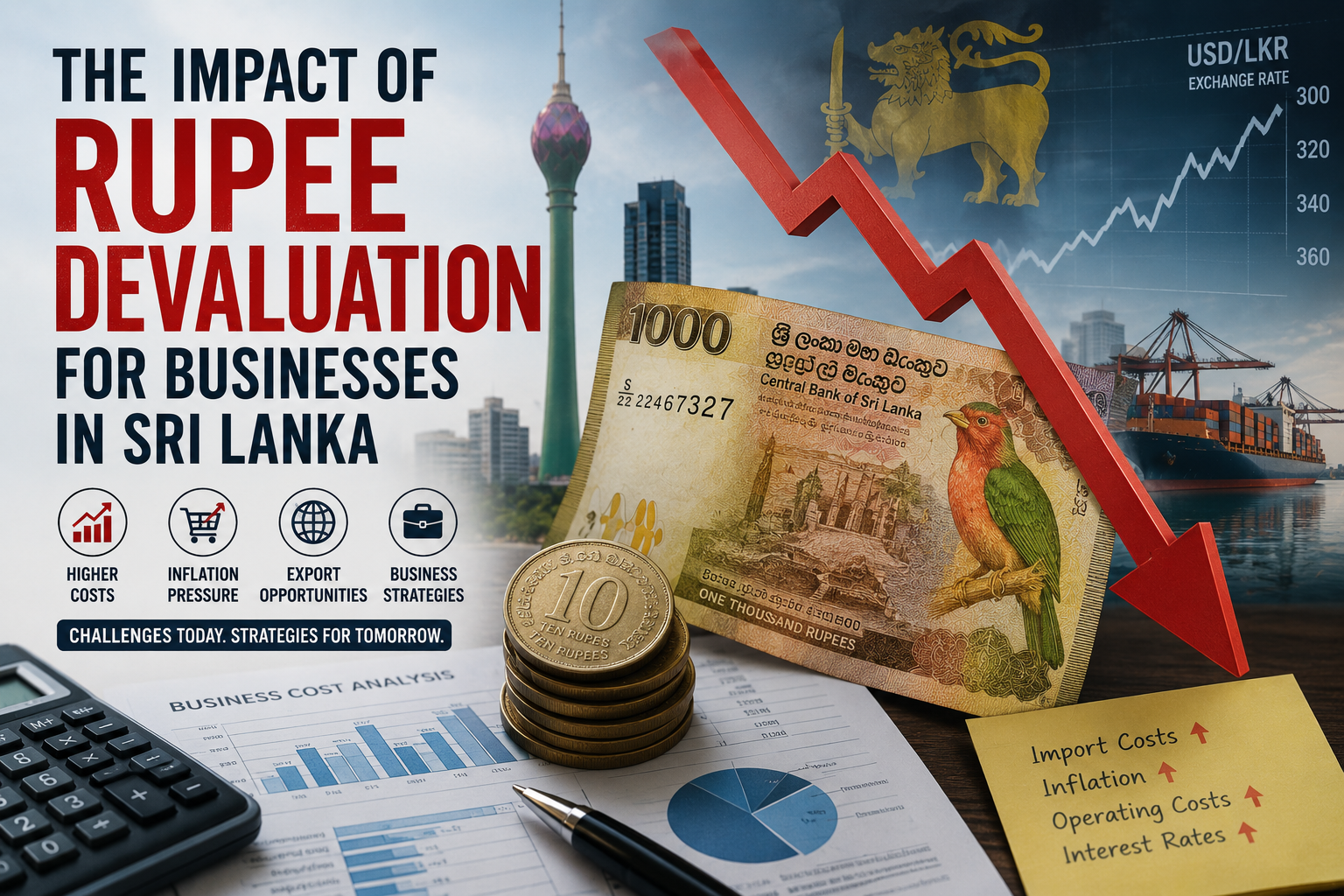
When the Sri Lankan Rupee weakens against major foreign currencies, headlines usually focus on exchange rates, inflation, and economic uncertainty.
But for businesses, rupee devaluation is not just an economic term — it directly affects costs, profits, pricing, investments, and customer behaviour.
Whether you run a retail outlet in Colombo, an export business in Galle, a tourism operation in Kandy, or an SME serving the local market, currency movements can significantly influence your bottom line.
So, what does rupee devaluation really mean for Sri Lankan businesses?
More importantly — who wins, who loses, and how should businesses respond?
What is Rupee Devaluation?
In simple terms, rupee devaluation occurs when the Sri Lankan Rupee loses value compared to foreign currencies such as the US Dollar, Euro, or British Pound.
For example:
If USD 1 = LKR 300 today and later becomes USD 1 = LKR 350, the rupee has weakened.
This means Sri Lanka needs more rupees to purchase the same dollar value of imports.
And that is where businesses begin to feel the pressure.
The Immediate Impact: Rising Import Costs
Sri Lanka remains heavily dependent on imports.
Many businesses rely on imported:
- Raw materials
- Machinery and equipment
- Fuel and energy inputs
- Packaging materials
- Technology products
- Consumer goods
When the rupee depreciates, importing becomes more expensive almost overnight.
A manufacturer importing raw materials from overseas may suddenly face higher production costs without any change in supplier pricing.
The challenge?
Businesses cannot always pass these increases directly to customers.
Higher prices risk losing market share.
Absorbing the cost damages profit margins.
Neither option is particularly comfortable.
Inflation: The Silent Pressure on Business Operations
Rupee devaluation often fuels inflation in Sri Lanka.
As import costs increase, the ripple effect spreads across the economy.
Fuel costs influence transport.
Transport affects logistics.
Logistics affect retail pricing.
Eventually, nearly every business sector feels the impact.
Operational expenses may rise through:
- Transportation costs
- Electricity and utility expenses
- Supplier price adjustments
- Wage pressures from employees facing a higher cost of living
For business owners, this creates a difficult balancing act between maintaining affordability and protecting profitability.
Exporters: One Sector That May Benefit
Not every business loses during rupee depreciation.
Export-oriented businesses can experience advantages.
Industries such as:
- Apparel exports
- Tea exports
- IT and BPO services
- Tourism and hospitality
- Freelance and remote service industries
may receive payments in stronger foreign currencies.
When converted into rupees, these earnings can increase.
This can improve competitiveness and revenue performance.
However, there is a catch.
Many exporters also depend on imported inputs.
So while foreign income improves, operating costs may rise simultaneously.
The real winners are businesses with strong foreign currency earnings and lower import dependency.
Consumer Behaviour Changes During Currency Pressure
One often overlooked effect of rupee devaluation is changing consumer psychology.
When inflation rises and purchasing power weakens, customers typically become:
- More price sensitive
- More value driven
- More selective in spending
- Less brand loyal in certain categories
Luxury purchases may slow down.
Impulse buying often declines.
Consumers begin comparing prices more aggressively.
For marketers and business leaders, this creates a new battlefield.
Brand positioning alone may no longer be enough.
Customers increasingly demand visible value, affordability, and trust.
How Sri Lankan SMEs Are Affected
Small and medium-sized enterprises (SMEs) often face the greatest pressure.
Unlike large corporations, SMEs may have limited ability to:
- Hedge currency risk
- Negotiate supplier terms
- Secure foreign currency financing
- Maintain large inventory reserves
Cash flow becomes critical.
Pricing becomes complex.
Business planning becomes less predictable.
For SMEs, rupee devaluation is not simply an accounting issue — it becomes a daily operational challenge.
Business Strategies to Survive Rupee Devaluation
Businesses cannot control currency markets.
But they can strengthen resilience.
Several practical strategies are increasingly relevant for Sri Lankan companies:
1. Diversify Revenue Streams
Depending entirely on one market or customer segment increases vulnerability.
Businesses should explore:
- Export opportunities
- Digital services
- Regional customer markets
- Foreign currency earning channels
2. Strengthen Cost Management
Not every cost increase should lead to price hikes.
Operational efficiency, waste reduction, procurement optimisation, and smarter inventory planning matter more than ever.
3. Invest in Local Alternatives
Reducing import dependence where feasible can improve long-term stability.
Local sourcing, local partnerships, and domestic production strategies may reduce exposure to exchange volatility.
4. Build Stronger Financial Planning
Businesses operating in uncertain currency environments require:
- Cash flow forecasting
- Scenario planning
- Risk analysis
- Strategic budgeting
Short-term thinking becomes dangerous during prolonged economic fluctuations.
The Bigger Picture: Crisis or Competitive Reset
Rupee devaluation creates undeniable challenges for businesses in Sri Lanka.
Higher costs, inflationary pressure, and shifting consumer behaviour test even experienced business leaders.
Yet economic disruption also reshapes markets.
Some businesses struggle.
Others adapt, innovate, reposition, and emerge stronger.
History consistently shows that resilient companies are not necessarily the biggest — they are often the most agile.
For Sri Lankan businesses, the question may no longer be whether currency fluctuations will continue.
The real question is:
Is your business model prepared for an economy where volatility becomes the new normal?