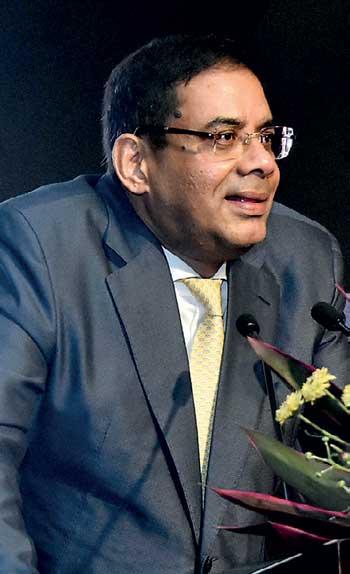
Sri Lanka’s private sector needs stronger institutions and directors who can combine practical decision-making with sound governance, Sri Lanka Institute of Directors (SLID) Chairman Dinesh Weerakkody said at the institute’s Annual Members Meeting and 25th anniversary celebration in Colombo.
Weerakkody said the private sector must strengthen its credibility by developing a culture based on accountability, integrity and responsible decision-making. He emphasized that building institutions people can trust should be a shared responsibility across the corporate sector.
Looking ahead, he said directors would face increasingly complex challenges as artificial intelligence, geopolitical conflicts and climate-related disasters reshape the business environment. In his view, boards will need to be capable of making decisions during periods of uncertainty and disruption.
Reflecting on his early experience as a board director, Weerakkody recalled being invited by SLID’s founding chairman, Deshamanya Ken Balendra, to join the institute’s first committee. He noted that corporate governance requirements were considerably less developed at the time, with no mandatory corporate governance code, limited disclosure requirements and fewer public mechanisms for scrutinising companies.
He contrasted that period with today’s environment, where companies and their directors operate under significantly greater public and regulatory scrutiny, with social media becoming an influential source of accountability.
Sri Lanka’s Capital Market Has Expanded
Weerakkody also highlighted the significant changes in Sri Lanka’s capital market over the past 25 years.
When SLID began, the Colombo Stock Exchange had around 235 listed companies, with a total market capitalisation of approximately Rs.100 billion, while the Sri Lankan rupee traded at about Rs.89 against the US dollar.
Today, around 290 companies are listed, with market capitalisation reaching approximately Rs.8 trillion, while the exchange rate has moved to around Rs.328 per US dollar.
This represents roughly a 23 percent increase in the number of listed companies and an approximately eightyfold increase in market capitalisation in rupee terms. In US dollar terms, market capitalisation has risen from about US$1.1 billion to approximately US$24.4 billion, despite the substantial depreciation of the rupee against the dollar.
SLID Expands Its Corporate Governance Initiatives
The institute now has a membership exceeding 1,000 professionals.
During the past year, SLID organised the Sri Lanka Corporate Director Summit 2026, attracting more than 400 chairpersons, directors and senior business leaders, along with over 20 international speakers.
The institute also introduced the SLID–ACCA National Corporate Director Awards, aimed at recognising achievements in corporate stewardship. Other initiatives include its Women on Boards programme and the Board Ready Directors directory.
Weerakkody concluded by referring to the late Ratan Tata’s view that good governance ultimately depends on making ethical choices even when there is no external observer. He urged directors and business leaders to have the courage to follow that principle in practice.
Technology Makes Governance More Important
The event’s chief guest, Secretary to the Prime Minister G. Pradeep Saputhanthri, said Sri Lanka is continuing economic and structural reforms following the country’s recent economic crisis.
He also highlighted the growing influence of artificial intelligence and other emerging technologies on businesses, institutions and decision-making.
Saputhanthri argued that technology can no longer be treated solely as a matter for technical departments. For corporate boards, technological change increasingly involves questions of governance, accountability and institutional responsibility.
Referring to historian Yuval Noah Harari’s argument about the growing importance of wisdom in an age of abundant intelligence, he noted that technology can supply information and produce possible answers, but human beings still have to determine priorities, acceptable risks and the type of institutions they want to create.
He further stressed that strong institutions depend on accountability, integrity, transparency and the rule of law, with their quality influenced not only by government but also by businesses, boards and professional organisations.
Saputhanthri also emphasised that effective governance and long-term business performance should reinforce rather than undermine one another. Ultimately, he said, leadership should be judged not only by immediate results but also by the strength and resilience of the institutions leaders leave behind.
Image Disclaimer: Images used in this article are the property of their respective copyright holders and rightful owners. No ownership is claimed over the images.