
Sri Lankan retailers and consumer brands need to look beyond the limits of the domestic market, pursue asset-light international expansion and tap foreign private capital to achieve sustainable growth, keynote speakers at the Sri Lanka Retail Forum 2026 said.
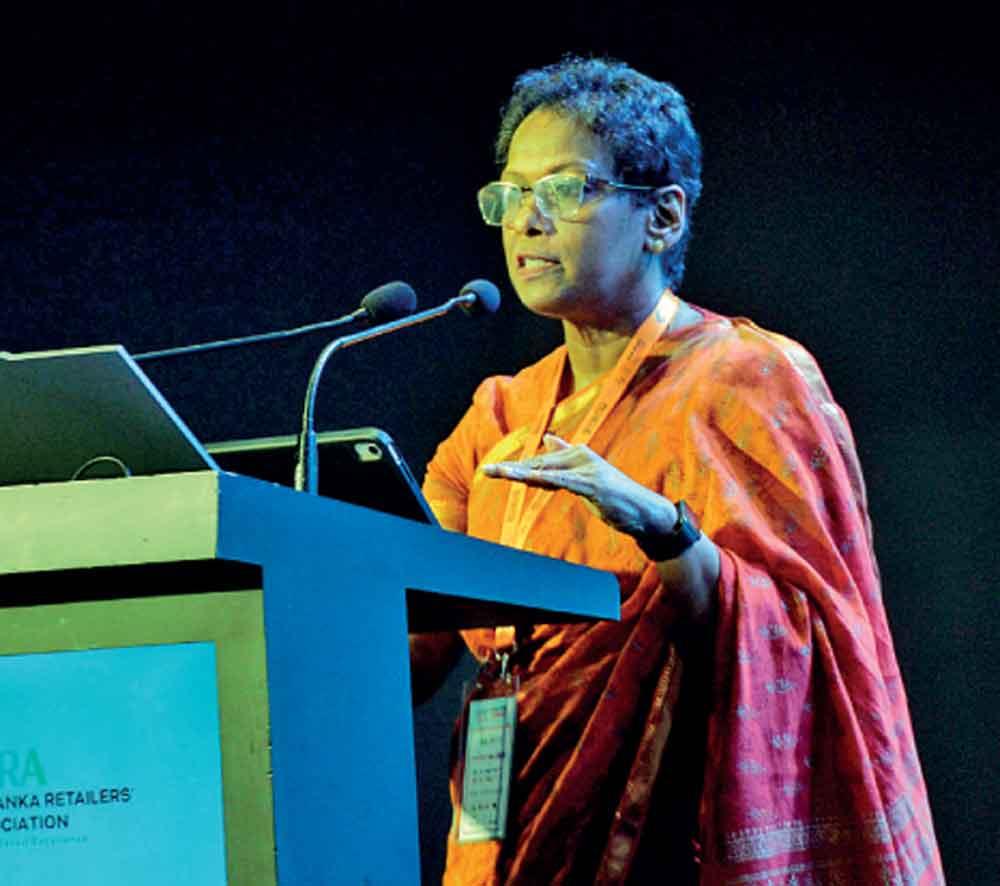
Speaking at the forum, organised by the Sri Lanka Retailers’ Association in Colombo under the theme ‘Retail Without Boundaries: Building the Next Growth Engine’, Centre for Poverty Analysis Consultant Dr. Roshan Perera highlighted the gap between Sri Lanka’s recent macroeconomic stabilisation and a broader recovery in household incomes and purchasing power.
Delivering a keynote address on macroeconomic productivity and retail bottlenecks, Dr. Perera noted that although GDP per capita has returned to pre-crisis levels, the recovery has not been evenly distributed across households. She pointed out that poverty remains significantly above pre-crisis levels while real wages have declined.
“Poverty has come down from where we were but it’s still double what we were prior to the crisis. There are still more than one in five people who are still living below the poverty line and the real wages have actually fallen, even as the per capita GDP has increased,” Dr. Perera said.
“What this implies really is that this recovery has not been necessarily evenly shared across the households. That’s something probably you retailers will feel, that the spending power or spending capacity of the households has probably declined,” she added.
Adding to the pressure on consumers and businesses is the recent resurgence of inflation. Dr. Perera warned that inflation is once again moving above the Central Bank’s five percent target, while underlying price pressures are also becoming more broad-based.
“The worrying thing is that core inflation, which sort of strips out fuel and food prices, is also moving above this 5 percent target. That is worrying because it suggests the pickup is not just in terms of food and fuel but it is a bit more broad-based and this will obviously matter directly for your own retail input costs and also for how long the Central Bank can keep the policy rates on hold,” she said.
Dr. Perera said retailers are facing pressure from elevated energy tariffs, taxation and import costs while simultaneously having limited scope to pass these increases on to consumers. Changing consumer behaviour, including greater access to online shopping and price comparisons, has also made customers more conscious of value.
“I think the retailers are now very conscious of value and I don’t think you can just pass the costs to the consumers because there’s much more opportunity to shop around. It’s not just physical stores; there are online stores. Being more value-conscious, reducing costs, making your operations more efficient would be important for the retailers if you want to keep your customers,” she said.
With Sri Lanka’s domestic consumer market limited to approximately 22 million people, Dr. Perera encouraged retailers to look towards regional integration, bilateral free trade agreements and regional value chains. She pointed to India’s large middle-class consumer base as an example of the wider market opportunities available to Sri Lankan businesses.
Echoing the need for international expansion, Deloitte Touche Tohmatsu India LLP Partner Soumya Dwibedi urged Sri Lankan businesses to take advantage of ongoing global supply chain realignments, including the ‘China Plus One’ and ‘India Plus One’ strategies, to build enterprises capable of competing internationally.
Drawing comparisons with brands and sectors that have successfully expanded beyond their home markets, including the Philippines’ Jollibee, Brazil’s Havaianas, South Korea’s beauty industry and Sri Lanka’s Dilmah, Dwibedi said local brands do not necessarily need to abandon their identity when entering international markets.
“Build an international brand but you don’t need to look international,” Dwibedi said, highlighting the potential of authentic local heritage and storytelling when combined with market-specific customisation and strong hero products.
Dwibedi also identified access to capital as an important consideration for retailers seeking to expand beyond Sri Lanka. He encouraged businesses with established domestic operations to use their local track record to attract foreign direct investment, private equity and strategic partnerships.
“If you’re worried about capital, you can tap outside international capital. You can tap international capital through partnerships, joint ventures or strategic M&A,” he said.
He explained that a proven domestic business model can provide a stronger foundation when approaching international investors. “It’s almost like you’re going to a country, telling that private equity: ‘I am from Sri Lanka. I have done this. I have this product proposition. I took it to the market. I want the money to expand.’ The difference is that you have a proven track record in Sri Lanka,” Dwibedi noted.
Sri Lanka’s recovering tourism industry could also serve as a platform for local brands seeking international exposure, he said. Tourists can provide an initial customer base for products, potentially leading to further discovery and purchases through digital channels after they return to their home countries.
“What you’re doing is using tourists as the first sampling point. If they like it, they will do digital discovery when they are back. The tourism can lead to trial; trial can lead to good memory; they can share it digitally. Others discover it digitally and you create an engine loop for a global brand,” he said.
Looking ahead, Dwibedi advised retailers to focus on operational efficiency while preparing for international growth. Among the areas highlighted were asset-light digital marketplace models in overseas markets, improved day-to-day supply chain visibility, automated replenishment systems and the use of artificial intelligence in product discovery.
The discussions at Sri Lanka Retail Forum 2026 highlighted the challenges facing retailers in a domestic market where household purchasing power remains constrained, while also examining potential pathways for businesses to expand through regional markets, international capital, digital channels and evolving global supply chains.
Image Disclaimer: Images used in this article are the property of their respective copyright holders and rightful owners. No ownership is claimed over the images.