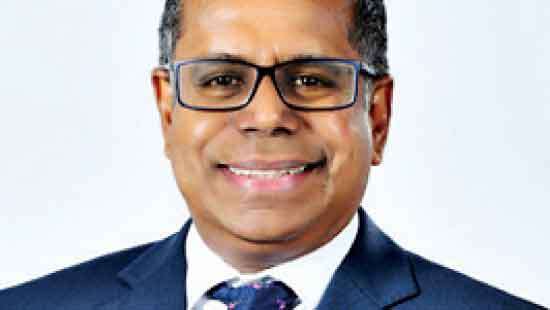
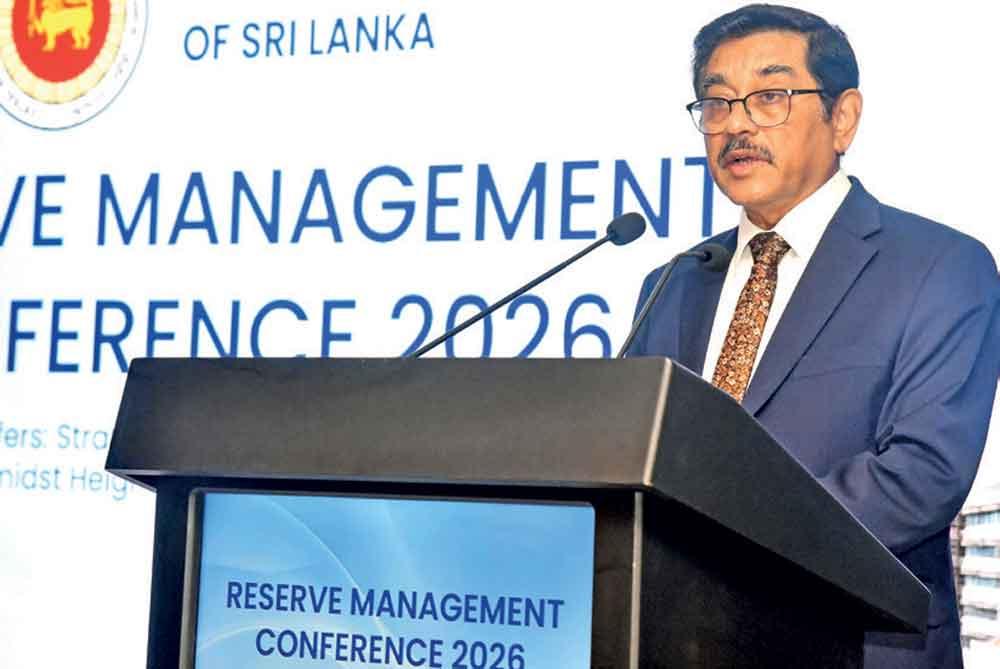
Central Bank Governor Dr. Nandalal Weerasinghe has called for a rethink of traditional foreign reserve management as rising geopolitical fragmentation, sanctions and shifts in global trade and investment reshape the risks confronting central banks.
Speaking at the inaugural Reserve Management Conference 2026 in Colombo, Weerasinghe said geopolitics could no longer be treated as an external factor in investment decisions. Reserve managers, he noted, increasingly need to consider jurisdictional, sanctions, settlement, counterparty and market-access risks alongside conventional financial considerations.
“Geopolitical risk can no longer be treated as something external to the investment process. It has become an integral part of reserve management,” Weerasinghe said at the conference, which brought together senior central bankers and investment professionals from around the world.
Addressing the theme “Challenges in building the foreign reserves amidst geopolitical uncertainties”, the Governor said the traditional objectives of reserve management, safety, liquidity and return, remain fundamental. However, the environment in which these objectives are pursued has changed considerably.
Central banks are now managing reserves against a backdrop of geopolitical fragmentation, strategic competition, trade tensions, sanctions, volatile commodity prices, changing interest-rate cycles and rapid technological transformation. At the same time, the international financial system is becoming increasingly fragmented, with trade and investment patterns shifting, supply chains being reconfigured and capital flows capable of reversing rapidly.
Weerasinghe said strategic competition among major economies is increasingly influencing trade, investment and financial relationships, while sanctions have become a more prominent policy instrument. This has created a delicate balancing act for reserve managers between maintaining investments in deep and liquid markets and diversifying portfolios across currencies and jurisdictions.
“Should reserves remain concentrated in the deepest and most liquid markets? Should portfolios be diversified across jurisdictions? How should we balance diversification against liquidity?” he asked.
“These are no longer theoretical questions. They are increasingly becoming practical reserve-management decisions.”
Addressing the role of the US dollar, Weerasinghe said it continues to hold a dominant position in international trade, finance and global reserves, with the depth and liquidity of US dollar financial markets remaining unmatched.
However, he noted that reserve managers are increasingly examining the risks associated with excessive concentration in a single currency or jurisdiction. While acknowledging the role of diversification, he cautioned that diversification should not become an objective in itself.
According to Weerasinghe, the more relevant question is which currency composition best supports the objectives and risk tolerance of a country’s reserves. Decisions should consider factors including trade patterns, external liabilities, intervention requirements, liquidity, market depth, expected returns, correlations and geopolitical risks.
“There is, therefore, no universal optimal currency composition,” he said.
The Governor also cautioned against sacrificing liquidity in pursuit of greater diversification, particularly given the role of foreign reserves during periods of financial stress.
“A theoretically diversified portfolio that cannot be liquidated efficiently when markets are under stress may provide little practical protection,” he said, stressing that liquidity must remain a priority when reserves may need to be deployed quickly.
Weerasinghe also addressed growing interest among central banks in gold and other alternative reserve assets. He noted that gold’s historical role as a store of value and its lack of sovereign credit risk have renewed its appeal. However, he said gold allocations should be determined by the role the asset plays within the overall portfolio rather than simply by a desire to increase gold holdings.
Unlike cash and highly liquid government securities, gold does not offer the same liquidity characteristics. Central banks therefore need to balance gold allocations against liquidity requirements, risk tolerance and the broader structure of their reserve portfolios.
The Governor adopted a similarly cautious position on emerging instruments such as digital assets and tokenised financial instruments.
“Innovation is important. But innovation should never come at the expense of the fundamental objectives of official reserves. Safety and liquidity must remain the anchor,” he said.
Looking ahead, Weerasinghe said diversification should be purposeful, with geopolitical risk firmly embedded in investment decisions. Traditional financial metrics alone, he noted, are no longer sufficient to assess the risks associated with reserve assets.
“The optimal portfolio today may not be the optimal portfolio tomorrow,” he said, highlighting the need for reserve management strategies to remain responsive to a rapidly changing global financial and geopolitical environment.
Image Disclaimer: Images used in this article are the property of their respective copyright holders and rightful owners. No ownership is claimed over the images.