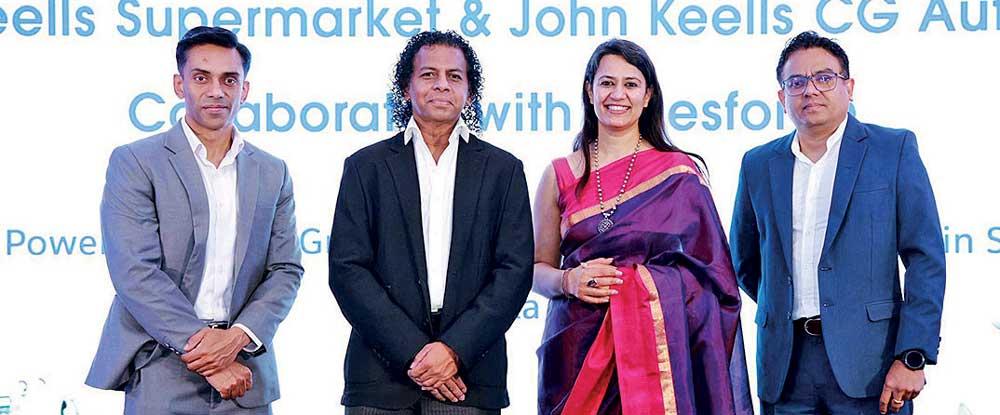
Global customer relationship management (CRM) technology company Salesforce has signalled an aggressive expansion into Sri Lanka, strengthening its presence through digital transformation partnerships with two major subsidiaries of John Keells Holdings PLC (JKH).
The developments were announced in Colombo yesterday during a press conference held alongside Salesforce’s inaugural Salesforce Innovation Day in Sri Lanka, bringing together industry leaders, business representatives and technology stakeholders.
The newly announced enterprise partnerships involve Keells Supermarket and John Keells CG Auto (JKCG Auto), the authorised distributor of BYD passenger vehicles in Sri Lanka.
Salesforce Managing Director for India and Sri Lanka Mankiran Chouhan said Sri Lanka’s economic recovery, digital ambitions and growing technology talent base create favourable conditions for the company to expand its operations in the country.
“Today we’re in Sri Lanka and we’re really excited about the opportunity,” Chouhan said.
He pointed to Sri Lanka’s ambition to build a US$15 billion digital economy by 2030, develop more than 200,000 digitally skilled workers and maintain economic growth of more than 5 percent as indicators of the country’s potential.
“The momentum is right for us to partner with you in your country to help the businesses in Sri Lanka grow,” he added.
Keells moves towards hyper-personalised retail
At Keells Supermarket, Salesforce is supporting a major modernisation of the retailer’s Nexus loyalty platform, which currently has more than two million active members.
The transformation brings together Salesforce Loyalty Management, Customer 360, MuleSoft and Agentforce Service to create more personalised and real-time customer journeys.
Rather than relying primarily on broad, generic discounts, Keells intends to use customer data to understand purchasing behaviour and deliver offers based on individual preferences and shopping patterns.
A Keells representative, Asanka, said the rapid growth of the loyalty programme made a new technology architecture necessary.
“Because we were growing so fast and we have exceeded the two-million-member base, instead of giving generic discounts, we wanted to move in the direction of personalisation,” he said.
The new system will analyse factors such as what customers purchase, how frequently they shop and when they make purchases, allowing Keells to automate customer journeys and deliver more relevant offers.
JKCG Auto digitises the vehicle ownership journey
Meanwhile, JKCG Auto is deploying Salesforce Automotive Cloud to bring together the customer journey for its electric vehicle portfolio.
The platform will support the process from capturing and converting potential customer leads through vehicle delivery, maintenance, warranty management and post-sales servicing.
Salesforce Country Sales Head for Sri Lanka Pablo Tachil highlighted the difference between the two implementations.
While a supermarket requires high-frequency interactions with customers and large volumes of transactions, automotive businesses require longer-term relationship management extending across the entire vehicle ownership lifecycle.
The two deployments demonstrate how Salesforce is adapting its cloud-based technology to different industries while maintaining a common focus on customer data and engagement.
Digital transformation must begin with the foundation
JKH Executive Vice President and Chief Information Officer Ramesh Shanmuganathan stressed that businesses should not adopt new technologies simply because they are fashionable.
Using an automotive analogy, he said: “You can’t put a V8 engine on a Maruti, right? You can’t bolt on AI or an experience strategy onto a legacy organisation or legacy systems. You’ve got to look at your foundation.”
He argued that successful digital transformation starts with clearly identifying the business problem and defining how the resulting value will be measured.
“Always start with the problem statement. What are you trying to solve, for whom and what’s the value you’re trying to create? How will I measure it? If it ticks the box, scale it. If it doesn’t, kill it,” Shanmuganathan said.
He added that technological capabilities often develop faster than organisations can adapt, making leadership and change management critical to successful implementation.
“Technology is always exponential; organisations are not. Leadership has to bridge that gap,” he said.
Salesforce outlines four-pillar Sri Lankan strategy
Salesforce also outlined a four-pillar strategy for expanding its operations in Sri Lanka, centred on digital skills development, start-up enablement, partner ecosystem expansion and customer transformation.
Through Trailhead and its Agentblazer community, Salesforce plans to provide students and professionals with job-ready digital skills.
The company is also rolling out its Salesforce Startup Programme to support and mentor local technology entrepreneurs.
To strengthen local implementation capabilities, Salesforce is working with a network of Sri Lankan consulting partners and resellers, including DMS, MillenniumIT ESP, Softlogic, South Asian Tech, Cybersoft and Altria.
The network also includes global system integrators such as Virtusa, TCS, HCLTech, Tech Mahindra, Wipro and Deloitte.
Building the ‘Agentic Enterprise’
The technology showcased at the event also highlighted Salesforce’s vision of the “Agentic Enterprise”, where autonomous AI agents work alongside employees across functions including sales, customer service, marketing and commerce.
The architecture is built around Data 360 and incorporates federated zero-copy architecture and MuleSoft connectivity, allowing businesses to connect data and systems while maintaining governance controls.
Salesforce’s AI Trust Layer is designed to provide additional safeguards when organisations deploy foundation models within enterprise environments.
The company sees these capabilities as part of a broader shift from conventional automation towards AI agents capable of independently supporting business processes while working within defined organisational controls.
Combining technology expansion with social impact
Salesforce also incorporated its global 1-1-1 philanthropic model into its Sri Lankan launch.
The company said it has contributed more than 10.84 million volunteer hours globally, alongside US$970 million in equity giving and US$348 million towards training and reskilling initiatives.
As part of the Colombo event, Salesforce partnered with Colombo-based non-profit SERVE to assemble educational and essential supply kits for 100 vulnerable children.
The initiative reflects Salesforce’s broader approach of combining its commercial expansion with community engagement and skills development.
With major enterprise deployments already underway at Keells Supermarket and JKCG Auto, alongside investments in local skills, start-ups and technology partnerships, Salesforce is positioning Sri Lanka as an increasingly important market in its regional digital transformation strategy.
Image Disclaimer: Images used in this article are the property of their respective copyright holders and rightful owners. No ownership is claimed over the images.