The worship of the Buddha’s bodily remains has a long history in Buddhist tradition, with the practice traced to accounts recorded in the Maha Parinibbana Sutta. According to Buddhist tradition, the corporal remains of the Buddha, Pacceka Buddhas and Arahants are considered worthy of veneration. Buddhist devotees also pay homage to Paribhogika objects, which are items associated with or used by the Buddha, as well as Buddha images.
The Digha Nikaya records that the Buddha’s bodily relics were enshrined in stupas and venerated by devotees. Buddhist tradition also refers to four canine teeth of the Buddha being preserved separately. One was believed to have been placed in Sakra Bhavana, regarded as the abode of the king of the gods, while others were associated with Gandhara and Nagadeepa. Another tooth relic was taken from the Buddha’s funeral ashes by a monk and eventually entrusted to the King of Kalinga.
The Sacred Tooth Relic eventually became closely connected with the history and religious traditions of Sri Lanka. Historical accounts state that King Guhasiva of Kalinga, amid conflict with a neighbouring kingdom, decided to send the relic to Sri Lanka for safekeeping.
According to tradition, the relic was brought to Sri Lanka by Princess Hemamala, the daughter of King Guhasiva, together with her husband, Prince Danta. The Sacred Tooth Relic was reportedly concealed in Hemamala’s hair during the journey. It arrived in Sri Lanka during the reign of King Kithsiri Mevan in the fourth century.
The Mahavamsa also records the importance attached to processions associated with the Sacred Tooth Relic, with Sri Dalada Perahera traditions receiving royal patronage during the reigns of King Parakramabahu the Great and King Pandita Parakramabahu.
The modern Esala Perahera associated with the Sri Dalada Maligawa in Kandy is generally traced to the Kandyan period, particularly the reign of King Keerthi Sri Rajasinghe. Before this period, the Sacred Tooth Relic was regarded as being under the personal authority of the monarch.
Under the guidance of the Most Venerable Weliwita Sri Saranankara Sangharaja, King Keerthi Sri Rajasinghe ordered that the Sacred Tooth Relic be taken in procession so that the public could have the opportunity to see and venerate it. Custody of the relic was subsequently entrusted to the Maha Sangha.
A lay official known as the Diyawadana Nilame was appointed to oversee the administrative responsibilities associated with the relic in the absence of the king. The position continues to hold an important place in the traditions surrounding the Sri Dalada Maligawa and the annual Kandy Esala Perahera.
The Kandy Esala Perahera had originally been associated primarily with processions held by the Hindu devalayas. The tradition underwent an important transformation during King Keerthi Sri Rajasinghe’s reign. Following the arrival of Siamese monks in Sri Lanka to assist with the restoration of the Upasampada ordination, the king directed that a procession carrying the Sacred Tooth Relic should lead the processions of Kandy’s four principal devalayas—Natha, Vishnu, Kataragama and Pattini.
The resulting pageant developed into one of Sri Lanka’s most significant religious and cultural events. The Kandy Esala Perahera brings together traditional Kandyan dancing, drumming, music and other ceremonial practices in a grand procession through the streets of the hill capital.
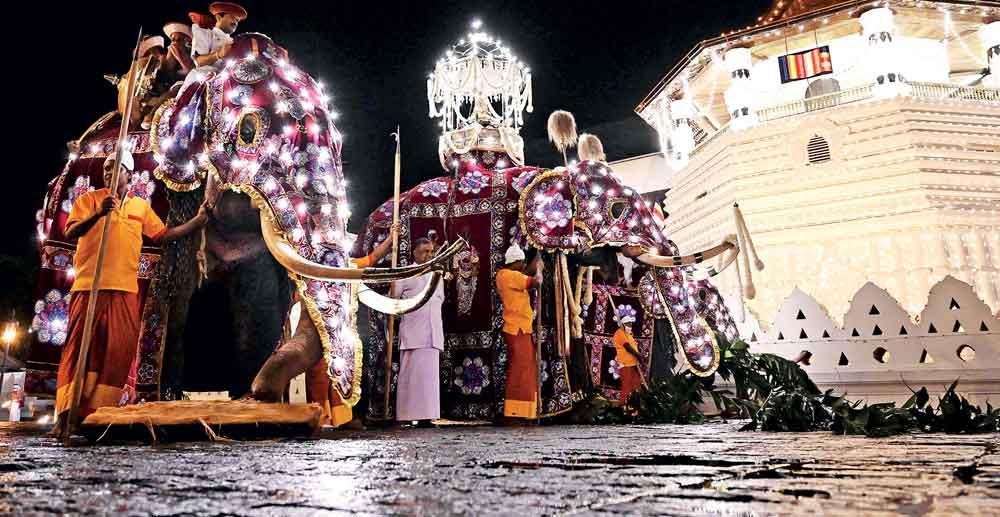
The nighttime procession is particularly striking, with traditional lamps and modern lighting illuminating the pageant. Elephants, dancers, drummers and other performers form part of the procession, while religious customs and ceremonial practices are observed throughout the event.
The preparations for the annual Esala Perahera begin with a ceremony known as Kap Situweema. This ritual is conducted by the Natha, Vishnu, Kataragama and Pattini devalayas and takes place according to an auspicious time determined by the astrologer associated with the Sri Dalada Maligawa, known as the Nekath Rala.
Kap Situweema involves the erection of a sacred post as a vow associated with the forthcoming ceremonies. Traditionally, a suitable tree is selected and prepared for this purpose. Trees associated with the ceremony include the Esala tree, as well as Ruk Attana and Jak.
Before the selected tree is cut, ceremonial offerings are made, including frankincense and a liquid prepared using sandalwood. The selected section of the tree is then shaped into a small spire and wrapped in white cloth.
At the designated auspicious time, the prepared pole is erected within a designated structure known as the Kap Ge. Three coconuts are placed around it, with one attached to the pole. A coconut-oil lamp is also kept burning beside the Kap as part of the traditional ceremony.
Among the most prominent figures in the Kandy Esala Perahera is the Diyawadana Nilame, who takes part in the procession throughout the festival period. As the lay custodian associated with the Sri Dalada Maligawa, he has a highly visible ceremonial role and traditionally wears the elaborate Kandyan national dress during the procession.
The central highlight of the pageant is the ceremonial procession of the Sacred Tooth Relic. A specially selected Maligawa tusker carries the golden casket containing the sacred relic, becoming the focal point of the grand procession as devotees and spectators gather to pay homage.
The Kandy Esala Perahera therefore represents more than a spectacular cultural pageant. It brings together centuries of Buddhist tradition, royal history, religious observances, traditional arts and Sri Lanka’s living cultural heritage, with the Sacred Tooth Relic remaining at the heart of the annual celebrations.
Disclaimer: Pictures used in this article belong to their rightful owners. No copyright infringement is intended.