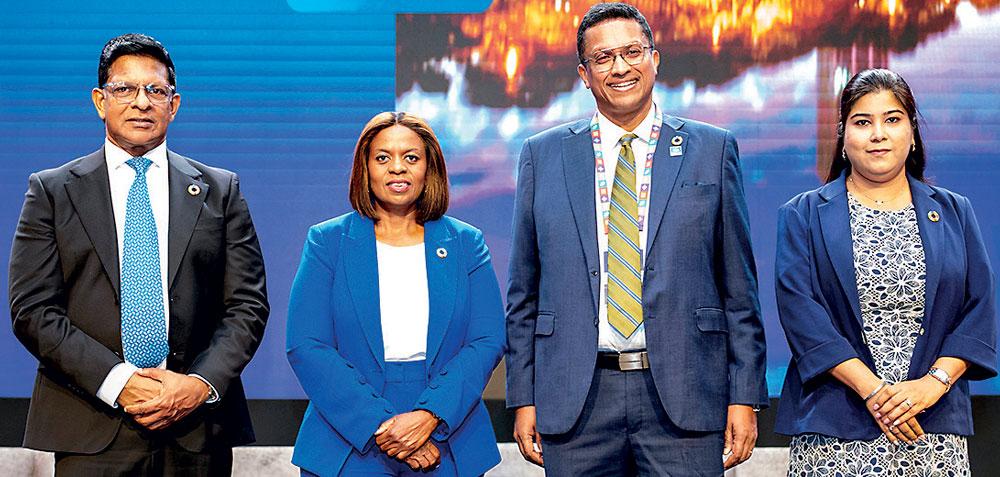
More than 200 business leaders, policymakers, investors, sustainability professionals and United Nations representatives gathered in Colombo on 11 and 12 August for Forward Faster Now/APAC 2026, a regional forum focused on strengthening business leadership for sustainable and inclusive growth across Asia-Pacific.
The event, titled “Driving Business Leadership for Sustainable and Inclusive Growth,” was hosted by UN Global Compact Network Sri Lanka and organised by the UN Global Compact APAC Hub in partnership with 14 Global Compact Country Networks.
The two-day forum brought together more than 80 speakers from across the Asia-Pacific region, representing the business community, financial sector, government, United Nations agencies and civil society. The event also attracted CEOs, C-suite executives, board directors and senior decision-makers, creating a platform for cross-sector discussions on the future of responsible and sustainable business.
Discussions throughout Forward Faster Now/APAC 2026 focused on several issues expected to shape businesses and economies across the region. These included climate action, sustainable finance, gender equality, resilient supply chains, water stewardship, governance and integrity, digital transformation, human rights due diligence, circular economy practices and the use of ESG data in business decision-making.
Rather than concentrating only on long-term sustainability ambitions, the forum placed emphasis on turning commitments into measurable outcomes. Participants examined how businesses can establish meaningful targets, strengthen internal systems, make informed decisions and implement practical solutions capable of delivering sustainability progress at scale.
One of the key highlights was the visit of Sanda Ojiambo, Assistant Secretary-General, CEO and Executive Director of the UN Global Compact. Her presence in Sri Lanka highlighted the country’s increasing participation in the regional sustainability conversation and reinforced the role of the private sector in supporting progress towards the United Nations Sustainable Development Goals.
Her visit also included bilateral meetings and strategic engagements with business and institutional leaders. These discussions provided opportunities to strengthen existing relationships and identify new areas of collaboration between the UN Global Compact and stakeholders in Sri Lanka.
The forum also served as a launchpad for three initiatives introduced by UN Global Compact Network Sri Lanka, extending the impact of the event beyond the two-day programme.
The Responsible Business Coalition was launched as a collaborative platform bringing together leading professional and industry associations in Sri Lanka. The initiative aims to integrate the Ten Principles of the UN Global Compact into existing training, knowledge-sharing and thought-leadership platforms operated by these organisations.
The initiative seeks to position responsible business practices as a broader leadership priority rather than an issue confined to sustainability teams, encouraging greater involvement from C-suite executives and corporate boards.
Another initiative launched during the forum was the next phase of the SDG Innovation Coalition. The programme aims to accelerate measurable progress towards the Sustainable Development Goals by encouraging innovation and strengthening collaboration between the private sector and other stakeholders around national development priorities.
On the second day, the SDG Investment Forum provided the setting for the launch of a one-year Sustainable Finance Workplan. The initiative brought together institutional investors, corporate representatives and policymakers to explore ways of unlocking transition finance in Sri Lanka.
Discussions at the investment forum included case studies from across the Asia-Pacific region, offering insights into how capital can be directed towards businesses and projects supporting sustainable economic transformation.
The leadership roundtable further strengthened the high-level nature of the discussions, with Prime Minister Dr. Harini Amarasuriya and Sanda Ojiambo participating alongside C-suite representatives from Sri Lanka and other parts of the region. Their participation highlighted the relationship between effective public policy, investment and sustainable economic development.
Forward Faster Now/APAC 2026 ultimately provided a platform for businesses, governments, investors and international organisations to collaborate on the challenges facing sustainable development in the region.
By connecting international perspectives with Asia-Pacific expertise and national priorities, the forum encouraged stronger partnerships and a greater focus on practical solutions. It also highlighted the growing expectation for businesses to move beyond sustainability commitments and demonstrate measurable progress.
As Asia-Pacific continues to face interconnected environmental, social and economic challenges, the forum reinforced a central message: achieving sustainable development will require more than individual corporate commitments. Collective leadership, cross-sector partnerships and measurable action will be essential to delivering meaningful progress at scale.