
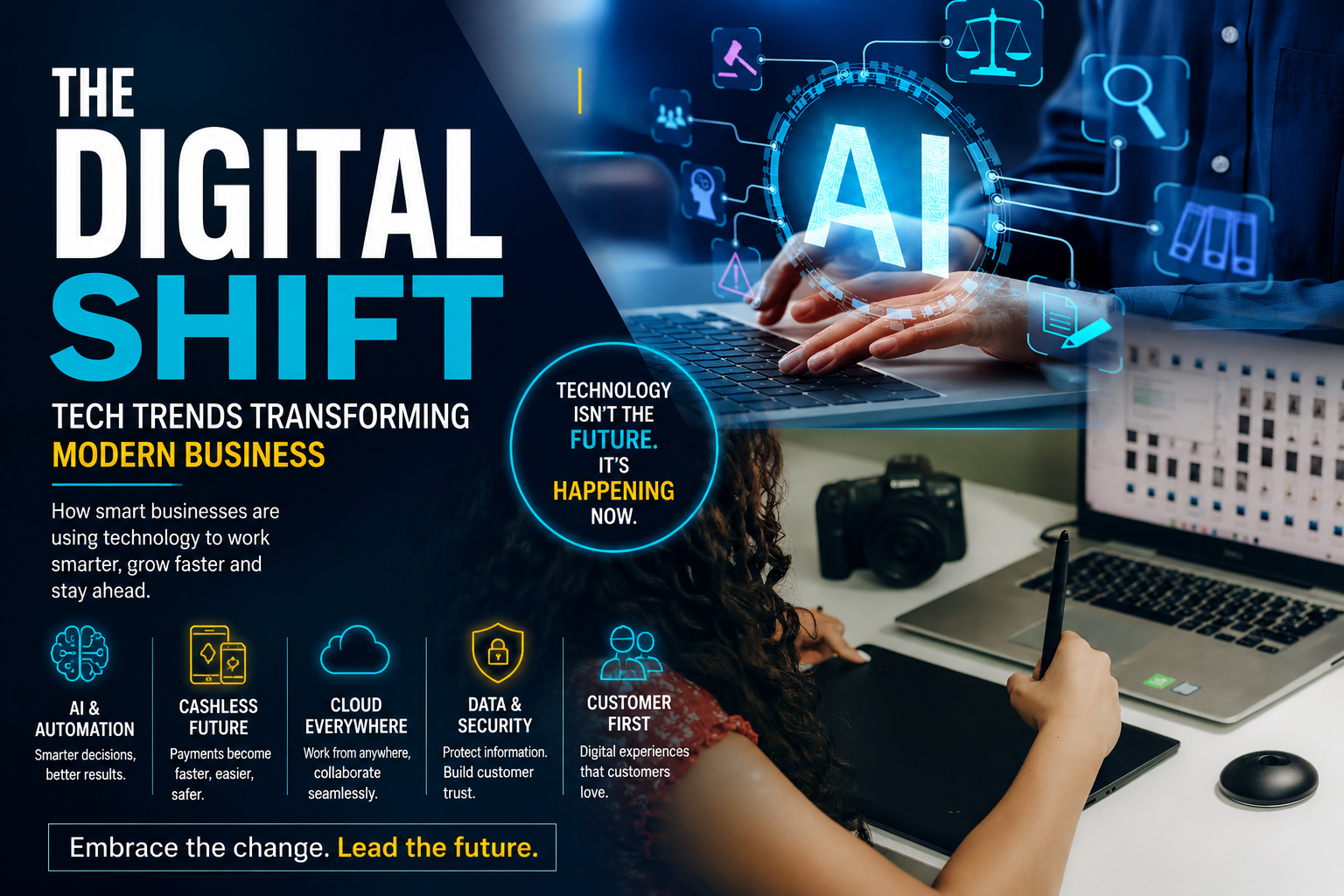
Technology is moving fast — and businesses that fail to keep up may risk falling behind.
Not long ago, digital transformation felt like something only big companies worried about.
Today? Even small businesses are using technology to grow faster, work smarter, and better understand customers.
From Artificial Intelligence (AI) to cashless payments and automation, technology is reshaping how businesses operate — often faster than expected.
The biggest question for businesses in 2026 isn’t:
“Should we go digital?”
It’s:
“How fast can we adapt?”
Here are the biggest tech trends transforming modern business — and why they matter.
1. AI Is Becoming a Business Essential
Artificial Intelligence is no longer just a buzzword.
Businesses are using AI to:
- Create content
- Improve customer support
- Analyse customer behaviour
- Automate repetitive tasks
- Predict sales trends
And the best part?
You no longer need a massive budget to start using AI.
Why Businesses Should Care
AI can:
- Save time
- Reduce workload
- Improve productivity
- Support smarter decision-making
Sri Lankan Example
Many Sri Lankan SMEs are already using AI-powered tools for social media captions, customer messaging, and digital marketing.
The businesses learning AI early may gain an advantage.
2. Automation Is Quietly Changing Everything
Businesses increasingly want to do more with less effort.
That’s where automation comes in.
From automatic emails to chatbot responses and inventory tracking, businesses are finding ways to reduce manual work.
Actionable Tip
Ask yourself:
“What repetitive task can we automate?”
Even small automation changes can improve efficiency significantly.
3. Cashless Payments Are Becoming the New Normal
Consumers increasingly expect faster, easier payment options.
QR payments, online banking, tap-to-pay systems, and mobile wallets are becoming increasingly common.
Why This Matters
Convenience influences buying behaviour.
Businesses offering multiple payment methods often create better customer experiences.
Sri Lankan Shift
Digital payments are becoming increasingly common among restaurants, cafés, supermarkets, and small businesses.
The future looks increasingly cash-light.
4. Data Is Becoming a Superpower
Modern businesses no longer need to rely purely on guesswork.
Today, businesses can track:
- Customer behaviour
- Best-selling products
- Website traffic
- Customer engagement
- Marketing performance
Why Businesses Win With Data
Data helps answer questions like:
- What products are customers buying most?
- Which marketing campaigns actually work?
- What keeps customers returning?
Businesses using data wisely often make smarter decisions faster.
5. Cybersecurity Is Becoming More Important
As businesses become more digital, cyber risks are growing too.
Customers expect businesses to protect their information.
Even smaller businesses are becoming more aware of:
- Online security
- Password protection
- Customer data privacy
- Safe payment systems
Business Reality
Trust takes years to build — but one security mistake can damage it quickly.
Digital growth must come with digital responsibility.
6. Cloud-Based Work Is Growing Fast
Teams are no longer limited to one office.
Cloud technology allows businesses to:
- Share files instantly
- Collaborate remotely
- Store information safely
- Work from anywhere
This flexibility is especially valuable for growing businesses and startups.
Sri Lankan Example
Many local businesses increasingly rely on cloud tools for accounting, project management, and communication.
Work is becoming more connected.
7. Customers Expect Digital Convenience
Today’s customers expect businesses to be easy to reach online.
People increasingly want:
- Quick replies
- Online ordering
- Social media support
- Mobile-friendly experiences
Ask Yourself
How easy is it for customers to interact with your business online?
Because convenience increasingly shapes loyalty.
The Bottom Line
Technology is no longer a separate part of business.
It is business.
The companies growing fastest are often the ones willing to experiment, adapt, and embrace digital change early.
You don’t need to adopt every new technology overnight.
But ignoring digital change completely?
That’s becoming the bigger risk.