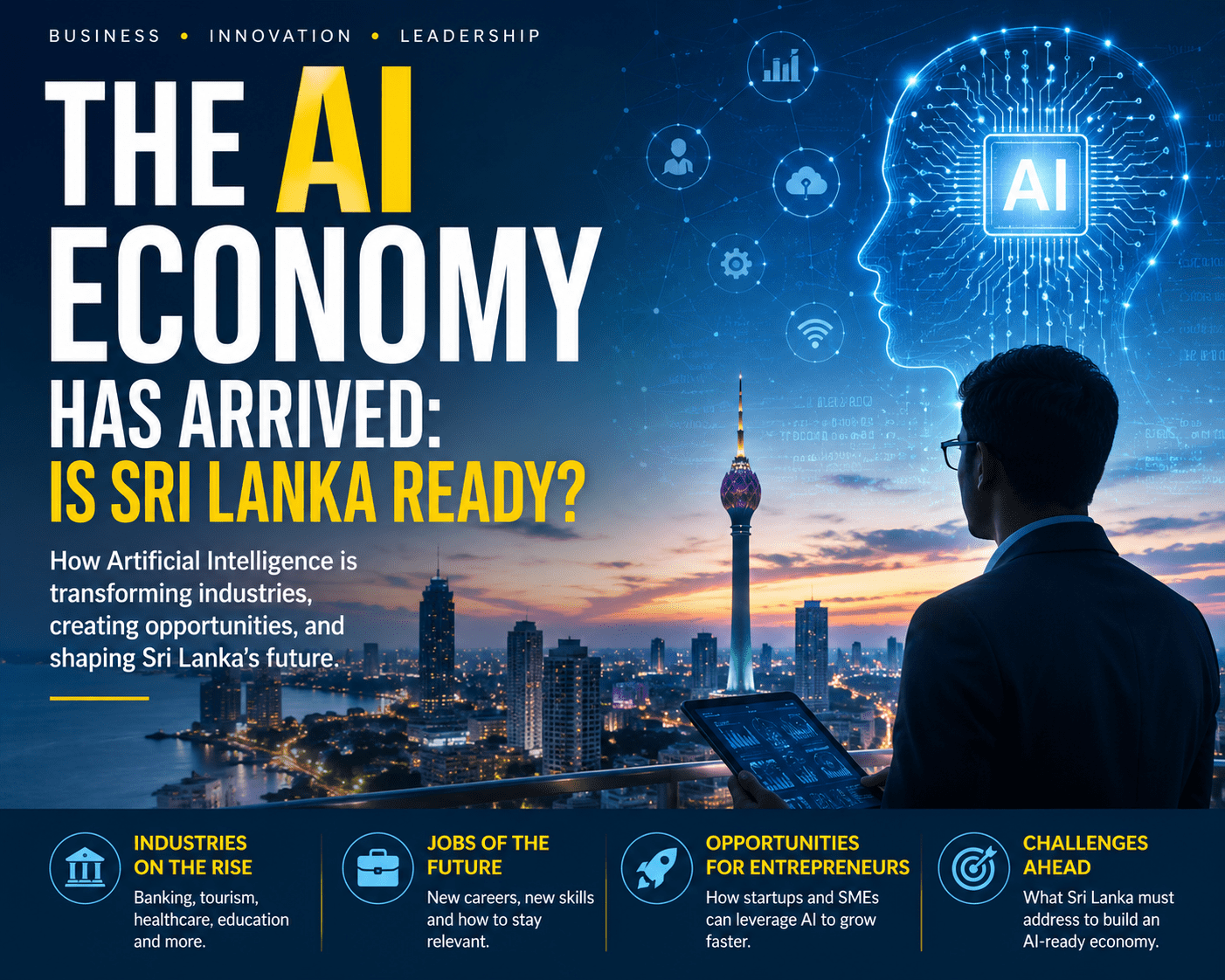
Artificial Intelligence (AI) is no longer a futuristic concept reserved for Silicon Valley or global technology giants. It is already transforming the way businesses operate, how consumers interact with brands, and how economies compete on the world stage.
For Sri Lanka, AI presents both an opportunity and a challenge. The countries that embrace AI today will be the ones that create jobs, attract investment, improve productivity, and build globally competitive industries tomorrow. The question is no longer whether AI will change Sri Lanka—it is whether Sri Lanka is prepared for the change.
AI Is Becoming a Business Necessity
Only a few years ago, AI seemed like a technology accessible only to large corporations. Today, even small businesses can use AI-powered tools for marketing, customer service, content creation, sales forecasting, and data analysis.
A local retailer can use AI to understand customer buying patterns. A hotel can personalize guest experiences. A marketing agency can create campaigns faster and more effectively. Financial institutions can detect fraud more accurately. Educational institutions can provide personalized learning experiences.
What was once considered an innovation is quickly becoming a competitive necessity.
Businesses that fail to adapt risk falling behind competitors who can make faster decisions, reduce costs, and serve customers more effectively through AI-driven solutions.
Industries That Will Benefit the Most
Banking and Financial Services
Sri Lanka’s banking sector has already begun adopting digital technologies. AI has the potential to further transform customer service, fraud detection, credit scoring, and financial planning.
Chatbots and virtual assistants can provide instant support to customers, while machine learning systems can identify unusual transactions and reduce financial crime.
Tourism and Hospitality
Tourism remains one of Sri Lanka’s most important economic sectors. AI can help hotels personalize guest experiences, optimize pricing, predict demand, and improve customer satisfaction.
As tourism becomes increasingly digital, businesses that leverage data and automation may gain a significant advantage.
Healthcare
AI-powered diagnostics, patient monitoring, and administrative automation are already being used worldwide. Sri Lanka’s healthcare sector has the opportunity to improve efficiency and accessibility through similar technologies.
While AI cannot replace medical professionals, it can support faster and more accurate decision-making.
Education
The future workforce will require new skills. AI-powered learning platforms can help students learn at their own pace while providing educators with valuable insights into student performance.
Educational institutions that embrace AI today may be better positioned to prepare students for tomorrow’s economy.
What About Jobs?
One of the biggest concerns surrounding AI is its impact on employment.
Certain repetitive and routine tasks are likely to become automated. However, history shows that technological revolutions often create new opportunities alongside disruption.
The demand for professionals skilled in AI, data analysis, cybersecurity, digital marketing, software development, and technology management is expected to increase significantly over the coming years.
Rather than replacing all jobs, AI is more likely to change how many jobs are performed.
Employees who learn to work alongside AI will be more valuable than those who ignore it.
The Opportunity for Sri Lankan Entrepreneurs
Perhaps the most exciting opportunity lies within Sri Lanka’s startup ecosystem.
AI has dramatically reduced the barriers to launching new businesses. Entrepreneurs can now access tools that help them build websites, create content, analyze markets, automate operations, and reach global customers at a fraction of the traditional cost.
This creates opportunities not only in technology but also in retail, education, healthcare, tourism, agriculture, and professional services.
For ambitious entrepreneurs, AI may become one of the most powerful business accelerators ever created.
Challenges Sri Lanka Must Address
Despite the opportunities, Sri Lanka faces several challenges.
Digital infrastructure must continue to improve. Businesses need greater awareness of AI applications. Educational institutions must update curricula to meet changing workforce demands. Organizations need to invest in training and upskilling employees.
Perhaps most importantly, business leaders must develop a mindset that embraces innovation rather than fears disruption.
Technology adoption is no longer a luxury. It is a survival strategy.
Looking Ahead
The global AI revolution is already underway. Countries, businesses, and professionals who adapt early are likely to capture the greatest benefits.
For Sri Lanka, AI offers a chance to accelerate economic growth, improve productivity, create new industries, and compete more effectively on the international stage.
The opportunity is real. The technology is available. The question is whether businesses are prepared to act.
Because in the AI economy, waiting may be the most expensive decision of all.