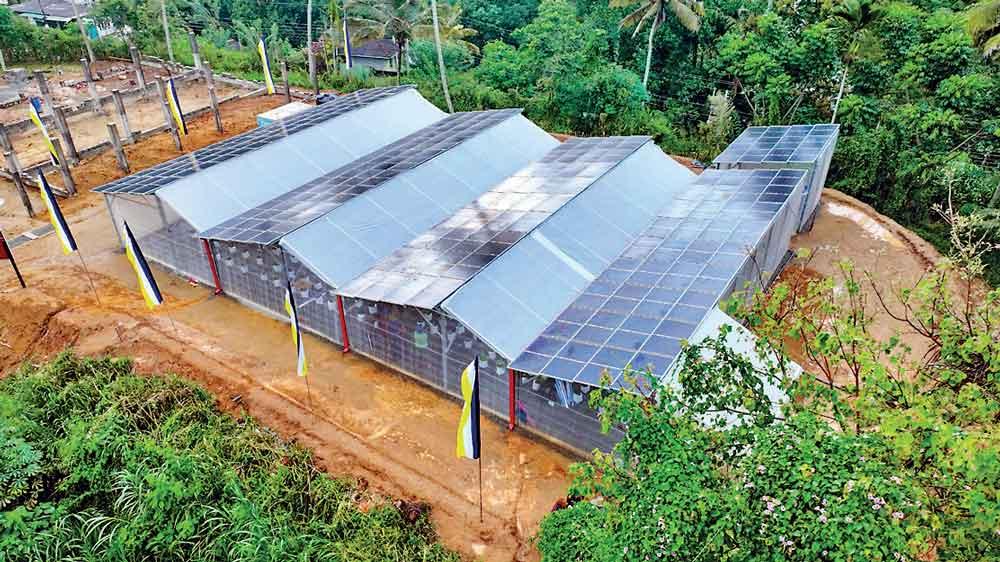
The Agri-Solar Pilot Demonstrator for Training and Research was officially opened at the National Seminary of Our Lady of Lanka, Ampitiya, Kandy, recently.
The project introduces agrivoltaics or agri-PV, an approach that integrates solar photovoltaic (PV) electricity generation with agricultural cultivation on the same land.
By allowing farming to continue beneath the elevated solar panels, agri-PV offers an opportunity to make more effective use of land while exploring how renewable energy generation and agricultural production can complement one another.
The initiative is supported by the German Federal Ministry for Economic Affairs and Energy under the Renewable Energy Solutions Programme of the German Energy Solutions Initiative, with the support from the German Energy Agency. It brings German renewable-energy expertise to Sri Lanka while promoting technology transfer, practical training and applied research.
SUNfarming International GmbH, Germany contributes its agri-PV technology and engineering expertise, while SUNfarming Lanka (Pvt.) Ltd coordinates the local implementation in collaboration with the National Seminary, which hosts the facility.
The installation has a total solar PV capacity of 51.48 kWp, comprising elevated agri-solar structures and a separate modular installation designed for practical PV training. The elevated structures incorporate the SUNfarming-branded bifacial glass-glass solar PV modules, allowing the agricultural activities to continue beneath them.
The system incorporates a specially designed panel arrangement intended to protect the crops from heavy rainfall and intense sunlight, while potentially helping to reduce soil moisture loss and crop stress. The demonstrator will provide a practical platform for researchers and agricultural specialists to investigate which crops and cultivation methods are best suited to agri-PV under Sri Lankan conditions.
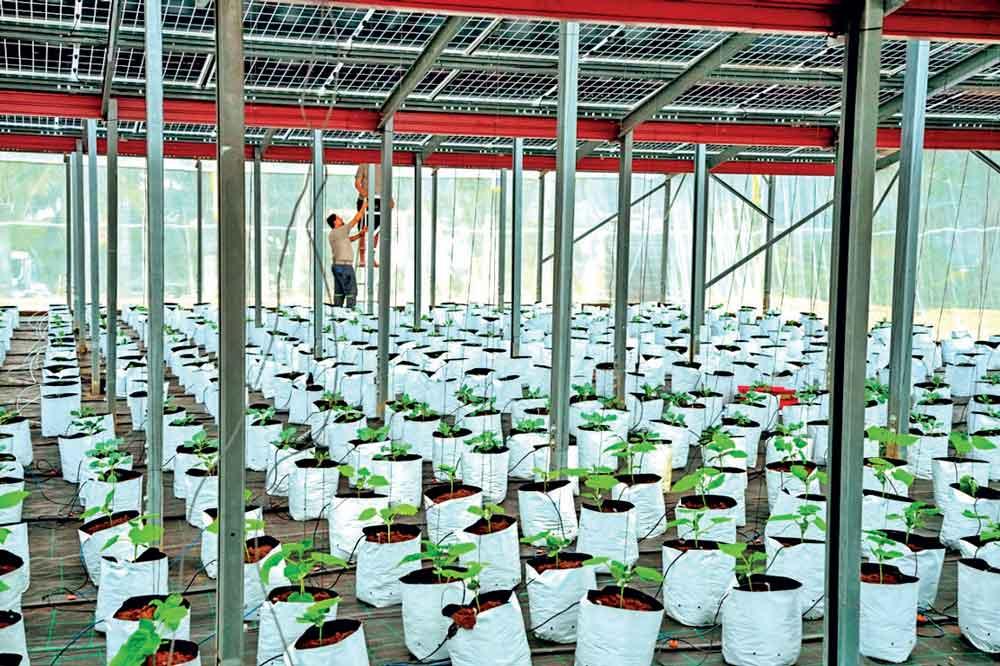
It will also enable agricultural performance to be monitored and assessed over time, building evidence on crop suitability, growing conditions and the practical application of agri-PV in Sri Lanka.
Technical training is another central component. During installation, 26 trainees from the Ceylon German Technical Training Institute gained hands-on experience alongside the German engineering team. The facility is intended to support further practical training, technology demonstration and applied learning in solar PV and agri-PV.
For Sri Lanka, the project provides a practical starting point for exploring innovation at the intersection of agriculture and renewable energy. By combining technology demonstration, skills development and local assessment, it can help strengthen technical capacity and generate knowledge to inform future agri-PV initiatives.
As a pilot demonstrator dedicated to training and research rather than commercial-scale development, its longer-term value will lie in the lessons learned and the evidence generated under local agricultural and climatic conditions.