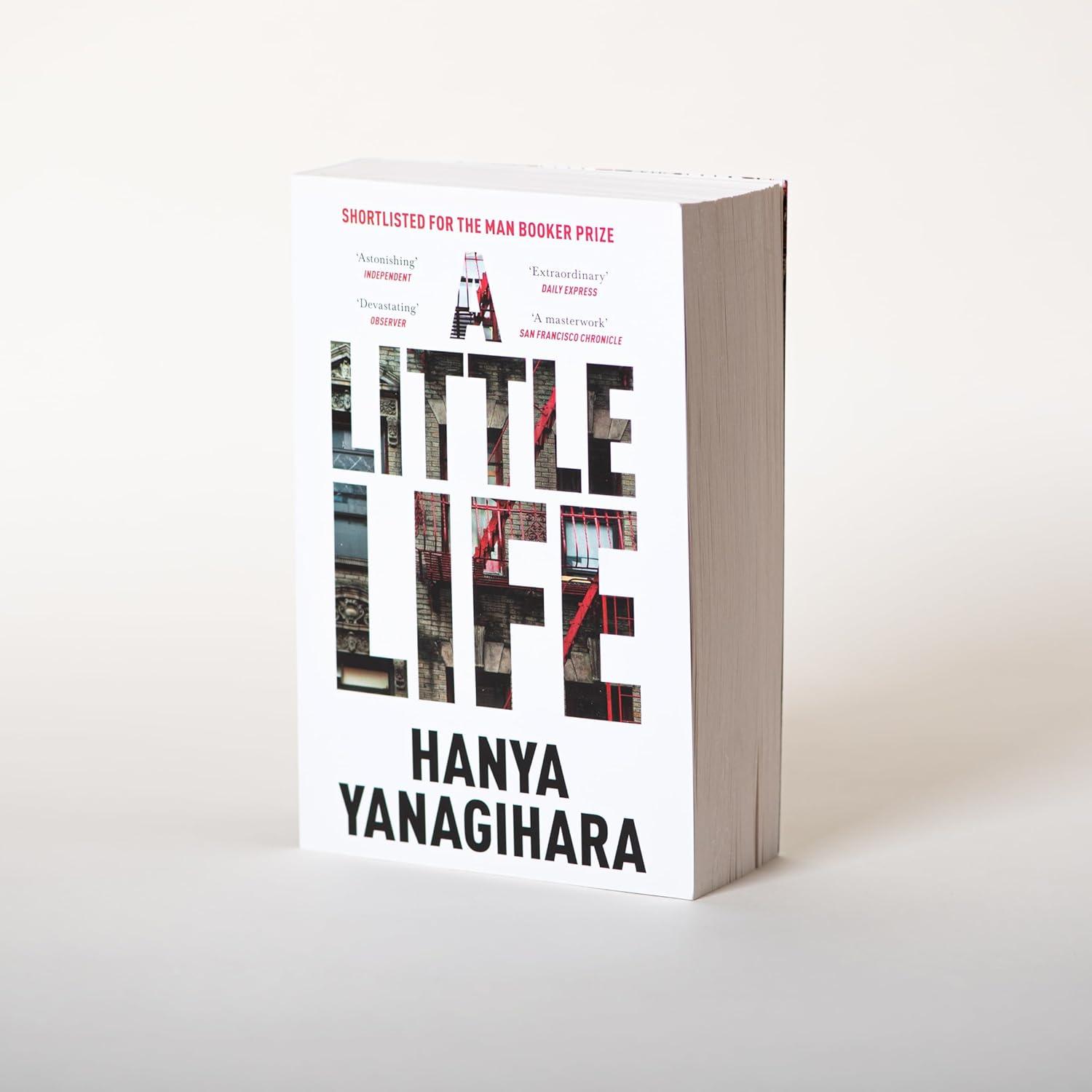
Some novels tell stories. Others leave emotional scars. Hanya Yanagihara’s A Little Life is an extraordinary, controversial and deeply unsettling exploration of friendship, trauma, survival and the desperate human desire to be loved.
There are books you finish and forget.
There are books you remember fondly.
And then there is A Little Life—a novel that can leave readers emotionally exhausted long after its final page.
Published in 2015, Hanya Yanagihara’s monumental second novel is an uncompromising examination of human suffering, enduring friendship and the complicated relationship between love and psychological pain.
Spanning more than 700 pages, the novel follows four college friends as they navigate adulthood in New York City. What initially resembles a familiar story of ambition, professional success and lifelong companionship gradually transforms into something considerably darker.
At its centre is one of contemporary literature’s most unforgettable and fiercely debated characters: Jude St. Francis.
A Little Life is not an easy novel. It does not promise comfort, offer simple resolutions or suggest that love can miraculously repair every wound.
Instead, it asks an uncomfortable question:
What happens when someone is surrounded by love but cannot believe they deserve it?
The Woman Behind the Novel: Hanya Yanagihara

Born in Los Angeles in 1974, Hanya Yanagihara is an American novelist and editor whose work has become synonymous with emotionally demanding, psychologically intricate literary fiction.
Her debut novel, The People in the Trees (2013), established her interest in moral ambiguity, human relationships and uncomfortable psychological territory.
But it was A Little Life that propelled her into international literary prominence.
Yanagihara subsequently published To Paradise in 2022, further demonstrating her willingness to experiment with narrative structure, social expectations and the darker dimensions of human experience.
Unlike many contemporary novels that approach difficult subjects with reassuring resolutions, Yanagihara’s fiction frequently refuses emotional consolation.
Her characters are complex, imperfect and occasionally impossible to understand.
That refusal to simplify human behaviour is central to her literary identity—and a major reason A Little Life continues to provoke such intense reactions.
Four Friends, One City, and a Lifetime of Secrets

The novel begins with four friends who have recently graduated from college and are attempting to build their futures in New York.
Willem Ragnarsson dreams of becoming an actor. Compassionate and emotionally perceptive, he provides a stabilising presence within the group.
JB Marion is an ambitious artist whose confidence and creativity conceal insecurities of his own.
Malcolm Irvine pursues architecture while struggling with questions of identity, expectations and professional achievement.
And then there is Jude St. Francis.
Brilliant, reserved and extraordinarily capable, Jude becomes a successful lawyer. Yet beneath his professional accomplishments lies a history of severe childhood abuse, exploitation and trauma that he has never fully disclosed to his friends.
As the years pass, careers flourish, relationships evolve and the four men confront the realities of adulthood.
But Jude’s past continues to shape his present.
His difficulty accepting affection, his physical suffering and his deeply internalised shame gradually become the emotional centre of the novel.
Yanagihara constructs a world in which extraordinary professional success can coexist with profound personal anguish.
The result is a disturbing reminder that outward achievement tells us remarkably little about someone’s internal life.
Why A Little Life Became a Literary Phenomenon

Few contemporary novels have generated the combination of admiration, emotional attachment and fierce criticism that surrounds A Little Life.
Its reputation began with its ambitious scope and its unflinching portrayal of trauma. But over time, the novel found an entirely new audience through online reading communities, particularly BookTok and Bookstagram.
Its distinctive cover—featuring Peter Hujar’s photograph Orgasmic Man—became instantly recognisable.
Readers began sharing photographs of their annotated copies, emotional reactions and discussions about Jude and Willem. The novel became a frequent recommendation among readers seeking emotionally intense literary fiction.
A decade after publication, the Booker Prize revisited its extraordinary cultural afterlife, documenting how the book continued to attract new readers and provoke debate.
But popularity alone does not explain its lasting influence.
The novel challenges the comforting assumption that suffering always produces wisdom, that love invariably heals, or that every damaged person can eventually experience a conventional happy ending.
Those questions make it difficult to dismiss.
They also make it difficult to forget.
Awards and Literary Recognition: What Did A Little Life Actually Win?

A Little Life received some of the most prestigious literary recognition available to a contemporary novel. However, it is important to distinguish between awards won and awards for which the book was shortlisted.
Its confirmed major wins include:
- 2015 Kirkus Prize for Fiction — Winner.
- 2016 British Book Awards, Fiction Book of the Year — Winner.
The novel also achieved an exceptional series of shortlist and finalist placements:
- 2015 Man Booker Prize — Shortlisted.
- 2015 National Book Award for Fiction — Finalist.
- 2016 Baileys Women’s Prize for Fiction — Shortlisted.
- Andrew Carnegie Medal for Excellence in Fiction — Shortlisted.
- 2016 Ferro-Grumley Award — Finalist.
- 2017 International Dublin Literary Award — Shortlisted.
The Booker and National Book Award distinctions are especially significant, placing Yanagihara’s novel among the most widely discussed literary works of 2015.
Yet the book’s most remarkable achievement may be its longevity.
Many acclaimed novels enjoy a brief period of intense attention before disappearing from public discussion.
A Little Life has done almost the opposite.
Its audience has continued expanding, and its ability to provoke both devotion and discomfort remains central to its reputation.
Is A Little Life a Love Story?

In many ways, yes.
But not in the conventional sense.
Although romantic relationships become important, the novel’s deepest emotional foundation is the relationship between people who choose to become one another’s family.
Jude, Willem, JB and Malcolm enter adulthood without knowing exactly what their futures will contain.
They pursue careers, experience success and disappointment, form relationships and gradually discover that friendship requires more than shared history.
It requires patience.
Forgiveness.
Presence.
And sometimes the willingness to remain beside someone whose suffering you cannot resolve.
The relationship between Jude and Willem becomes particularly significant, illustrating how affection can evolve beyond familiar categories of friendship and romance.
Yanagihara portrays love as something simultaneously magnificent and painfully limited.
People can offer tenderness, security and devotion.
But they cannot necessarily erase another person’s past.
That is one of the novel’s most challenging ideas.
Love may be profoundly meaningful without being all-powerful.
The Controversy: Brilliant Literature or Excessive Suffering?

Not everyone considers A Little Life a masterpiece.
Indeed, some of its most passionate discussions concern whether Yanagihara pushes suffering beyond the boundaries of emotional credibility.
Critics have questioned the extraordinary accumulation of traumatic experiences within Jude’s life, arguing that the novel occasionally approaches what is sometimes described as trauma porn—the repeated presentation of suffering in ways that risk overwhelming character development.
Others question the novel’s treatment of mental illness, disability and psychological recovery.
These criticisms deserve serious consideration.
There are moments when the narrative becomes so relentlessly painful that readers may wonder whether the suffering is illuminating something new or simply intensifying an already established emotional effect.
Yet defenders argue that this discomfort is precisely what makes the novel artistically distinctive.
Yanagihara refuses to offer the reassuring narrative conventions readers often expect.
There is no guarantee that a traumatic childhood will be followed by a triumphant recovery.
There is no promise that extraordinary friendship will resolve every psychological wound.
The result is a book that forces readers to confront the limits of their expectations about healing.
Whether that approach is courageous or excessive remains one of the novel’s defining debates.
From the Page to the Stage: A Little Life Comes Alive

The emotional intensity of A Little Life eventually attracted the attention of acclaimed theatre director Ivo van Hove, who brought the novel to the stage.
Following an earlier Dutch-language production, an English-language adaptation arrived in London’s West End in 2023, featuring an impressive cast:
- James Norton as Jude St. Francis
- Luke Thompson as Willem Ragnarsson
- Omari Douglas as JB Marion
- Zach Wyatt as Malcolm Irvine
- Zubin Varla as Harold Stein
- Emilio Doorgasingh as Andy Contractor
The production brought Yanagihara’s devastating narrative into an intensely physical theatrical environment. Its performances attracted considerable attention, particularly Norton’s portrayal of Jude.
The stage production was also filmed and released in selected cinemas in September 2023, allowing audiences beyond the theatre to experience it. This was a filmed theatrical performance, not a separate feature-film adaptation.
The adaptation demonstrated how the novel’s emotional power could extend beyond literature, while simultaneously renewing debate about the portrayal of suffering as entertainment.
Why You Should Read A Little Life

Read A Little Life if you appreciate character-driven fiction that prioritises emotional complexity over conventional plot.
Read it if you are fascinated by the psychology of friendship and the ways relationships evolve across decades.
Read it if you enjoy novels that challenge easy assumptions about happiness, personal achievement and recovery.
And read it if you are interested in understanding why one contemporary novel has generated such extraordinary admiration and criticism.
But it is important to approach the book with an understanding of its subject matter.
Content advisory: The novel contains extensive depictions and discussions of childhood abuse, sexual violence, self-harm, suicidal behaviour, addiction and severe psychological distress. Some passages are graphic and prolonged. It may not be suitable for readers who find these subjects especially distressing.
There is also an important distinction between emotional intensity and literary quality.
A book does not become great simply because it makes people cry.
Its value must also be measured through characterisation, structure, prose, originality and the ideas it leaves behind.
A Little Life offers much to admire in these areas, although its unrelenting darkness will not appeal to every reader.
Final Verdict: Is A Little Life Worth the Emotional Devastation?

4/5
A Little Life is an extraordinary literary achievement, but it is not an unquestionable masterpiece.
Yanagihara’s prose is immersive, her characterisation frequently remarkable, and her portrayal of long-term friendship unusually ambitious.
Jude and Willem, in particular, emerge as characters whose emotional significance extends well beyond the boundaries of the novel.
Yet the relentless accumulation of suffering sometimes threatens to undermine the very emotional realism the book seeks to establish.
Certain narrative developments feel almost calculated to intensify devastation, and the novel’s refusal to offer meaningful relief may leave some readers questioning its artistic choices.
Nevertheless, few contemporary novels have inspired such passionate discussion about love, friendship, trauma and the limits of human endurance.
Its greatest accomplishment is not simply that it can break a reader’s heart.
It is that it makes readers question what it means to care for another person when love alone cannot resolve their suffering.
Four stars—not because the novel lacks ambition, but because its extraordinary ambition is both its greatest strength and its most significant weakness.
Book Quote

“Wasn’t friendship its own miracle?”
— Hanya Yanagihara, A Little Life
Perhaps this brief question captures the novel more effectively than any description of its suffering.
Beneath its darkness, A Little Life is an extended meditation on the people who choose to remain in our lives—not because they are obligated to, but because they love us.
And perhaps that is the most powerful idea Yanagihara leaves behind:
A life does not have to be extraordinary to matter. Sometimes, its greatest meaning is found in the people who make it less lonely.