As global trade faces increasing uncertainty, regional economic partnerships are becoming more important than ever. International trade growth is expected to slow considerably in the coming years due to geopolitical tensions, supply chain disruptions, protectionist policies, and weakening business confidence. In this environment, countries that strengthen economic cooperation and improve regional connectivity are likely to be better positioned for long-term growth.
For Sri Lanka, one of the most significant opportunities lies in deepening its economic relationship with India.
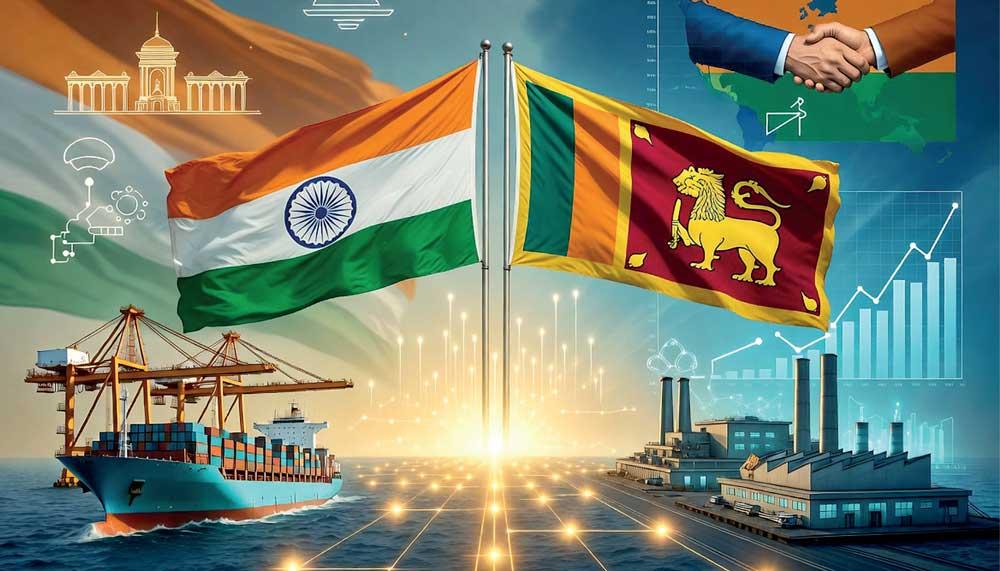
As the India–Sri Lanka Free Trade Agreement (ISFTA) reaches its 25th year, policymakers and business leaders are increasingly questioning whether the agreement remains capable of meeting the demands of today’s global economy.
A Landmark Agreement for South Asia
When the ISFTA came into force in 2000, it represented a major milestone for the region. It was the first bilateral free trade agreement in South Asia and marked a shift away from protectionist economic policies that had previously dominated regional trade.
The agreement provided preferential market access for goods between the two countries while recognizing the differences in economic size and industrial development. India opened its market more rapidly, while Sri Lanka was given additional time and flexibility to adjust, with both countries maintaining lists of protected products.
At the time, the arrangement reflected economic realities and helped establish a foundation for stronger commercial ties.
Trade Growth Over Two Decades
The agreement has contributed significantly to the expansion of bilateral trade.
Over the past twenty-five years, trade between Sri Lanka and India has grown dramatically, transforming India into Sri Lanka’s largest trading partner. The composition of trade has also evolved beyond traditional commodities, with a wider range of manufactured goods, consumer products, industrial inputs, and agricultural exports now moving between the two economies.
This growth demonstrates the value of reducing trade barriers and creating predictable market access for businesses.
The relationship has also generated benefits beyond trade itself.
Investment and Economic Cooperation
Although investment was not formally included within the original agreement, stronger economic ties have encouraged substantial cross-border investment.
Indian companies have established a significant presence in Sri Lanka across sectors such as energy, manufacturing, logistics, hospitality, and retail. These investments have contributed to employment creation, technology transfer, infrastructure development, and increased business activity.
At the same time, several Sri Lankan companies have successfully expanded into the Indian market, leveraging its vast consumer base and growing economy.
The result has been a more interconnected business environment that extends well beyond traditional trade flows.
Tourism Strengthens Bilateral Links
Tourism has emerged as another important pillar of the relationship.
India consistently ranks among Sri Lanka’s largest sources of tourist arrivals. Strong flight connectivity, geographical proximity, simplified travel procedures, and competitive tourism offerings have supported this growth.
In recent years, Indian visitors have played a particularly important role in sustaining Sri Lanka’s tourism sector during periods of global uncertainty and travel disruptions.
Their contribution highlights how economic partnerships can create benefits across multiple sectors rather than being limited to merchandise trade alone.
A Changing Global Trade Landscape
Despite its successes, the ISFTA was designed for a very different economic era.
When negotiations began, international trade was largely focused on the exchange of finished goods between countries. Today, global commerce operates through highly integrated supply chains where products are manufactured across multiple locations before reaching consumers.
Services, technology, logistics, data flows, and investment now play a much larger role in international trade than they did two decades ago.
At the same time, multinational companies are actively diversifying production networks and reducing dependence on single-country manufacturing hubs. This shift has created new opportunities for countries that can position themselves within regional and global value chains.
India has emerged as a major beneficiary of this transformation.
Opportunities for Sri Lanka
As India expands its manufacturing base and attracts global investment, Sri Lanka has an opportunity to become a complementary partner within regional supply chains.
Rather than competing directly with larger economies, Sri Lanka could focus on areas where it possesses strategic advantages, including logistics, maritime services, information technology, professional services, and specialized manufacturing.
To achieve this, however, the existing trade framework must evolve.
Industry experts argue that the next phase of economic integration should focus on modern trade realities. This includes updating rules governing product origin, simplifying customs procedures, reducing administrative barriers for businesses, and expanding cooperation in services trade.
Digital trade facilitation and greater regulatory harmonization could also make it easier for small and medium-sized enterprises to participate in cross-border commerce.
The Need for a Modern Investment Framework
Investment protection and investor confidence will be equally important in the years ahead.
Businesses increasingly seek clear regulatory frameworks, transparent dispute resolution mechanisms, and predictable policy environments before committing long-term capital.
A modernized economic partnership should therefore include stronger provisions related to investment, helping both countries attract greater levels of private-sector participation.
Such reforms could support infrastructure projects, industrial development, innovation, and job creation.
Toward an ISFTA 2.0
The future of India–Sri Lanka economic relations should be viewed through a broader lens than trade alone.
A modernized agreement could serve as the foundation for deeper cooperation in investment, technology, energy, logistics, tourism, and industrial development. Enhanced physical connectivity, improved business-to-business engagement, and stronger integration into regional supply chains would further strengthen economic resilience.
Most importantly, a renewed framework could help Sri Lanka accelerate export growth and increase foreign exchange earnings at a time when economic stability remains a national priority.
Looking Ahead
Twenty-five years ago, the ISFTA helped reshape trade relations between India and Sri Lanka. Today, a new chapter is needed.
The global economy has changed, supply chains have evolved, and regional integration has become increasingly important. By modernizing its trade relationship with India, Sri Lanka has an opportunity to attract investment, expand exports, improve competitiveness, and secure a stronger position within the emerging Asian economic landscape.
With political commitment, private-sector engagement, and a shared vision for growth, the next generation of economic cooperation could unlock opportunities far greater than those achieved during the agreement’s first twenty-five years.