
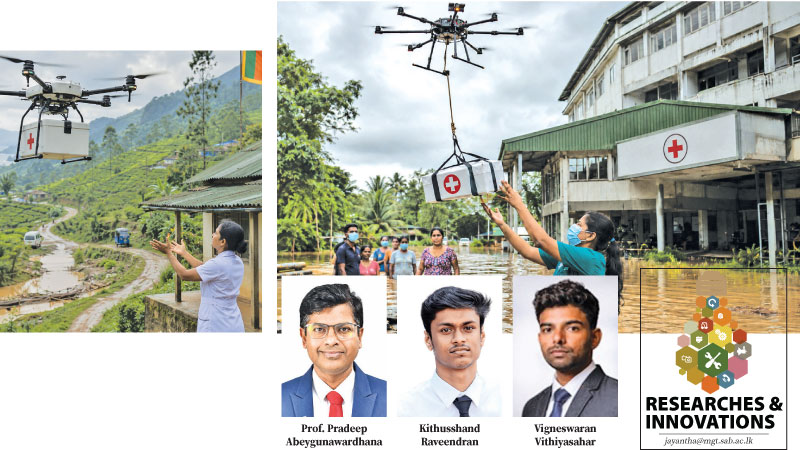
A medical drone delivers essential healthcare supplies to a rural clinic, showing how drone technology could support Sri Lanka’s disaster-prone and hard-to-reach communities.
When heavy rain cuts off a rural road in Ratnapura, or when a landslide blocks access in Badulla or Nuwara Eliya, a patient waiting for urgent medicine cannot wait for the road to reopen.
A mother in an estate community, a child in a remote village, or a hospital waiting for a blood sample may lose valuable time because transport is delayed. In healthcare, even a few minutes can sometimes change the outcome.
It is in this spirit that we put forward a proposal to the Government, to our universities and researchers, and to the wider public: medical drone delivery should be recognized as part of the country’s national development agenda. Sri Lanka is ready to test this idea, and the time to begin is now.
Why this matters
Sri Lanka has made strong progress in healthcare, education and digital development.
Yet, in many rural, estate, island and disaster-prone communities, delivering essential medical supplies quickly remains a challenge. Ambulances and road transport are still vital, but they are often affected by traffic, poor road conditions, floods, landslides and distance.
True national development is not only about highways, ports and buildings. It is also about ensuring that a citizen in a remote village receives timely healthcare support when it is needed most. Medical drone delivery can become one practical way to close this gap.
What we propose
We propose a drone-based healthcare delivery system called Medi-Fly, designed for short-distance medical transport. It uses small, unmanned aircraft to carry essential medical items such as medicines, blood samples, vaccines, diagnostic kits and emergency supplies between nearby hospitals, rural clinics, laboratories and disaster response centres.
This is not a proposal to replace doctors, nurses, ambulances or existing healthcare transport. It is an additional support system that helps healthcare workers act faster, especially when roads are slow, unsafe or unavailable.
The strength of the idea is simple: a delivery that may take more than half an hour by road can be completed in just a few minutes by drone over a short distance. In controlled short-distance trials, Medi-Fly showed around 80 percent faster delivery compared with road transport and achieved a 96 percent mission success rate. This shows strong potential for quick, short-range healthcare delivery in Sri Lanka.
Such a system could help many parts of the country: Ratnapura and Kalutara during floods, Badulla and Nuwara Eliya during landslides, Jaffna’s island communities where distance limits access, and estate communities and rural hospitals that need faster movement of small but important medical items.
Safety, privacy and public trust
Speed alone is not enough. A medical drone system must be safe, controlled and accountable. Before take-off, the drone should check its battery, route, payload and communication links. During flight, an operator should monitor its location, battery level and delivery progress. If a problem occurs, such as low battery, weak signal or route deviation, the drone should safely return to where it started.
Public safety and privacy must be at the centre of this proposal. Medical drones should fly only on approved routes, at approved times and for approved healthcare purposes. They should never be used to watch people, record private activities or fly randomly over communities. Their role must be limited to medical deliveries, emergency support and healthcare logistics.
People must understand that medical drones are not toys or surveillance tools. They are healthcare helpers designed to save time, improve access and strengthen emergency response.
Ready for disasters
A medical drone delivers essential healthcare supplies to a rural clinic, showing how Sri Lanka can use drone technology to support remote and disaster-affected communities faster.
A disaster-ready version of this system is especially important for Sri Lanka. During floods, landslides or other emergencies, roads and communication can fail at the same time. In such situations, a medical drone can do more than carry a package. It can also send back live information about where it is, how the delivery is progressing and whether the payload is safe.
This can help emergency teams coordinate better when they need it most. For disaster-prone regions, medical drones can become not only a delivery tool, but also part of a wider emergency-response system.
How Sri Lanka can begin
Sri Lanka does not need a large national drone network immediately. A careful pilot programme is the best first step.
The Ministry of Health, Disaster Management Centre, Civil Aviation Authority of Sri Lanka, universities and private drone companies should work together to create approved pilot zones in rural, flood-prone, landslide-prone and island areas. The first use cases could include carrying blood samples to laboratories, delivering urgent medicines to isolated areas, supporting vaccination programmes and moving small emergency supplies during disasters. Universities can support research and safety testing, private companies can provide drones and training, the Civil Aviation Authority can guide flight approvals, and the Disaster Management Centre can identify emergency needs. The model should be simple: pilot first, study the results, improve safety and then expand.
Affordable and realistic
Any national proposal must fit the country’s means. Large international drone networks often require heavy infrastructure and major investment. A smaller local hub model using commercially available drones is more realistic for Sri Lanka.
One small healthcare drone hub could serve several nearby clinics within a short distance, reducing delays at a manageable cost. Of course, drone operations must follow aviation rules. Weather, maintenance, battery life, communication reliability and operator training must be carefully managed. Flights over crowded areas should be avoided in the early stages, and longer-distance operations would require stronger approval and advanced safety systems.
These are reasons to pilot carefully — not reasons to wait.
Call to the nation
This proposal builds on our Medi-Fly research work at SLIIT, developed in two phases through related conference papers for the 9ᵗʰ International Research Conference on Smart Computing and Systems Engineering (SCSE 2026) and the International Conference on Technology Innovations for Crisis Management (ICTICM 2026), focusing on medical drone delivery and disaster-resilient healthcare logistics.
Sri Lanka’s future should not be measured only in roads, buildings and infrastructure projects. It should also be measured in smart systems that save lives, reduce delays and give every community fair access to healthcare.
The future of healthcare delivery may not always depend on roads. In the years ahead, when a village is cut off by floods, when a rural hospital urgently needs medicine, or when a clinic must send a blood sample quickly, help may arrive from the sky.
Prof. Pradeep Abeygunawardhana
Dean | Faculty of Computing
Sri Lanka Institute of Information Technology (SLIIT) Malabe.
Email: Pradeep.a@sliit.lk
Kithusshand Raveendran, Academic Instructor,
Faculty of Computing,
Sri Lanka Institute of Information Technology (SLIIT) Metro Campus, Colombo.
Email: kithusshand.ra@sliit.lk
Vigneswaran Vithiyasahar, Assistant Lecturer,
Faculty of Computing,
Sri Lanka Institute of Information Technology (SLIIT) Northern Uni, Jaffna.
Email: vithiyasahar.v@sliit.lk