Artificial intelligence is changing the world faster than many imagined.
From writing emails and analysing data to generating images and automating repetitive tasks, AI is rapidly transforming industries, workplaces, and everyday life. What once seemed futuristic has quietly become part of the present.
Naturally, this transformation has sparked an important question.
If machines are becoming smarter, what skills will matter most in the future?
Surprisingly, the answer may lie not in competing with technology, but in embracing what makes humans uniquely human.
Creativity.
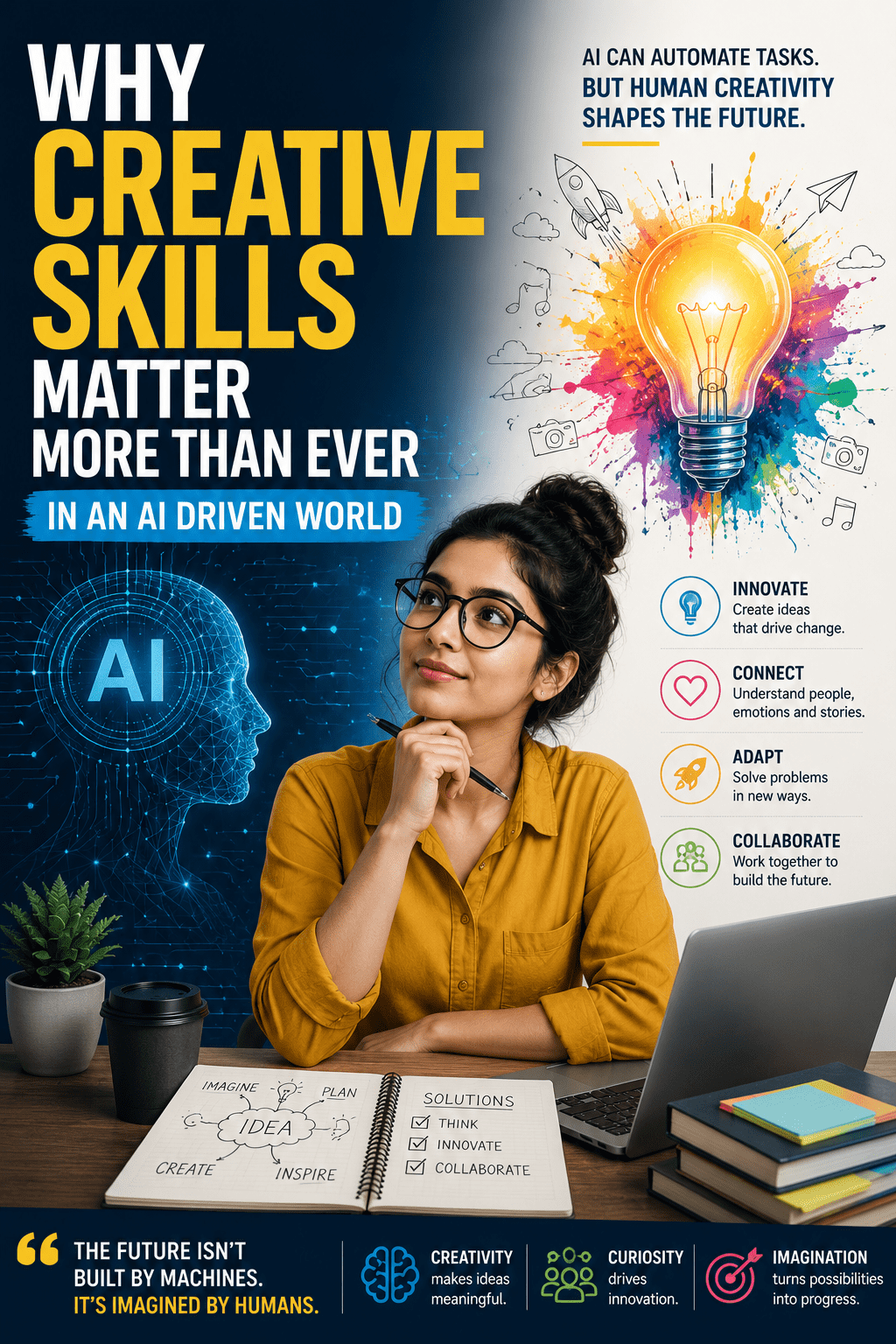
In a world increasingly powered by automation and artificial intelligence, creative thinking is emerging as one of the most valuable skills of all.
The Rise of AI and the Fear of Replacement
The growing presence of AI has understandably created uncertainty.
Many people worry about automation replacing jobs, reshaping industries, or changing traditional career paths. Tasks that once required hours of human effort can now sometimes be completed within minutes using intelligent systems.
However, while AI can process information at incredible speed, it still operates differently from human imagination.
Artificial intelligence can generate ideas based on patterns and existing data.
Humans create meaning.
This difference matters more than ever.
Machines may be capable of efficiency, but originality, emotional understanding, and deep storytelling continue to rely heavily on human thinking.
What Are Creative Skills?
When people hear the word creativity, they often think of artists, musicians, or designers.
But creativity extends far beyond traditional artistic fields.
Creative skills include:
- Problem solving
- Critical thinking
- Innovation
- Storytelling
- Communication
- Idea generation
- Adaptability
- Strategic thinking
These abilities shape how people approach challenges, solve problems, and imagine possibilities.
In workplaces increasingly supported by technology, these human centred skills are becoming highly valuable.
After all, businesses still need people who can think differently, ask better questions, and create meaningful experiences.
Why Creativity Is Becoming More Valuable
Ironically, as technology becomes more advanced, human creativity becomes more important.
AI may be able to automate repetitive tasks, but it still struggles with emotional depth, cultural understanding, humour, intuition, and originality in the way humans naturally understand them.
A machine may generate marketing content.
But humans build emotional connections.
AI can analyse trends.
But people often recognise opportunities through instinct, experience, and imagination.
In industries such as marketing, media, education, design, entrepreneurship, and business strategy, creative thinking continues to shape innovation.
The future workplace may increasingly reward those who know how to work alongside AI rather than fear it.
The Future Belongs to Human AI Collaboration
Perhaps the future is not about humans versus artificial intelligence.
Perhaps it is about collaboration.
Instead of replacing creativity, AI may become a tool that enhances it.
Writers can brainstorm ideas faster. Designers can experiment with concepts more efficiently. Businesses can use AI for research while relying on human insight for strategy and emotional connection.
In many ways, AI may remove repetitive barriers, allowing people to focus more on imagination and meaningful thinking.
The people who thrive may not necessarily be those who resist technology.
They may be the ones who learn how to combine technology with human creativity.
Are Schools and Workplaces Ready?
This shift raises important questions for education and professional development.
For years, many systems prioritised memorisation, standardised learning, and predictable outcomes.
But the future may demand something different.
Creative confidence, problem solving, communication, and adaptability may become just as important as technical knowledge.
Schools, universities, and workplaces may increasingly need to create environments that encourage curiosity, experimentation, and original thinking.
Because in an AI driven world, knowing information may matter less than knowing how to think.
Final Thoughts
Artificial intelligence is undoubtedly reshaping the future.
But rather than making human skills irrelevant, it may be highlighting their importance more clearly than ever.
As machines grow smarter, creativity may become one of humanity’s greatest competitive advantages.
Because while AI can process information, humans still imagine possibilities.
And in a rapidly changing world, the ability to think creatively may matter more than ever before.
Meta Description:
Why are creative skills becoming more valuable in an AI driven world? Explore how creativity, innovation, and human thinking are shaping the future of work.