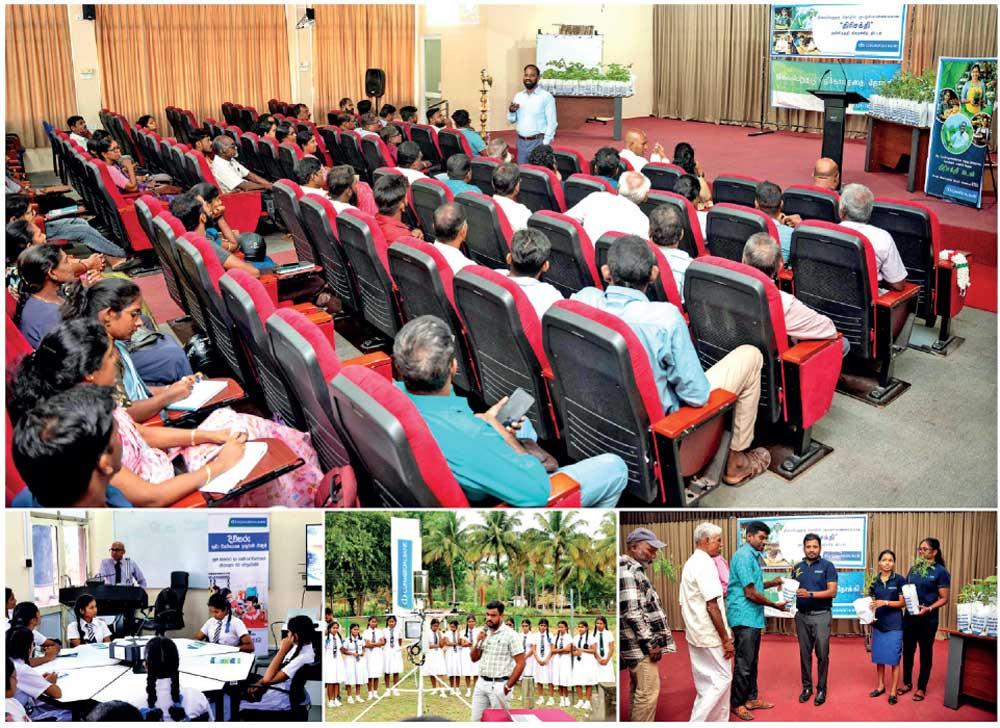
Commercial Bank of Ceylon has introduced a comprehensive agricultural awareness and technology initiative aimed at helping Sri Lankan farmers prepare for potential climate-related disruptions associated with the 2026 El Niño weather pattern.
Implemented through the bank’s Development Credit Department, the programme brings together universities, government agricultural authorities, technology specialists and farming communities to strengthen climate resilience and encourage more sustainable agricultural practices.
The initiative represents a shift towards preventive agricultural risk management, focusing on providing farmers with scientific knowledge, practical guidance and technological resources before adverse weather conditions significantly affect their livelihoods.
During September 2026, Commercial Bank collaborated with two prominent state universities to conduct educational programmes designed to improve farmers’ understanding of changing weather patterns and their potential consequences for agricultural production.
The initiative was developed against a backdrop of growing concerns regarding El Niño and its possible effects on Sri Lanka’s agricultural sector.
According to climate assessments referenced by the bank, Sri Lanka’s Department of Meteorology had identified an 80% probability of El Niño conditions developing during the June to August 2026 period, with potential impacts extending into November and subsequent months.
El Niño is a natural climate phenomenon associated with changes in Pacific Ocean temperatures that can influence rainfall distribution, temperature patterns and weather conditions in different parts of the world.
For agricultural economies such as Sri Lanka, changes in rainfall and prolonged periods of dry weather can create challenges involving irrigation, crop productivity, water availability and rural household incomes.
The Food and Agriculture Organization of the United Nations has also recognised El Niño as a factor capable of intensifying existing vulnerabilities affecting food production, water resources and agricultural livelihoods.
Recognising these risks, Commercial Bank developed a collaborative programme connecting agricultural research institutions, extension officers, technology providers and financial services with farming communities.
The awareness campaign received support from 12 Commercial Bank branches and reached more than 1,100 farmers across 15 locations throughout Sri Lanka.
The areas covered included Vattapalai, Muththajankaddu, Palampas, Oddusuddan, Siyambalanduwa, Lindula, Neluwa, Kalawana, Pannala, Madampe, Mannar, Vavuniya and Kumalamunai, alongside other agricultural communities.
By extending the initiative across different regions, the bank sought to address the varying climate-related challenges experienced by farmers operating under different geographical and agricultural conditions.
The first major educational programme took place in Kilinochchi at the District Secretariat’s Skill Development Hall.
Organised in partnership with Commercial Bank’s Kilinochchi branch and the University of Jaffna, the programme attracted approximately 100 participants interested in strengthening their ability to manage agricultural risks associated with climate variability.
The sessions featured academic specialists and industry representatives who shared practical insights into climate-related agricultural challenges and possible adaptation measures.
Among the principal resource persons were Professor Nagamuthu Piratheeparajah, Dean of the Faculty of Arts at the University of Jaffna, and Dr. Suvanthini Terensan, Head of the Department of Agricultural Biology.
Maheswaran Rajeethan, Managing Director of Inthira Group, also contributed to the programme, providing perspectives relevant to agricultural operations and practical farming requirements.
The discussions focused on helping participants better understand how changing weather conditions could influence farming activities, including planting decisions, water usage and crop management.
Farmers were introduced to methods of reducing exposure to climate-related losses through improved preparation and more informed agricultural practices.
The second major phase of the initiative was conducted at the Faculty of Agriculture of Rajarata University, where greater emphasis was placed on the application of modern technology in agricultural risk management.
The programme was led by Professor M.H.J.P. Gunaratne, Dean of the Faculty of Agriculture, together with Professor N.S. Abeysingha and senior lecturers E.J. Kosgollegedara and H.G.S.C. Wickramasinsooriya.
A central feature of this session was the introduction of smart weather-monitoring technologies powered by the Internet of Things (IoT).
These systems use connected devices and environmental sensors to gather and communicate weather-related information, helping users monitor local conditions and make more informed operational decisions.
In agriculture, such technologies can support the observation of temperature, rainfall, humidity and other environmental factors that influence crop performance.
Access to timely information can help farmers respond more effectively to changing weather conditions, particularly when managing irrigation schedules and preparing for periods of water scarcity.
The Rajarata University programme also focused on encouraging younger generations to participate in modern agricultural development.
The targeted audience of 100 participants comprised 50 young farmers representing local farming societies, 30 students and school leavers pursuing agriculture and biosystems technology, and 20 agricultural instructors attached to the Department of Agriculture.
By involving both emerging agricultural professionals and experienced instructors, the programme aimed to support the wider dissemination of climate-smart farming knowledge within rural communities.
The two university collaborations were designed to complement one another.
While the Kilinochchi programme concentrated on climate awareness and practical approaches to agricultural risk management, the Rajarata University sessions introduced participants to technology-assisted decision-making.
Together, the programmes provided a broader understanding of how scientific research, agricultural experience and digital innovation can be applied to reduce climate-related vulnerabilities.
A major component of the initiative involved helping farmers translate climate information into practical decisions relevant to everyday agricultural activities.
Participants received guidance on adjusting planting schedules to reflect anticipated weather conditions and selecting crop varieties better suited to periods of limited rainfall.
The importance of efficient irrigation methods was also highlighted, particularly in regions where agricultural production depends heavily on reliable water supplies.
Improved water management can help farmers make more effective use of available resources while reducing the potential impact of prolonged dry conditions.
Another area of attention was soil and moisture conservation.
Farmers were encouraged to consider agricultural techniques that protect soil quality, minimise moisture loss and preserve the productive capacity of cultivated land.
These practices can be especially valuable during periods of elevated temperatures and reduced rainfall, when soil degradation and insufficient moisture can affect crop development.
The programme additionally introduced the benefits of incorporating real-time weather information into farm management.
Through IoT-enabled monitoring systems, farmers can potentially obtain more accurate localised data, enabling them to respond to environmental changes with greater precision.
Such information could support decisions relating to irrigation, crop protection, resource allocation and the timing of agricultural activities.
Beyond improving productivity, the adoption of these practices can contribute to reducing unnecessary expenditure and protecting investments in farming operations.
Commercial Bank also highlighted the financial implications of climate-related agricultural risks.
Unfavourable weather conditions can reduce crop yields, increase production expenses and disrupt the income farmers depend on to maintain their livelihoods.
For agricultural borrowers, these challenges can create additional difficulties in meeting loan repayments and fulfilling other financial obligations.
As a financial institution with significant involvement in agricultural financing, Commercial Bank recognises the importance of connecting financial support with effective risk management.
The bank’s approach seeks to help farming enterprises consider climate-related uncertainties when making investment decisions and planning future agricultural activities.
By combining access to agricultural expertise with appropriate financial services, the initiative aims to support more sustainable farm development.
Commercial Bank indicated that its support could include specialised lending facilities, leasing arrangements and environmentally focused financing solutions, depending on the requirements of individual farming enterprises.
Such financial services can potentially assist farmers seeking to modernise equipment, improve irrigation infrastructure or introduce more efficient agricultural technologies.
The programme also demonstrates the value of cooperation between different sectors in addressing challenges that cannot be resolved through financial assistance alone.
Academic institutions contribute research findings and specialised knowledge, while government agricultural officers provide practical guidance and support to farming communities.
Technology providers introduce tools capable of improving agricultural monitoring and decision-making, while financial institutions can facilitate access to resources needed for investment.
When these capabilities are brought together, farmers can benefit from a more coordinated approach to agricultural development and climate adaptation.
The geographical reach of the awareness campaign is another important aspect of the initiative.
Agricultural communities across Sri Lanka experience different environmental conditions, crop requirements and water management challenges.
Consequently, strengthening climate preparedness requires solutions that recognise local circumstances rather than relying exclusively on uniform national approaches.
By engaging farmers in multiple agricultural regions, Commercial Bank’s initiative seeks to encourage the application of climate-resilient practices suited to different farming environments.
The programme also reflects the growing relevance of digital transformation within Sri Lanka’s agricultural sector.
As environmental uncertainty increases, access to reliable information and practical technological solutions can become increasingly important for agricultural planning.
Introducing these tools through educational partnerships may help bridge knowledge gaps and support wider adoption among farming communities.
The involvement of universities also provides opportunities for researchers and agricultural practitioners to strengthen connections with farmers, allowing scientific knowledge to be communicated in ways that address real-world production challenges.
For younger participants, exposure to modern agricultural technologies could encourage greater interest in innovation-driven farming and related professional opportunities.
Commercial Bank stated that the wider objective of the initiative is to strengthen relationships among research institutions, agricultural extension services, technology providers and financial organisations.
These partnerships are intended to support customers in adopting more informed, productive and environmentally sustainable agricultural practices.
The programme illustrates how financial institutions can contribute to agricultural resilience beyond their conventional role as providers of credit.
Through education, collaboration and access to appropriate financial solutions, banks can support farmers in preparing for environmental risks while encouraging responsible investment in agricultural development.
As Sri Lanka continues to confront the challenges posed by changing climate conditions, initiatives that combine scientific expertise, digital technology and financial support could play an increasingly valuable role in protecting agricultural livelihoods.
Commercial Bank’s collaboration with the University of Jaffna, Rajarata University and other participating organisations represents an effort to strengthen the agricultural sector’s capacity to respond to environmental uncertainty.
By encouraging early preparation, improved resource management and the adoption of climate-smart technologies, the initiative seeks to help farming communities build greater resilience while supporting the long-term sustainability of Sri Lanka’s agricultural economy.
Image Disclaimer: All photographs and images featured in this article are the property of their respective copyright owners. They are included solely for illustrative and informational purposes. We do not claim ownership of any third-party images or visual materials.