Sri Lanka has largely regained economic stability, but the country now faces the more difficult task of establishing a new engine for sustainable growth, according to the World Bank.
The Bank has called for a shift towards a growth model driven by private investment, exports and productivity, warning that the post-crisis recovery alone will not be sufficient to generate the jobs, incomes and investment needed for a durable economic transformation.
“Moving from recovery to transformation requires a new growth model in which private investment, exports, and productivity, rather than public spending, drive growth,” the World Bank said at the launch of its latest Sri Lanka Development Update, titled ‘From Recovery to Transformation’.
Following several years focused on debt restructuring, fiscal consolidation and restoring macroeconomic stability, the World Bank said Sri Lanka’s next challenge is to convert those gains into sustained private sector-led growth.
“Macroeconomic stability remains a necessary foundation for growth and job creation, but on its own it is insufficient,” the Bank said.
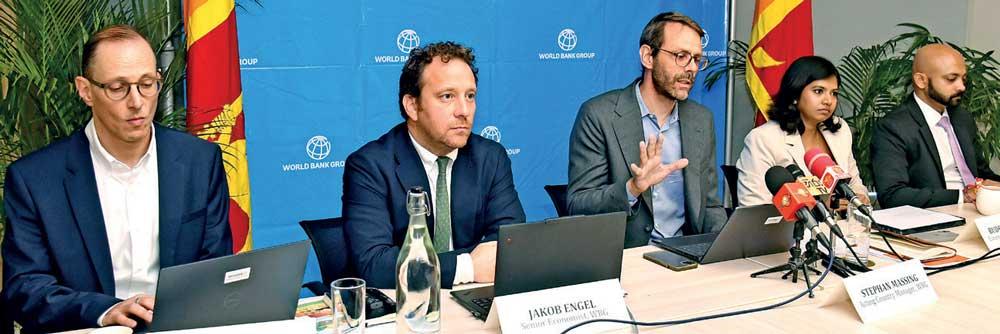
The Sri Lanka Development Update was presented by World Bank Acting Country Manager for Sri Lanka and Maldives Stephan Massing, Senior Country Economist for Sri Lanka Jakob Engel, Senior Country Economist for Sri Lanka Anthony Obeysekera and Regional Practice Manager, Poverty, Alan Fuchs.
The World Bank warned that Sri Lanka’s current growth trajectory remains insufficient to generate more and better-quality jobs, sustainably reduce poverty and raise household incomes.
“The next phase of Sri Lanka’s recovery will require more private investment, faster export growth, and meaningful productivity improvements to raise medium-term GDP growth toward the government’s target of 7 percent,” the Bank said, while calling for greater ambition and faster implementation of structural reforms.
According to the World Bank, the need for such reforms is becoming increasingly urgent as the strong rebound following the economic crisis begins to lose momentum.
The Bank upgraded its forecast for Sri Lanka’s economic growth in 2026 to 4.4 percent, from the 3.6 percent projected in April. Growth is expected to moderate to 4.2 percent in 2027 and 4.0 percent in 2028, with weak productivity expected to constrain the economy’s ability to sustain faster expansion.
While acknowledging that stabilisation was necessary, the World Bank noted that it has not addressed several structural weaknesses that existed before the crisis, including the economy’s longstanding difficulty in generating sufficient productive and high-quality employment.
Addressing these challenges will require more than simply increasing investment. The World Bank stressed the importance of creating a more predictable business environment, strengthening infrastructure, establishing clearer rules for investment and competition, and mobilising private finance towards sectors capable of generating exports and employment.
Agribusiness, tourism, logistics and the digital economy were identified as areas with the potential to play a greater role in driving future growth.
The urgency of improving productivity is underscored by what the World Bank described as Sri Lanka’s “productivity dilemma”.
New evidence highlighted in the report indicates that the post-crisis recovery in company sales and employment has not translated into a comparable improvement in productivity. Between 2023 and 2025, sales and employment increased by around 15 percent, while overall labour productivity improved by only 0.3 percent.
Productivity among medium and large manufacturing firms declined by between 3.8 percent and 8.3 percent. Exporters also recorded a 4.1 percent decline in sales and an 8.3 percent fall in productivity, despite investing more in research and development than non-exporting firms.
The report further noted that Sri Lanka was the only country among its South Asian and lower-middle-income peers to record negative labour productivity growth in 2024. Manufacturing value added per worker was also less than half the level recorded in Vietnam.
The World Bank linked this productivity challenge to weak competition rather than a lack of capability among Sri Lankan businesses, arguing that firms have not been investing sufficiently in efficiency improvements.
Meanwhile, despite stronger headline economic growth, many households have yet to recover the living standards lost during the crisis. While poverty is expected to continue declining, the World Bank expects it to remain above its pre-crisis level even in 2028.
Higher fuel prices and inflation are also expected to weigh on real income growth this year, potentially slowing the pace of household recovery.
The Bank identified several risks to Sri Lanka’s outlook, including slower global growth, geopolitical and trade disruptions, persistently elevated energy and food prices, weak foreign investor appetite and climate-related shocks.
Sri Lanka therefore enters the next stage of its recovery with limited room for policy complacency.
“Stabilisation has been necessary but is not enough to meet Sri Lanka’s core development challenges,” the World Bank said.
However, the Bank also pointed to significant opportunities if reforms can remove constraints affecting land, labour and investment while strengthening investor confidence.
A faster recovery in tourism and remittances could further strengthen Sri Lanka’s external buffers. The World Bank also noted that sustained macroeconomic credibility and the normalisation of commercial debt relations could support faster credit-rating upgrades and help restore access to international markets on more favourable terms.
Image Disclaimer: Images used in this article are the property of their respective copyright holders and rightful owners. No ownership is claimed over the images.