As Online Shopping Continues to Grow, Many Are Asking a Surprising Question: Is the Traditional Store Becoming Obsolete?


For years, experts predicted that physical stores would eventually disappear.
The logic seemed simple.
Online shopping is faster.
It is more convenient.
It offers endless choices.
And it allows customers to buy almost anything without leaving home.
Yet despite the explosive growth of e-commerce, shopping malls remain busy, flagship stores continue to open, and retailers are investing billions into physical locations.
So what is really happening?
Is the future of shopping entirely digital?
Or will physical stores continue to play an important role in consumers’ lives?
The answer may surprise you.
The Death of Retail Has Been Greatly Exaggerated
Every few years, headlines appear predicting the end of brick-and-mortar retail.
And every few years, physical stores prove those predictions wrong.
While online shopping has undoubtedly transformed consumer behavior, it has not eliminated the desire for real-world shopping experiences.
People still enjoy:
✔ Seeing products before purchasing
✔ Trying on clothing
✔ Testing electronics
✔ Experiencing luxury brands
✔ Spending time with friends and family
✔ Discovering products unexpectedly
Shopping is often more than a transaction.
It is an experience.
And experiences remain difficult to replicate through a screen.
“Consumers don’t just buy products. They buy confidence, convenience, and experiences.”
Why Online Shopping Became So Powerful
The rise of e-commerce was inevitable.
Consumers increasingly value convenience above almost everything else.
Today, customers can:
- Order groceries from their couch
- Compare prices instantly
- Read reviews before buying
- Receive products within hours
- Shop at any time of day
The result is a shopping experience that feels effortless.
For busy consumers, convenience has become one of the most valuable products of all.
This is why online retail continues to grow across nearly every category.
The E-Commerce Revolution


What Physical Stores Still Do Better
Despite technological advances, physical stores possess advantages that digital platforms cannot easily replicate.
Imagine purchasing:
- A luxury watch
- A wedding dress
- A premium sofa
- A new car
Many customers still prefer seeing, touching, and experiencing these products before making major purchasing decisions.
Physical stores also provide something increasingly valuable in a digital world:
Human interaction.
A knowledgeable sales consultant can answer questions, provide recommendations, and create trust in ways that algorithms cannot.
For many brands, stores have evolved from sales locations into relationship-building spaces.
“The future of retail isn’t online versus offline. It’s about creating the best of both worlds.”
The Rise of the Experience Economy
Perhaps the biggest reason physical stores remain relevant is that consumers increasingly seek experiences.
Modern retailers are redesigning stores to become destinations rather than simple shopping venues.
Today’s stores often include:
- Coffee shops
- Product demonstrations
- Interactive displays
- Workshops and events
- Entertainment zones
- Social spaces
The goal is no longer simply selling products.
The goal is creating memorable experiences that customers want to share.
In the age of Instagram and TikTok, a visually stunning store can become a marketing tool in itself.
A customer who posts photos from your store may reach thousands of potential buyers.
Experience Is The New Retail


Technology Is Transforming Physical Retail
Ironically, technology may be helping physical stores survive.
Retailers are increasingly integrating digital tools into the in-store experience.
Innovations already becoming common include:
✔ Smart mirrors
✔ Mobile checkout systems
✔ AI-powered recommendations
✔ Digital price tags
✔ Augmented reality product previews
✔ Personalized shopping experiences
The store of the future may look very different from the store of the past.
Instead of replacing physical retail, technology is making it smarter.
The result is a shopping experience that combines convenience with personal interaction.
The New Hybrid Shopping Model
Increasingly, consumers move seamlessly between online and offline shopping.
A customer may:
- Discover a product on social media.
- Research it online.
- Visit a physical store to see it.
- Purchase through a mobile app.
- Collect it from a nearby location.
This journey no longer fits neatly into traditional categories.
Shopping is becoming a connected ecosystem.
Retailers who understand this shift are building omnichannel experiences where every touchpoint works together.
The customer does not care whether the interaction is online or offline.
They simply want it to be easy.
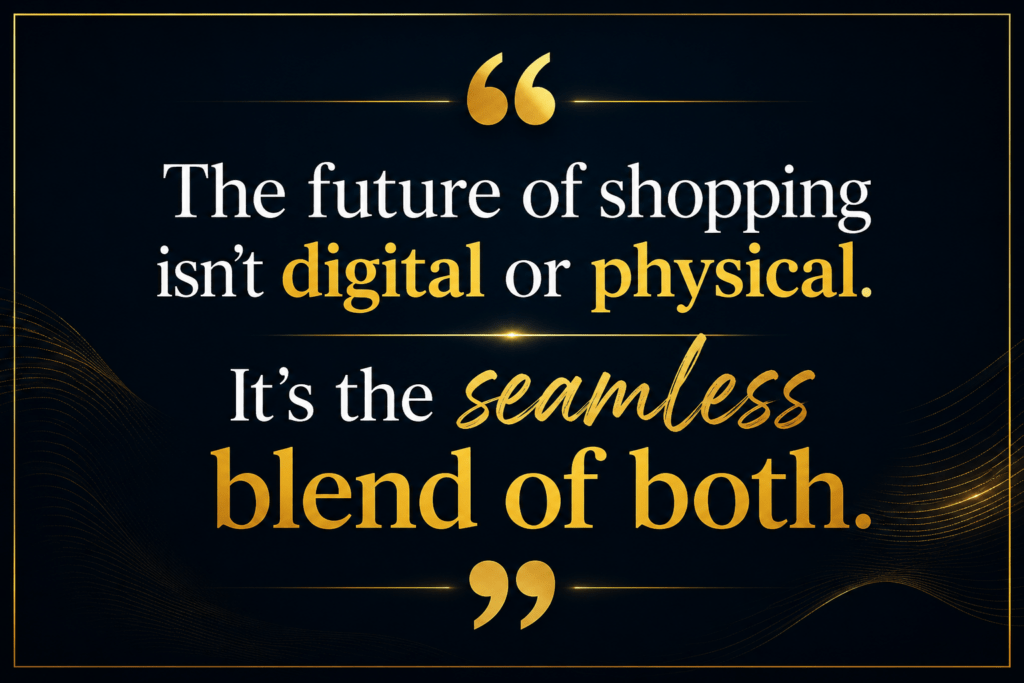
“The most successful retailers of the future will not choose between digital and physical—they will master both.”
What This Means for Businesses
For retailers, the future is not about abandoning stores or focusing exclusively on e-commerce.
It is about integration.
Businesses that succeed will likely:
- Combine digital and physical experiences
- Use technology to enhance customer journeys
- Create memorable in-store experiences
- Build communities around their brands
- Focus on convenience without sacrificing human connection
Consumers today expect flexibility.
They want to shop when, where, and how they choose.
Businesses that deliver this freedom will have a significant advantage.
The Future Retail Store


Final Thoughts
Physical stores are not disappearing.
They are evolving.
The future of shopping is unlikely to be a battle between online and offline retail.
Instead, it will be a powerful combination of both.
Digital platforms will continue to dominate convenience.
Physical stores will continue to deliver experiences, trust, and human connection.
The retailers that thrive in the coming decade will be those that recognize a simple truth:
Consumers no longer distinguish between online shopping and in-store shopping.
They simply expect great shopping.
And the businesses that deliver it—regardless of channel—will shape the future of retail.