
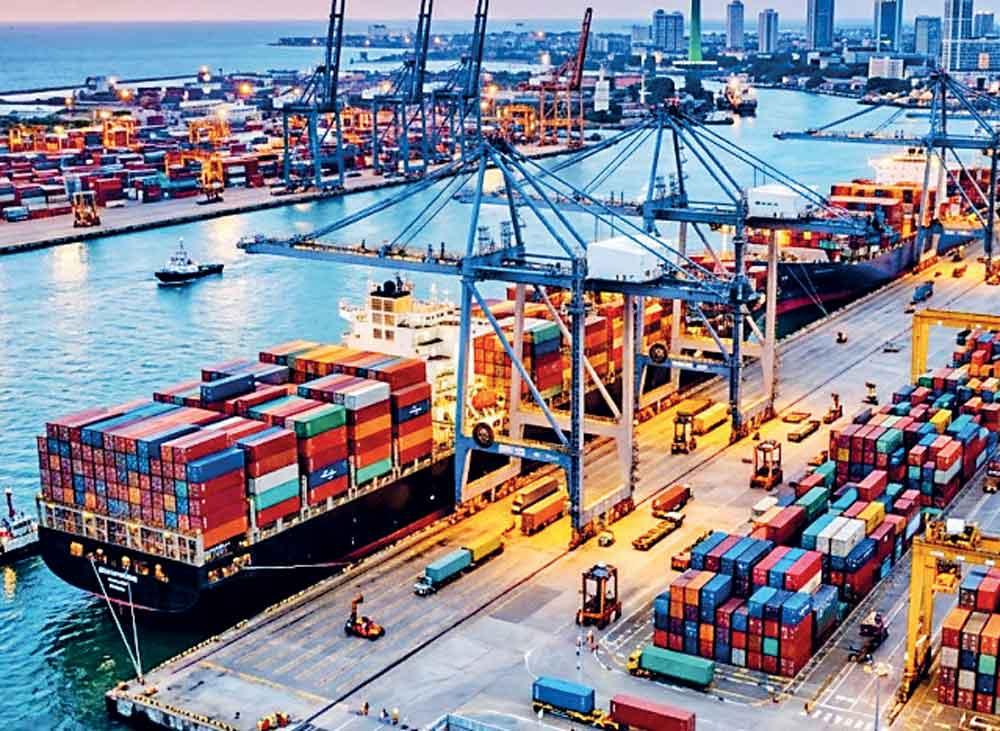
Transshipment volumes at the Port of Colombo rose 10.0 percent year-on-year to 636,623 TEUs in October, lifting their share of total container throughput to 80.4 percent from 77.7 percent a year earlier, while overall container handling grew at a slower 6.3 percent to 791,811 TEUs, as per Sri Lanka Ports Authority (SLPA) data.
Transshipment added 57,693 TEUs during the month, well above the port’s net gain of 47,019 TEUs, as domestic cargo continued to move in the opposite direction. Laden imports fell 15.5 percent to 51,898 TEUs from 61,428 TEUs, extending the decline recorded in August, although laden exports rose 5.7 percent to 28,128 TEUs. As a result, ten-month growth in laden imports has narrowed to 1.0 percent at 531,433 TEUs, down from 4.9 percent at the end of August, which suggests the slowdown in import demand has carried into the final quarter.
October’s throughput also marked an 8.2 percent month-on-month recovery from September, when the port handled an estimated 731,959 TEUs, 1.4 percent fewer than in the same month last year, based on calculations from SLPA’s cumulative data. Transshipment grew a modest 2.0 percent to 596,755 TEUs in September, a month in which congestion at the port peaked and adverse weather disrupted operations.
However, the gains were once again concentrated in a single terminal. Colombo West International Terminal (CWIT) handled 175,180 TEUs, a 46.6 percent increase, and its gain of 55,663 TEUs exceeded the port’s entire net increase, lifting its share to 22.1 percent from 16.0 percent. Colombo International Container Terminals (CICT) remained the largest operator with 280,772 TEUs, a marginal rise of 1.4 percent, although its share slipped to 35.5 percent from 37.2 percent. South Asia Gateway Terminals (SAGT) reversed its August decline with a 6.9 percent increase to 150,189 TEUs, whereas the SLPA-operated Jaya, Unity and East Container Terminals together handled 185,670 TEUs, a decline of 10.6 percent.
For the first ten months, the port handled 7,518,617 TEUs, 8.6 percent more when compared to the same period last year, with transshipment of 6,061,346 TEUs accounting for 544,568 TEUs, or 91.2 percent, of the 596,871 TEU increase. Over the same period, the three terminals other than CWIT collectively handled 415,140 fewer TEUs, with SAGT recording the steepest fall of 15.3 percent. Colombo now needs only 772,561 TEUs to surpass its 2025 record of 8,291,178 TEUs, fewer than it handled in October alone, placing the milestone within reach in November. Should the ten-month average of around 751,862 TEUs a month hold, the port would close the year at just over nine million TEUs, 8.8 percent higher than in 2025 and in line with the projection by SLPA Chairman Dr. Parakrama Dissanayake in September.
Total ship arrivals fell 6.3 percent to 345 in October, with container vessel calls declining 7.9 percent to 291. Nevertheless, the volume handled per container call rose 15.4 percent to around 2,721 TEUs, indicating larger exchanges per vessel rather than more ships. At CICT, calls dropped 18.8 percent to 91 even as volumes edged up, lifting its average exchange by 24.7 percent to around 3,085 TEUs. Total cargo handled rose 3.3 percent to 9.94 million tonnes in October and 1.0 percent to 98.89 million tonnes for the ten months.
Meanwhile, the October figures are the first since CWIT’s second phase was inaugurated on September 30, doubling the terminal’s annual capacity to 3.2 million TEUs. CWIT’s October volume was only 1.9 percent higher than the 171,875 TEUs it handled in August, and annualised, it equates to around 2.1 million TEUs, or roughly two-thirds of the expanded capacity. Dr. Dissanayake had also cautioned in September that utilisation at the port was nearing levels at which operational strain becomes increasingly evident, with the SLPA targeting an additional 1.5 million TEUs of capacity by end-2027.