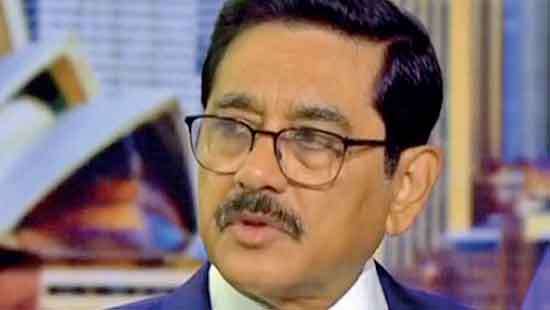
Central Bank Governor Dr. Nandalal Weerasinghe yesterday urged the foreign investors to take a fresh look at Sri Lanka, arguing that the economy has moved beyond its crisis-era instability.
He asserted the island nation is entering a phase where a steadier growth, a more stable currency and greater policy discipline are strengthening the investment case.
“For anyone to benefit from the future steady growth that we are seeing over the last years and next couple of years, this is the time,” Dr. Weerasinghe told Bloomberg Television’s The Asia Trade, as Sri Lanka takes its investment pitch to Australia.
The Central Bank, Securities and Exchange Commission, Colombo Stock Exchange (CSE) and stockbroking industry are conducting the ‘Invest Sri Lanka’ forums in Sydney and Melbourne this week, returning to Australia with the investor roadshow for the first time in nearly nine years.
Dr. Weerasinghe said Sri Lanka’s ability to maintain its economic recovery, despite a succession of domestic and external shocks, showed that some of the vulnerabilities exposed during the economic crisis had been reduced.
“Clearly after the crisis (the economy is) recovering nicely. Around 5 percent is very good growth,” he said.
The economy has maintained a growth around the 5 percent mark during its post-crisis recovery, although the Central Bank expects some moderation during the second half of this year, as the tighter monetary conditions and higher prices weigh on the activity.
Dr. Weerasinghe said the growth could ease to between 4 percent and 5 percent in the second half, before returning towards the economy’s potential growth rate of around 5 percent from next year.
He highlighted the relative stability of the rupee, more prudent monetary and fiscal policies and the prospect of greater private-sector participation as the factors strengthening Sri Lanka’s proposition to the investors.
The rupee came under pressure in April and May, as the higher oil import costs increased the demand for foreign exchange but Dr. Weerasinghe said the currency had since stabilised and was gradually appreciating.
The improvement followed the Central Bank’s 100-basis-point monetary tightening in May and the measures aimed at containing the import and credit-related pressures. The May increase took the policy rate to 8.75 percent, with the Central Bank moving pre-emptively as inflation accelerated and the private-sector credit expanded rapidly.
Dr. Weerasinghe said the effects of those measures were becoming visible, with the credit growth beginning to slow and pressure on the currency easing.
That stability is being tested by another external energy shock, as Sri Lanka remains heavily exposed to the movements in the global oil prices as a net energy importer, with the imported fuel required for both thermal power generation and transportation.
Colombo inflation accelerated to 7.3 percent in July, from 6.8 percent in June, moving further above the Central Bank’s 5 percent target, following the increases in the domestic energy prices.
The Central Bank nevertheless believes the shock can be managed, if the global oil prices remain around US $ 80 a barrel. Dr. Weerasinghe said that the level forms part of its baseline assumptions for the remainder of this year and into next year, with inflation expected to move back towards the 5 percent target thereafter.
“If the oil prices remain around US $ 80 a barrel … then we can manage the situation,” he said and cautioned that an upside surprise would present a fresh challenge.
Dr. Weerasinghe went on to describe the May monetary tightening as “proactive and sharp”, saying it was intended to anchor the inflation expectations, curb rapid credit growth and prevent the initial energy shock from developing into more persistent price pressures.
The ability to absorb those shocks, without a return to the severe foreign exchange and balance-of-payments pressures experienced during the economic crisis, is one of the key messages of the investment case Dr. Weerasinghe is presenting in Australia.
Sri Lanka has also further advanced in its International Monetary Fund (IMF)-backed reform programme. The IMF Executive Board in May completed the combined fifth and sixth reviews of the country’s Extended Fund Facility, unlocking about US $ 695 million and taking the total disbursements under the programme to about US $ 2.0 billion.
Another review is expected around November or December and expects Sri Lanka to complete the four-year programme during the second half of 2027.
For the investors, however, the macroeconomic stabilisation is only one part of the equation.
Sri Lanka is seeking to translate the recovery into stronger private investment after years in which foreign direct investment (FDI) remained relatively modest compared with the country’s potential.
There have been signs of improvement. The FDI inflows reached US $ 1.06 billion in 2025, up 72 percent from the previous year, according to the Board of Investment (BOI) data. Manufacturing accounted for 46 percent of the inflows, followed by port development at 26 percent and tourism at 11 percent.
The BOI approved 146 projects, valued at US $ 1.91 billion during 2025, including an expected US $ 896 million in foreign capital, while the government has set its sights on attracting US $ 1.5 billion in FDI in 2026.
The capital market is also being used as part of the investment pitch. Australia was among the top 10 sources of foreign investment into Sri Lanka’s stock market by end-2025, while the country’s growing diaspora there has emerged as an increasingly important potential investor base.
The CSE said the Sri Lankan equities were trading at a market price-to-earnings multiple of around 11.2 times, ahead of the Australian roadshow, which it said placed the market among the more competitively valued in Asia.