1. Preamble
Honourable Speaker,
Our government presents its third Budget with the honest and genuine determination of making the story, cherished over many generations, of building a thriving nation to a reality. Every Budget we have presented bears witness to our collective resilience, and has established a firm conviction that, as a nation, we are emerging from the deepest crisis and are on a correct and well-planned trajectory.
We have been able to kindle an unfading dawn of hope in the hearts of hundreds of thousands of our people. I wish to recall that we are unconditionally fulfilling the expectations of the noble trust that the entire people of this country placed in us two years ago.
Eradicating poverty, building a just society, uprooting bribery and corruption, accelerating economic development, restoring the trust of the people and providing every citizen with the opportunity to build a decent life are among our key objectives. However, the foundation for all of these must be the creation, through education, of citizens who are equipped with knowledge, endowed with virtue, think critically and act creatively, as well as visionary leaders. What we need is to build an educated Sri Lankan generation that is rich in knowledge and intellect, contributes to the world through new ideas and new inventions, and is capable of facing any challenge at the international level. Our aim is to create a situation where, wherever in the world a Sri Lankan is recognized, he or she is accepted as a person endowed with knowledge, intellect, creativity and good virtues.
It is to make the Sri Lankan identity a symbol of intelligence, virtue and excellence. Creating a true renaissance through all of these is the core objective of our Budget. This is because ushering in a renaissance era is not merely a change in economic indicators or statistics. It is a broad social transformation that brings about a change in people’s thinking, knowledge, attitudes and behaviour, and breathes new life into the cultural, intellectual and artistic life of the country.
We must all come together and, through a collective people’s intervention, take this country forward towards the development that we, as Sri Lanka in the 21st century, should have already achieved.
On this journey, the first thing we had to do was to bring about a fundamental transformation in the political culture. For the first time in history since independence, the people of this country gave us the mandate to establish a genuine people’s governance in place of a government administration that had been in the hands of a few corrupt elite families.
What we need is not merely a Government that collects revenue, but a Government that delivers value to the people for every tax rupee it collects. What we need is not a large Government machinery, but an efficient and transparent Government machinery that is accountable to the people.
Our policy is to recognize, at every level of governance, that the true owners of public money are the citizens of this country.
Honourable Speaker,
Today, we have the confidence, experience, economic foundation and stability required to take our country’s economy into a transformative era. The Budget we present for the year 2027 is the next step built on those foundations. Our expectation is to make it a Budget that strengthens the production economy, protects small and medium scale industrialists, makes room for investment, connects knowledge and technology to the economy through digital economic activities, protects the environment and ensures social justice.
Every Budget proposal we present is part of a continuous programme moving towards an interconnected common goal. Moreover, this Budget has not been prepared based solely on the views of one individual or one party. It is a programme prepared collectively, incorporating the views, proposals and experiences of various stakeholders. Due attention has been paid to every proposal submitted to us. This Budget has been prepared based on our policy priorities, available resources, fiscal space and implementation capacity.
Honourable Speaker,
It is no exaggeration to say that this economic stability of our country was built during a most difficult period. The war raging in the Middle East is becoming more prolonged than ever before, creating great uncertainty in the world. The closure of the Strait of Hormuz has affected nearly 20 percent of global petroleum shipments. Accordingly, the increase in fuel prices, premiums and shipping and insurance charges had a very adverse impact on our energy market. We have still not been able to free ourselves from the pressure this created on our economy and on people’s lives. As a result, more than Rs. 147 billion was spent to minimize the impact on the people and on economic stability.
Further, according to the Post-Disaster Needs Assessment (PDNA) report, the damage caused by Cyclone Ditwah to housing, industries, railway systems, agriculture, education and the health system has been estimated at USD 2 billion, which, together with economic losses of USD 1.4 billion, amounts to a total of about USD 3.4 billion (Rs.1.022 trillion).
We have been able to build economic stability while facing all these adverse circumstances.
Honourable Speaker,
As forecast by the World Meteorological Organization, it has been confirmed that there is a 100 percent probability that the El Niño weather condition that has now developed will reach its peak in February 2027. This El Niño weather condition poses a risk of adverse impacts on agriculture, food prices, water resources and hydropower. We consider it one of our foremost responsibilities to identify such risks that may arise both globally and domestically in advance, and to further stabilize the economy so that it is capable of facing them.
Our target is not only to manage today’s economic challenges, but also to transform the country into one where future generations will never again have to face an economic crisis such as the one that prevailed before. The essence of our policy statement, “A Thriving Nation – A Beautiful Life”, is not merely to improve the performance of economic indicators, but to create a society in which people can live with dignity and pride, and a country that has confidence in its future.
The main objective of this Budget is to move from economic stability towards transformation. It is to achieve a progressive transformation in every sphere, including investment, exports, productive employment, social welfare and sustainability.
Honourable Speaker,
During the past two years, our government has succeeded in achieving remarkable macroeconomic stability. Accordingly;
 Sustaining the economic growth of 5 percent achieved in 2025, an economic growth of 5.1 percent was achieved in the first quarter of 2026, even amidst the impact of Cyclone Ditwah. In the second quarter, a growth of 4.2 percent was achieved, despite the war situation in the Middle East region.
The negative primary balance, which had recorded over a long period, reported the highest positive balance of 5.4 percent in 2025 in its history. Against the positive primary balance target of Rs. 360 billion for end-2026, a positive primary balance of Rs. 1,844 billion was recorded by end-September.
In 2025, the budget deficit recorded its lowest value in 68 years at 2.3 percent.
Government revenue, which was at a historic low of 8.2 percent of GDP in 2022, reached 16.6 percent in 2025, the highest value recorded in 23 years, amounting to about 110 percent of the expected revenue.
In 2025, we were able to record the highest-ever current account surplus in history of USD 1,719 million.
In 2025, workers’ remittances recorded the highest value in history at USD 8.1 billion. Further, by October this year, it amounted to USD 7.6 billion. Accordingly, remittances exceeding USD 9 billion are expected this year.
Central Government debt, which was 114 percent of GDP at the end of 2022, was reduced to 95 percent by the end of 2025 as per the records of Public Debt Management Office (PDMO).
In 2022, 79.1 percent of Government revenue was spent on interest payments, which declined further to 45.9 percent by 2025 and to 39.6 percent by September 2026.
The total net loss before tax of Rs. 774.6 billion recorded by 52 key State-Owned Enterprises in 2022 was turned into a profit of Rs. 444.4 billion in 2025. This reduced the pressure on the Treasury. We turned loss-making institutions into profit-making institutions. By the end of August 2026, a profit before tax of Rs.367 billion was recorded. The accumulated loss of SriLankan Airlines from the date it was taken back in 2008 up to 2025 amounts to Rs. 528 billion. Accordingly, SriLankan Airlines has become a burden on the General Treasury. The Cabinet of Ministers has already appointed an expert committee to find the necessary solutions in this regard.
Even though total fuel import expenditure increased to USD 4,487 million by September 2026 compared to USD 4,042 million in 2025 due to the increase in world market fuel prices, and amidst the opening of the vehicle import market, foreign reserves were recorded at over USD 7 billion by October 2026.
Nevertheless, annual inflation, which was recorded at 2.1 percent in December 2025, increased to 8.3 percent by October 2026 due to the rise in fuel prices in the face of the Middle East conflict and other related factors.
Credit extended by commercial banks to the private sector increased by 25.2 percent, from Rs. 8,156 billion in 2024 to Rs. 10,212 billion in 2025.
Honourable Speaker,
During the past two years, Sri Lanka has been able to achieve significant progress in global rankings, including economic and social rankings.
According to the 2026 Fitch Ratings, Sri Lanka has been upgraded from ‘CCC+’ to ‘B-’.
According to the Corruption Perceptions Index (2025/2026) issued by Transparency International, Sri Lanka has advanced 14 places in the global rankings to 107th place.
According to the Global Peace Index (2026), Sri Lanka advanced 14 places to be ranked 67th globally.
According to GlobeTrotter & Flash Pack, in 2025, Sri Lanka was ranked first in the world index under the solo travellers category.
The World Economic Forum has named Sri Lanka 10th in the world among the countries that have shown the fastest progress among tourism economies.
The international magazine Condé Nast has named Sri Lanka the best destination in the world for the whole family to travel together.
According to the assessment carried out by the Institute of International Finance (IIF), among 57 emerging market and developingeconomies, Sri Lanka secured fourth place for progress in improving investor relations and fifth place for progress in improving transparency on public debt.
The World Bank had classified Sri Lanka as a lower middle-income country in 2020, down from the status of an upper middle-income country. Reflecting the recovery of the economy, the classification was upgraded again in 2026 to an upper middle-income country.
Honourable Speaker,
The above facts are not the only criteria that measure the success of our fiscal policy. The Government’s support for and care of distressed children, the elderly, persons with disabilities, those suffering from chronic illnesses, low-income households and families who have lost their livelihoods due to disasters are equally important.
Through the 2025 Budget, we laid the foundation for economic stability and social justice. Through the 2026 Budget, greater attention was paid to production, investment, digitalization and institutional reforms. What we propose through the 2027 Budget is to implement the reforms and proposals for a new economic transformation required, based on the economic stability we have achieved so far, to increase production, to involve the people as stakeholders engaged in the economy, to ensure that the gains achieved in the economy are distributed fairly among the people, and to achieve the sovereignty of the national economy.
Economic transformation does not mean presenting yet another list of expenditures. It means that every investment made by the Government, every tax concession granted, every borrowing undertaken and every social protection programme proposed will be assessed on the basis of the economic and social benefits generated through them.
It is not our objective to make all the sacrifices that the people bore during the economic crisis, and continue to bear even at this moment, into permanent sacrifices. It is our duty to build economic stability, better jobs, fair incomes, a quality public service, a safe social environment and a sustainable future for future generations.
2. Seven Strategic Objectives of the 2027 Budget
Honourable Speaker,
When the Budget for 2026 was presented to this House, we emphasized the need to build an economy that can move forward unshaken in the face of internal and external challenges. At the end of 2025, Cyclone Ditwah severely affected the lives of our people, production activities and infrastructure. Due to the Middle East conflict that escalated in the first half of 2026, new pressure exerted on energy prices, import costs and supply chains.
In facing a disaster such as Cyclone Ditwah, what was important for a Government was that we had built fiscal space in advance. Through this, we were able to strengthen the financial capacity required to provide relief to the people affected by the disaster, to maintain essential services and to deploy resources for reconstruction activities according to priorities.
The fundamental structural macroeconomic problem that Sri Lanka has faced for a long time has been the deficits in the budget, the balance of payments and the current account. Although we were able to reduce the budget deficit significantly through correct revenue and expenditure policies, the external sector has not yet been strengthened as required. While a current account surplus of USD 1,853 million was recorded in the first nine months of 2025, a deficit of USD 420 million was recorded in the corresponding period of 2026. The progress achieved in the fiscal sector must be made the foundation for a structural transformation that strengthens the external sector.
This need becomes even clearer when we look at the current state of the world economy. According to the World Economic Outlook issued by the International Monetary Fund in October 2026, global economic growth is expected to slow down to 3.1 percent in 2026. Risks such as the escalation of conflicts, rising energy and food prices and uncertainty in international trade still persist.
We need a long-term plan capable of withstanding these conditions.
2.1 Safeguarding Macroeconomic Stability and Strengthening the Resilience of the Economy
While safeguarding macroeconomic and fiscal stability, our main objective is to ensure debt sustainability and to prepare Sri Lanka to face future internal and external shocks. For this, sustainable Government revenue, prudent expenditure management, planned debt repayments, adequate fiscal space and strong foreign reserves are essential. It is also important to maintain adequate coordination between fiscal and monetary policies, while respecting the legal mandate of the Central Bank of Sri Lanka in maintaining price stability.
Central Government debt stood at 114 percent in 2022, the year in which the economy was plunged into crisis. What is taken into consideration in debt sustainability is the capacity to repay debt relative to GDP and Government revenue, and whether there is adequate liquidity to settle the debt servicing obligations falling due in the near term.
The target of the IMF-Extended Fund Facility programme is to bring public debt down to a level of 95 percent by 2032. Based on the progress in public financial management, the IMF 6th Review has forecast that this will decline to 87 percent. Annual borrowing plans and strategies are being implemented under the leadership of the Public Debt Management Office to maintain debt sustainability. In 2025, the Central Government debt ratio had reached 95 percent. Total foreign debt service amounted to USD 3,707 million in 2025 and USD 3,591 million in 2026. Going forward, it will be USD 2,986 million and USD 3,574 million in 2027 and 2028, respectively. We have the stability required for this debt servicing.
2.2 Accelerating Economic Growth Driven by Investment, Production and Exports
Our target is to accelerate the structural transformation towards a high productivity, export-competitive production economy. Expanding domestic and foreign private investment, diversifying export products and markets, integrating with international value chains and promoting industries and services with higher value addition are the main areas of this.
We are taking steps to broaden access to finance for small and medium-scale enterprises and to establish a clear and transparent investment environment for investors.
2.3 Enhancing Productivity through Technology, Innovation and Human Capital
We give priority to enhancing national productivity by strengthening education, competency development, research, innovation and digital transformation, modernizing public services, expanding digital infrastructure, encouraging the use of new technologies and strengthening collaboration among educational institutions, research institutions and industries.
In particular, it is essential to equip our younger generation with the competencies required for the changing domestic and global job market, and to transform knowledge and innovation into income-generating enterprises and services. Creating a technologically capable workforce and a more productive economy will also enhance export competitiveness and the capacity to earn foreign exchange.
2.4 Empowering the Rural Economy and Ensuring Inclusive Growth
The agri-food sector has very high potential for export and rural income growth. Instead of excessive reliance on broad-based and untargeted subsidies that do not contribute to raising productivity, high priority should be given to directing unproductive lands to productive cultivation, agricultural research, climate-smart technology, water management, storage and cold storage facilities, product quality certification and digital systems. It is also essential to resolve, after proper study, the existing barriers to land use, rural access to finance and connecting producers to markets. Then, it will be possible to make the empowerment of the livelihoods of rural people, food security and foreign exchange earnings the outcomes of a single development process.
A new economic transformation at the rural level can be brought about by encouraging small and medium-scale entrepreneurs, creating new economic opportunities for rural people, and developing the technical, vocational and linguistic skills required for the modern job market.
2.5 Stability and Continuity of the Energy Markets
Rising international fuel prices, supply chain disruptions and climatic changes form the basis of instability in the energy sector in our country. Our objective is to change these underlying conditions that we face with regard to energy. For this, it is also necessary to expand renewable energy, and to improve electricity transmission networks, energy storage and energy efficiency. Our target is to minimize the long-term pressure on foreign exchange spent on imported fuel, while safeguarding the continuity of essential energy supply through the use of diverse supply routes and energy sources.
2.6 Strengthening Resilience to Climate Disasters
It is important to follow standards capable of withstanding future disasters, early warnings and proper maintenance plans. Along with this, food supply chains, storage, public transport and the mechanisms for distributing essential goods must be strengthened. The continuity of services such as essential communication facilities and electricity must be ensured. Although the risks arising from natural disasters that may occur in the future cannot be completely eliminated, our objective is to significantly minimize the resulting paralysis of economic activities and the pressure on people’s lives.
2.7 Modernizing the Government Machinery
It is essential to build an efficient Government machinery that provides a quality service to the people, facilitates investment and production activities, and is accountable to the law and transparent. Modernizing public financial management, State-Owned Enterprise and asset management, tax administration and the procurement process are essential elements of this. Minimizing corruption and unnecessary administrative delays, while strengthening the rule of law and accountability, is equally important to enhance public trust and to safeguard public resources.
3. Medium-Term Macroeconomic and Fiscal Path
Honourable Speaker,
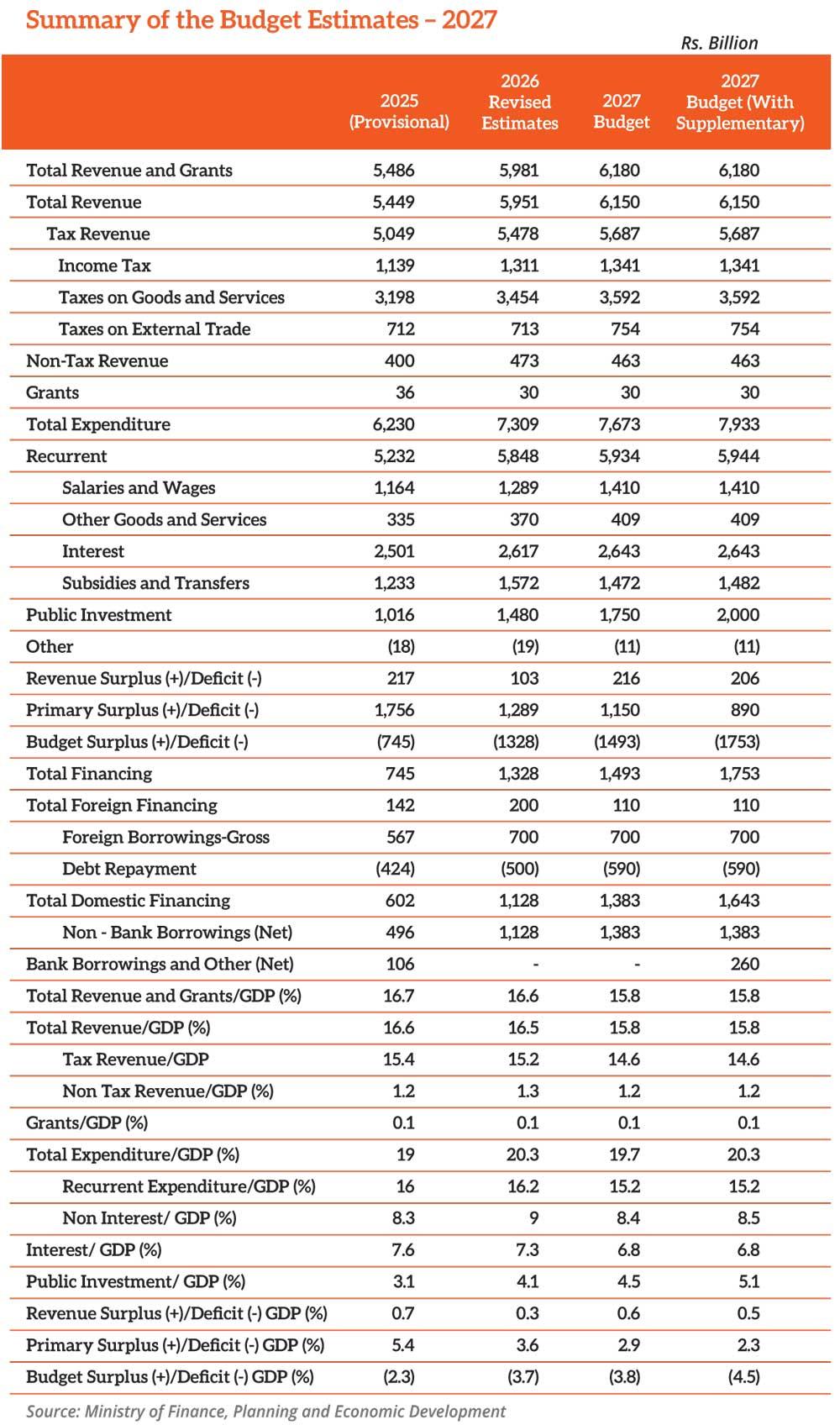
Our medium-term economic target is to move towards a sustainable economic growth of 7 percent or higher. A strong and credible fiscal foundation is essential for the economic transformation we envisage. Accordingly, we expect to continue fiscal consolidation in line with the responsibility framework established by the “Medium-Term Fiscal Framework 2027–2031” and the “Public Financial Management Act”. Maintaining a primary surplus of 2.3 percent of GDP, maintaining the budget deficit at a level below 5 percent, and placing public debt on a sustainable path are our core fiscal targets.
Our objective is to maintain Government revenue at a level not less than 16 percent of GDP in the medium term, and to gradually increase it to about 20 percent in the long term. To achieve these targets, the necessary reforms will be implemented to broaden the tax base, rationalize tax exemptions and incentives, digitalize tax administration and strengthen tax compliance.
In accordance with the Public Financial Management Act, we will take steps to maintain medium-term expenditure in line with the primary expenditure ceiling. However, due to the additional allocations required to restore the infrastructure and people’s livelihood damaged by Cyclone Ditwah, primary expenditure in 2027 is expected to increase temporarily to 13.6 percent of GDP. While managing these special expenditure requirements within the statutory fiscal framework, we also expect to bring primary expenditure back to 13 percent of GDP from 2028 onwards.
Honourable Speaker,
We expect to maintain public investment at a level exceeding 4 percent of GDP from 2027 onwards. In 2027, capital expenditure of Rs. 2,000 billion has been allocated, amounting to total public investment of 5.12 percent of GDP, comprising 4.48 percent through the Budget and 0.64 percent through the Supplementary Estimate for Ditwah.
The Extended Fund Facility programme entered into with the International Monetary Fund (IMF) is scheduled to conclude in March next year. We expect to successfully complete the 17th IMF programme. While the programme to stabilize the economy domestically is proceeding successfully, it is difficult to forecast the impacts arising from global and natural disasters at a time when we are preparing for an economic transformation for growth. We believe that our reserves must be further strengthened to successfully face such situations.
Therefore, the Cabinet of Ministers has appointed a committee headed by the Deputy Minister of Finance and Planning to examine and submit a report on the suitability of entering into another programme after the successful completion of the current IMF programme, and on what type of programme it should be.
For social justice and the protection of the people, targeted social protection programmes will be further strengthened to protect low-income and vulnerable households who face the highest risk in the face of economic and natural disasters.
Honourable Speaker,
Our people made exceptional sacrifices and endured great hardships for this economic stabilization. We must all pay our respect to them. Doing justice to these sacrifices means achieving a rapid turn from economic stabilization towards transformation. To that end, I present to this Honourable House the Budget proposals for the year 2027.
Building the Essential Foundations for Economic Transformation
4. Strengthening the Legal Framework
A new and strong legal framework and institutional structure are required to achieve the economic transformation we envisage and to enhance efficiency. Some of our laws are more than 100 years old. The historical role of some of our institutions has come to an end. Those laws and institutions have become shackles that bind our feet from reaching the economic transformation we envisage. Therefore, in order to achieve the new economic transformation, it is necessary toreformulate old and outdated laws and institutions so that they can face present day challenges, and to build new laws and institutions that correspond to the new circumstances that have arisen. Hence, we cannot move forward without removing these shackles. Accordingly;
The “Rescue, Rehabilitation and Insolvency (Corporate and Personal) Act, No. 12 of 2026” has been passed to provide an opportunity for businesses that collapsed due to various crises such as pandemics, natural disasters and terrorist acts to rebuild, contribute to the economy and repay their creditors.
The laws required to strengthen the prevention of money laundering have been passed through the “Prevention of Money Laundering (Amendment) Act, No. 16 of 2026”.
The “Financial Transactions Reporting (Amendment) Act, No. 17 of 2026” has made provisions to minimize the risk arising from transactions not being reported to the financial system and to enforce the law against non-compliers.
Through the “Convention on the Suppression of Terrorist Financing (Amendment) Act, No. 18 of 2026”, the financing of global terrorism using Sri Lanka, which poses a threat to national security, has been prevented by strengthening the financial system.
Many people who have obtained microfinance loans are still stranded in a severe debt trap. For their protection, the “Microfinance and Credit Regulatory Authority Act, No. 9 of 2026” has already been passed. Accordingly, the ‘Microfinance and Credit Regulatory Authority’ will be established in 2027 and steps will be taken to provide protection to business customers.
The “Public-Private Partnership (PPP) Act” has already been published in the Gazette for the initiation, development, management and monitoring of public-private partnership projects. It is expected to be presented to Parliament in early 2027.
The draft “State Owned Business Enterprises Management Bill” has already been referred to the Attorney General to incorporate a holding company for the efficient management of companies in which the State holds shares. 34 State-owned enterprises have already been identified for this purpose.
The draft “Investment Protection Bill” has already been referred to the Attorney General to promote and protect investments and assets belonging to investors, to ensure fair and equitable treatment, and to make provisions relating to the payment of compensation and the settlement of disputes.
The draft “Colombo Port City Economic Commission (Amendment) Bill” has been referred to the Attorney General to attract foreign investment to the Colombo Port City and to provide greater facilities for investors and those employed there.
The “Institute of Professional Actuaries of Sri Lanka Act” required to establish a new institute aimed at ensuring the quality of professional actuaries and improving professional training is being drafted.
Data and information are most important in policy decision-making in this era. The “National Statistics Act” is being drafted for the preparation, coordination and governance of official statistics in Sri Lanka.
The “Customs Ordinance (Amendment) Act” is expected to be passed in the first half of 2027 with the aim of making the Sri Lanka Customs more efficient and transparent and facilitating businesses. From October this year, Sri Lanka Customs has implemented a paperless programme and has digitalized the ‘Customs Long Room’, one of its divisions that had been in use for about a century.
The “Financial Reporting Regulatory (Amendment) Act” will be amended to formalize the Sri Lanka Accounting Standards, Sri Lanka Auditing Standards and the regulatory standards on quality control.
The “Excise (Special Provisions) Act” will be amended to provide solutions to long-standing issues that have arisen in its implementation.
The “Finance Business Act” will be amended to strengthen the regulation and supervision of finance companies, the investigation and prosecution of unauthorized finance businesses, and the requirements for winding up nonviable finance businesses.
The “Public Asset Management Act” will be introduced to meet the requirements of public asset management.
The Cabinet of Ministers has appointed an expert committee to reform labour laws that have been in place for decades, so as to align them with current social and economic needs. This initiative aims to create a conducive working environment required for investment and production processes, to be carriedout in an effective and efficient manner and to promote employer-employee relations in which professional responsibility and accountability are clearly defined. This committee is in the process of formulating recommendations, taking into account the views and proposals of relevant stakeholders, including the National Labour Advisory Council.
Essential Structural Changes to be Made
An officials’ committee has been appointed by the Cabinet of Ministers to look into minimizing delays in providing Government lands to investors, and to submit recommendations on the concessions to be granted according to the national importance of the project, the number of jobs generated and the area in which the investment is made.
It is expected to establish a company, 100 percent owned by the Treasury, comprising professionals with private sector and international experience, for the promotion of investment. It is expected to provide this company too with market-competitive salaries and allowances, as was considered in the establishment of the GovTech institution.
The Gambling Regulatory Authority has already been established to regulate casinos, online gambling and other games that fall into the category of gambling. The necessary regulations have already been finalized with expert assistance.
The National Single Window for Trade, which has been launched as a pilot project from the fifth of this month for the export of several selected goods, is expected to connect exporters as the first phase in the first half of 2027, and importers and re-exports in the second half of 2027. Rs. 1,990 million has been allocated for this purpose.
Bids have been called to obtain a consultancy firm for the creation of the National Single Window for Investment, and these bids are currently being evaluated. Rs. 100 million has been allocated for its establishment.
It is proposed to allocate Rs. 1,000 million for the procurement of body scanners and container scanners, aimed at expanding the scanning system to strengthen the border protection process of Sri Lanka Customs.
It is proposed to modernize the existing “Temporary Importation for Export Processing” (TIEP) process, under which goods imported for export are cleared with tax concessions, in order to introduce “inter-port trading” mechanisms and to direct small and medium-scale industrialists towards exports.
5. Free Trade Agreements
We expect to update the existing Free Trade Agreements and enter into new trade agreements with more countries in order to connect Sri Lanka to the global trade network.
An officials’ committee has already been appointed by the Cabinet of Ministers to expand the existing Free Trade Agreement with India.
Attention has been paid to a new Free Trade Agreement with China.
An application has been made to accede to the Regional Comprehensive Economic Partnership (RCEP).
It is expected to enter into Comprehensive Economic Partnership Agreements with the United Arab Emirates and Oman.
The “Sri Lanka–European Union Sustainable Trade and Economic Integration Project” will be implemented under a European Union grant of Rs. 3,430 million during the period 2027-2030, to promote export competitiveness, export diversification and sustainable production.
Further, we will work to enter into new Free Trade Agreements with other countries following a feasibility study.
6. Energy
A transformative change in the energy sector is required for the future economic transformation, national security and the improvement of the living standards of the people. The plans required for a new transformation in the energy sector, aimed at ensuring a stable and uninterrupted energy supply and reducing production costs, have been included in this Budget.
6.1 Electricity
Today, around 62 percent of our installed capacity comes from renewable energy. Plans have been prepared to increase this to 69 percent by 2029.
As energy sources that vary with weather and seasonal conditions, such as solar and wind power, are increasingly added, we must pay greater attention to the stability control of the system. The national power system failures that occurred in February 2025 and October 2026 were an important lesson for us to reflect on our system protection, frequency control, power flow management and network protection mechanisms. We expect to make an investment of Rs. 26.5 billion to technically strengthen our grid system so that such incidents do not recur.
The installation of two synchronous condensers of 75 MVA (megavoltamperes) each at the new Habarana and Mannar locations, which will help maintain grid stability when renewable energy is added to the national system at a high percentage, and the installation of STATCOM facilities with a capacity of 300 MVAr at the Padukka 220 kV grid substation, are expected to commence in 2027 and be completed in 2029 with the financial assistance of the World Bank.
A Wide Area Monitoring System will be established under the “World Bank Technical Assistance Project” to identify unstable conditions in the system in advance and to make prompt and effective decisions in emergencies.
We have already introduced Battery Energy Storage Systems (BESS) to store the surplus electricity we receive during the daytime. In 2026, 160 MW is received by the system through BESS. Plans have been made for this quantity to be 560 MW in 2027 and for the total quantity to be 1,245 MW by 2029.
The price selected in the first phase (160 MW) of calling bids for the BESS system in 2026 was Rs. 2.033 million per megawatt per month. In the second phase in 2026, when bids were called for 250 megawatts, the bid received had decreased to Rs. 1.808 million per megawatt per month. Accordingly, through competitive bidding, it has been possible to reduce the price by around 11 percent within this year itself.
With the aim of promoting renewable energy generation, enhancing energy security, and ensuring stability by minimizing imbalances in the national power system, it is proposed to provide a subsidy for the purchase of the batteries required for energy storage to domestic consumers who install rooftop solar power systems equipped with battery storage facilities under the Net Plus scheme.
Domestic consumers who newly install rooftop solar power systems will be provided a subsidy of Rs. 25,000 per kilowatt of battery storage capacity. It is proposed to provide this subsidy for up to 10 kilowatts, subject to a maximum of Rs. 250,000. It is proposed to provide Rs. 3,500 million for this purpose. It is also proposed to remove the Ports and Airports Development Levy (PAL) charged on the importation of batteries used for the storage of solar energy.
Although the need for supplementary power supply in the event of an emergency at the Norochcholai Lakvijaya Power Plant has been discussed for a long time, no appropriate steps have been taken to address it. Measures are now being taken to establish a BESS with a capacity of 30 MW to provide this supplementary power.
Rs. 500 million has been allocated for the preliminary work of the 400 kV Northern main transmission network from Kilinochchi to New Habarana, with the aim of completing it by 2030. We expect to obtain financial assistance of USD 150 million from the Asian Infrastructure Investment Bank (AIIB) to construct the transmission line.
It is expected to invite private investments for the construction of 2 transmission lines of 220 kV from Norochcholai to Wariyapola and from Moneragala to Hambantota, and the New Habarana–Kirindiwela 400 kV transmission line.
In 2027, smart meters will be provided free of charge to 300,000 electricity consumers who use more than 180 units, on a grant of USD 12 million from the Asian Development Bank (ADB). Smart meters will be provided to all electricity consumers who use more than 120 units in the areas served by Lanka Electricity Company (LECO).
A new capacity of 370 MW generated from wind power will be added to the system by 2029. Of this, steps will be taken to add 50 MW in 2027. By the end of 2029, the installed capacity generated from wind power will increase to 674 MW.
Ten reservoirs, including Randenigala, Deduru Oya, Ridiyagama, Ambalan Oya, Castlereigh, Chandrika Wewa and Kiri Ibban Ara, have been selected for the installation of floating solar panels. We expect to generate around 500 MW of electricity by installing solar panels using 10 percent or less of the water surface of these reservoirs. These projects will be carried out by the Government and the private sector. Steps will be taken in January 2027 to call for investment proposals from the private sector.
Four Distribution Control Centres will be established in Kuliyapitiya, Peradeniya, Battaramulla and Dehiwala to manage power failures, optimize the power grid, manage electricity demand, integrate and manage solar energy resources and other distributed energy resources into the power system, and strengthen data-driven planning of electricity distribution systems.
6.2 Petroleum
The Petroleum Development Authority of Sri Lanka (PDASL) has called for bids for oil and natural gas exploration and production (Sri Lanka Licencing Round 2026) in 4 blocks in the Mannar Basin, located off the western coast. The bids are expected to be opened on February 2, 2027.
To increase fuel storage capacity, 6 tanks with a capacity of 64,000 m3 are being constructed at the Kolonnawa Petroleum Complex with an investment of Rs. 3,746 million in 2025, 2 tanks with a capacity of 22,000 m3 with an investment of Rs. 1,446 million at the end of this year, and 3 tanks with a capacity of 40,000 m3 at the Muthurajawela Storage Terminal with an investment of Rs. 3,786 million in September 2026. Accordingly, our storage capacity will increase by 126,000 m3, up to the requirement for 45 days.
Bids have been called for the construction of a pipeline system from Kolonnawa to the Port with an investment of Rs. 16,332 million, with the aim of reducing the time taken to unload oil from ships from 96 hours to 48 hours. This is expected to be completed within 18 months.
In line with the proposal to develop the Bandaranaike International Airport, Katunayake as a hub serving the international aviation sector, construction work has already commenced on a tank complex with a capacity of 92,000 m3 for Jet A1 fuel at the Muthurajawela Petroleum Terminal and a pipeline to carry aviation fuel from Muthurajawela to the Bandaranaike International Airport, Katunayake, with an investment of Rs. 22,340 million.
The Sapugaskanda Oil Refinery will be upgraded from its current limit of 50,000 barrels per day to a capacity of 100,000 barrels under a public-private partnership. For this, Requests for Proposals (RFP) will be called in 2027 based on the Expressions of Interest (EOI) already called.
7. Digital Transformation and Development towards a Digital Era
Honourable Speaker,
Digital transformation is no longer merely a technological initiative, but a fundamental requirement for improving the efficiency of the public sector, strengthening governance, facilitating economic growth, and ensuring that every citizen can access Government services. Digitalisation has been identified as a fundamental tool for modernizing public administration, improving the efficiency and transparency of Government activities, and strengthening institutional capacity.
Reaching the level of development this sector has attained in today’s world is a challenging and multifaceted process. At the same time, this sector is constantly evolving. Therefore, in order to reap its true benefits, the necessary legal and institutional structure must first be built.
The GovTech institution has been established under the 100 percent ownership of the Treasury to guide and implement the digitalization of public services, and has already commenced its operations.
The Personal Data Protection Act has been amended and the Data Protection Authority has already been established and made operational.
The Bill for the establishment of the Digital Economy Authority and the National Digital Economy Council (Digital Economy Bill) is expected to be passed in the first quarter of 2027.
The Cyber Security Bill, which is essential for protection with the growth of the digital sector, has been submitted to the Attorney General for clearance. Accordingly, it is expected to establish a Cyber Security Authority under it in 2027.
There is a problematic situation in the Government procurement process when purchasing digital solutions and facilities. Therefore, Government procurement guidelines specific to digital solutions and facilities have been prepared, and discussions have already commenced with the Procurement Commission. Accordingly, it will be possible to introduce these procurement guidelines in the first half of 2027.
For a new transformation in the digital economy sector;
Establishing a National Artificial Intelligence Centre of Excellence at Wijerama Mawatha, bringing the Government, the expert community and industry under one roof to build national AI capabilities and promote the responsible use of AI;
Establishing the “Shared Platform First and Buy Before Build Policy”, which, in parallel with the standard for integrating public institutions through digital public infrastructure, gives priority to purchasing standardized solutions, and to shared use, before developing new software in software procurement;
Expanding the Lanka Government Cloud (LGC) system from LGC 2.0 to LGC 3.0 and establishing the core foundation of sovereign infrastructure for Artificial Intelligence;
Digitalising the services provided by Divisional Secretariats and Grama Niladharis so that citizens can easily access Government services;
Launching the “Presidential Digital Excellence Awards” programme to appriase high-performing public institutions with the aim of rapidly promoting digitalization;
Adopting and expanding cashless payment methods such as GovPay and QR to steer towards a digital revenue economy;
Further, preparing the necessary regulatory basis for Virtual Asset Service Providers (VASP) through the establishment of a formal legal framework;
Preparing sectoral digital plans to align the digitalization of key strategic sectors with the National Digital Economy Plan, and carrying out operations through institutional Digital Transformation Units (DTUs);
Providing electricity tariff concessions and other incentives to encourage investors selected under formal criteria, with the expectation of encouraging investment in the establishment of data centres;
Providing broadband vouchers to 750,000 selected school students to enhance digital literacy among them;
Strengthening the Digital Startup Fund of Funds to attract private investment into Sri Lankan businesses;
It is proposed to allocate Rs. 10,000 million for the above proposals.
Rs. 18,500 million has already been allocated to the Ministry of Digital Economy for the year 2027 to support the digital transformation and the development of the digital economy of the country under 6 key areas, namely 1) institutional strengthening, policy and regulation, 2) digital Government transformation, 3) digital industry development and growth, 4) empowering the digital revenue economy, 5) empowering digital activities in strategic industries, and 6) promoting inclusive access and adoption, and capacity development, and this amount will be increased to Rs. 28,500 million.
Regulations were formulated to remove the Cellular Tower Levy on new telecommunication towers for a period of 5 years, which was among the proposals I presented in the 2026 Budget. While expanding high-speed internet facilities within the country through the further successful implementation of that programme, there is a requirement for between 700 – 800 telecommunication towers to expand high-speed broadband internet coverage island-wide under the “Gamata Sannivedanaya” Programme by 2030. Of these, 573 telecommunication towers will be completed by 2028. A grant of 75 percent of the cost incurred for a new tower constructed or Rs. 35 million, whichever is lower, will be provided. In addition, Rs. 5 million will be provided for obtaining an electricity connection. Rs. 9,000 million has been allocated for this purpose by the Telecommunications Regulatory Commission through the “Gamata Sannivedanaya” Programme.
At present, there are problems with the Quality of Service and Quality of Experience in the mobile (broadband) connectivity networks in the country, and rural people in particular face great difficulty. To identify and correct these accurately, the Telecommunications Regulatory Commission will commence the introduction of an automated monitoring system in 2027 for this purpose, for the first time in Sri Lanka, through which it is expected to improve the Quality of Service and Quality of Experience of the networks of mobile (broadband) connectivity providers in the country. With the aim of correcting the financial loss incurred by the country as a result of the frequency spectrum belonging to the people of this country being issued without effective and efficient management, the installation of an Automated Spectrum Management System and an Automated Spectrum Monitoring System will commence in 2027. The Telecommunications Regulatory Commission has allocated Rs. 3,100 million for the procurement of all these systems.
Steps will be taken to rapidly expand the opportunity for citizens to obtain services without physically visiting Government institutions (presence-less services). Accordingly, from 2027 onwards, the range of priority public services relating to licences, applications, approvals and payments that are widely obtained by the public, from the village level to Divisional Secretariats, Local Government institutions and the Central Government level, will be gradually expanded to be delivered through digital means. With the introduction of the National Digital Identity (Digital ID) and the expansion of its use in the future, it is expected to enhance these services rapidly and sustainably and to extend them across the entire Government machinery.
Our objective is to build an efficient public service and a competitive digital economy, while making the daily lives of the people easier through digital technology.
8. Education
Education holds the greatest responsibility in building the human resources required for the modern world. Therefore, a qualitative transformation in education as well as a new technological transformation in the delivery of education is required. For this, it is essential to develop the necessary infrastructure and human resources.
The new education reforms have already commenced for Grade 1 and will commence for Grades 2 and 6 next year.
To ease the financial burden on trainees undergoing teacher training at the Colleges of Education, it is proposed to increase the monthly allowance paid to them from Rs. 10,500 to Rs. 20,000 with effect from April 2027. This is expected to serve as financial support during their teacher training period, as well as to help prepare them to assume the future responsibilities of our education system.
To support students pursuing their education at Pirivenas and to help meet their educational needs, we are taking steps to increase the daily allowance provided to student monks from Rs.15 to Rs.50, and the daily allowance for lay students from Rs.5 to Rs.25, with effect from April 2027.
With the aim of producing a generation of children endowed with values, morality and virtue, steps will be taken to increase by Rs.5,000, from Rs.7,500 to Rs.12,500, the annual allowance currently paid from 2027 to Dhamma School teachers who contribute voluntarily to safeguard the quality of Dhamma School education.
Steps will be taken to provide the school uniforms donated by the Government of China in the same manner next year as well. The Government of China has expressed its agreement to provide this donation for the next few years as well.
8.1 Digital Transformation Programme in School Education
Our target is to provide reliable internet connections to all secondary schools. At present, reliable internet connections have been provided to 6,225 schools, including 3,009 connections provided this year. Steps will be taken to provide connections to the remaining 750 schools expeditiously. This programme will also be launched for primary schools.
Providing equipment, including computers and smart boards, required for digital teaching, developing Information Technology and distance learning centres, improving the National Education Management Information System (NEMIS), providing accessible, interactive digital learning facilities for students with disabilities, and enhancing the digital literacy and technical skills of teachers are included in this 5-year programme. An estimate of Rs. 96,500 million has been made for these programmes, and it is proposed to allocate a further Rs. 3,000 million in addition to the Rs. 4,000 million allocated this year for its commencement.
Accordingly, Rs. 35,000 million has been allocated in 2027 for digitalization, the implementation of teacher capacity development programmes, and the development of other infrastructure, including the development and modernization of Teachers’ Colleges, National Colleges of Education, school buildings, school laboratories and teachers’ hostels.
8.2 Higher Education
Rs.450 million has been allocated for 2027 for the construction of fully-fledged Faculties of Medicine and clinical buildings at the Universities of Peradeniya and Wayamba, with an investment of Rs.8,000 million.
Rs.2,250 million has been allocated for the development of academic and infrastructure facilities, including the construction of a fully-fledged building for the Faculty of Science of the Eastern University, laboratory complexes with computer and research facilities for the Universities of Ruhuna and Sabaragamuwa, buildings for the Faculty of Allied Health Sciences of the University of Jaffna and for the Faculty of Commerce and Management Studies and the Faculty of Science of the University of Kelaniya, a laboratory complex for the Rajarata University, and multipurpose buildings for the Faculties of Management of the Uva Wellassa University and the University of Colombo.
Rs.6,250 million has been allocated for ongoing student welfare work, including Rs. 717 million for development programmes such as improving the existing hostel facilities at the Hardy Advanced Technological Institute and the Universities of Moratuwa and Sri Jayewardenepura, providing clean drinking water and sanitation facilities for the Kilinochchi premises of the University of Jaffna, and developing wastewater treatment systems at the Universities of Sri Jayewardenepura, Eastern and Jaffna.
It is proposed to commence a Rs. 2,050 million official quarters project in 2027 to provide residential facilities for the academic and non-academic staff of the University of Vavuniya.
Rs.6,150 million has been estimated for the restoration of the damage caused to the infrastructure of the University of Peradeniya by Cyclone “Ditwah”. In 2027, Rs. 700 million has been allocated for restoration work in higher educational institutions, including this.
Although approximately 42,000 students are admitted to government universities annually, many students who qualify for university entry are denied this opportunity due to limited resources. With the objective of providing higher education opportunities for these students, the government has implemented a programme, facilitated through state banks, that offers interest-free loans to eligible students, enabling them to pursue degree programs at private higher education institutions. It is proposed to increase the monthly subsistence allowance currently available to these students from Rs. 6,250 to Rs. 10,000, effective from April 2027.
8.3 Vocational Education
Vocational education is being carried out at various levels through various departments and institutions, in more than 550 centres scattered across the country. Rs. 50 million has been allocated to conduct a study on centralizing direction and regulation within a single institution, with the aim of providing quality vocational education and the necessary infrastructure in them, producing the targeted labour force required by the country, and utilizing resources productively.
In 2027, Rs. 800 million has been allocated for the Rs. 3,380 million project to develop hostel, canteen, laboratory and workshop facilities at the University of Vocational Technology in Ratmalana.
Rs. 200 million has been allocated in 2027 for improving the infrastructure of institutions belonging to the technical education and training sector, including the German Technical Training Institute and the Automobile Engineering Training Institute.
Rs. 1,500 million has been allocated for the year 2027 for the project costing Rs. 6,000 million to modernize 25 selected Technical Colleges in 25 districts.
It is expected to make a capital investment of Rs. 11 billion for the development of the vocational education and training sector, to modernize infrastructure, update curricula, integrate new technologies and strengthen collaboration between the public and private sectors.
9. Towards an Economic Transformation through Research, Development and Innovation
Honourable Speaker,
The National Council for Research and Development has been established for policy guidance in the field of science and technology and for directing and coordinating research activities. Through this, its main function is to identify all national research (science, technology, engineering, agriculture, medicine) and to work by giving priority to research that contributes to the production economy. This will not be limited to science and technology activities, but will also undertake research relating to defence and social welfare activities.
Through this,
Monitoring and regulating research and development activities carried out by the public as well as the private sector.
Directing research in a manner that contributes to national development goals and economic growth.
Developing the capabilities of local researchers and supporting advanced research of international standard.
Transforming the results of research carried out in laboratories and universities into products or services useful to society and the industrial sector.
Preparing national research and development policies to suit the future needs of the country.
Taking new technologies discovered through research to commercialization and integrating them into the country’s economy.
The National Innovation Agency, Sri Lanka Inventors Commission, the National Science Foundation and the National Research Council, the National Science and Technology Commission, and the Sri Lanka Council for Agricultural Research Policy, which come under the Ministry of Science and Technology, are scheduled to be incorporated into this National Council for Research and Development.
Steps will also be taken to provide the institutional, technical and infrastructure facilities necessary to carry out research covering various subject areas through research institutions and other public institutions under various Ministries. Through Government investment, Rs. 23,800 million has been allocated for research and development programmes in 2027.
Rs. 7,600 million, including operational expenses, has been allocated to coordinate all such research activities under the Ministry of Science and Technology.
The National Research and Development Bill has been drafted. It is expected to be presented to this Parliament in the first half of 2027.
10. Development of Expressways and Highways
Through this Budget, we expect to make the largest investment in the development of highways, expressways and railways. Rs. 251 billion has been allocated for this purpose in this Budget. Further, we expect to spend Rs. 487 billion, including Rs. 146 billion as new proposals and Rs. 90 billion from the Ditwah Supplementary Estimate for the restoration of damage caused to railways, highways and bridges by Cyclone Ditwah. Mainly;
It is proposed to allocate Rs. 30,000 million for the construction from Kurunegala to Galewela as the first step of the Kurunegala–Dambulla expressway section, which is the 4th phase of the Central Expressway.
An amount of Rs. 18,680 million has been allocated in 2026 for the initial activities of the development of the first phase of the Ruwanpura Expressway from Kahathuduwa to Ingiriya, and it is proposed to allocate Rs. 27,000 million in 2027.
Rs. 53,450 million has been allocated for the year 2027 with the aim of completing the Kadawatha–Mirigama section of the Central Expressway by September 2028, which had been stalled due to the collapse of the economy.
Rs. 4,500 million has been allocated for the year 2027 with the aim of completing the Pothuhera–Rambukkana section of the Central Expressway by May 2027.
Rs. 23,050 million has been allocated for the year 2027 with the aim of completing the Rambukkana–Galagedara section of the Central Expressway, which commenced in 2026 by July 2029.
In order to obtain maximum benefit from the Central Expressway, it is essential to improve the identified connecting road sections associated with it. It is proposed to allocate Rs. 500 million for the development of connecting roads associated with the Kurunegala–Dambulla Expressway, and Rs. 5,000 million and Rs. 3,000 million, respectively, for the development and rehabilitation of connecting roads associated with the Pothuhera–Galagedara and KadawathaMirigama sections of the Central Expressway.
It is also proposed to construct several new flyovers to minimize traffic congestion and improve transport efficiency. Accordingly, Rs. 1,900 million has been allocated in this Budget for the construction of 2 flyovers at the Alawwa and Kurunegala–Muttettugala railway crossings, and a new flyover near the Kandy Post Office to provide access to the newly constructed Kandy Multimodal Transport Hub bypassing the Kandy–Matale railway line.
Rs. 600 million has been allocated for the construction of the Kokkilai Bridge, Rs. 400 million for the construction of the Kiran Bridge, Rs. 200 million for the construction of the Ponduhalchenai Bridge, Rs. 340 million for the construction of a new bridge across the Verugal River in the Punnaiyadi area, and Rs. 500 million for the construction of the Vadduvakkal Bridge in 2027. The total estimate for these projects is Rs. 10,630 million.
Rs. 22,000 million has been allocated for the widening and development of selected road sections in order to minimize traffic congestion in the road network and ensure road safety.
Rs. 680 million has been allocated for carrying out feasibility studies on road developments identified from time to time, including the Ratnapura Bypass,the Kahawatta Bypass, the Kiribathgoda Bypass and the Katunayake–Chilaw Expressway.
11. Railway Electrification
The development of the railway sector, which is considered as the backbone of passenger transport, has been identified as a Government’s priority. Accordingly, an investment of over Rs. 1,200 billion is scheduled to be made to electrify three main railway lines. For the implementation of the first phase of this programme, for the year 2027;
Rs. 45,000 million for the electrification of the Kelani Valley railway line from Maradana to Homagama;
Rs. 16,400 million for the electrification of the Main line from Maradana to Ragama;
Rs. 17,700 million for the electrification of the Coastal line from Maradana to Panadura;
Rs. 900 million for other operational expenses, including land acquisition, it is proposed to allocate Rs. 80,000 million, including the above.
12. Micro, Small and Medium Enterprises Sector
We have recognized that the development of Micro, Small and Medium Enterprises (MSMEs) is most essential for a rapid transformation of the economy. Accordingly, in 2026, we have allocated Rs. 54,136 million for interest subsidies and refinancing for a number of schemes such as collateral-free loans, interest-free loans and low-interest loans. Through this, the State and private banking system has been able to grant loans amounting to Rs. 97,100 million owing to the surge that took place in that sector. Owing to the surge in that sector, we have been able to provide this entire allocation within this year.
Also, in 2027, Rs. 67,687 million has been allocated for interest subsidies and refinancing to banks. Through this, it is expected to provide Rs. 174 billion as concessionary loans to entrepreneurs through State and private banks. This includes the following loan schemes.
Refinance and Interest Subsidy Loan Scheme for Reviving the Micro, Small and Medium Enterprise Sector (Re-MSME Plus)
The Government will provide an interest subsidy for the granting of a further Rs. 20,000 million in loans, in addition to the Rs. 30,000 million currently allocated to provide concessionary loans at an interest rate of 5 percent for the capital and working capital requirements of Micro, Small and Medium Enterprises under the Refinance Loan Scheme, and it is also proposed to allocate Rs. 200 million for this purpose as the first phase. Steps will be taken to provide the additional provisions required.
In order to make the fisheries sector eligible for this concessionary loan scheme, it is proposed to grant loans to enterprises engaged in the fisheries industry by considering only the business turnover in the definition of Micro, Small and Medium Enterprises.
Schemes Implemented with the Financial Assistance of the Asian Development Bank
In order to meet the existing demand for concessionary interest loan programmes, a further Rs. 30,000 million has been allocated, with the funding assistance of the Asian Development Bank, for granting loans for the capital and working capital requirements of Micro, Small and Medium Enterprises.
Pledge Loan Scheme for Small and Medium-Scale Paddy Mill Owners
It is proposed to implement the Pledge Loan Scheme for small and medium scale paddy mill owners for the purchase of paddy at the Government guaranteed price as an interest-free loan scheme from 2027. It is expected to provide financial facilities of Rs. 20,000 million through this programme. In addition to the Rs. 350 million currently allocated, further allocations are proposed to bear the additional interest subsidy of this loan scheme.
Loan Scheme for Uplifting Women-headed Families
A special programme is essential for uplifting women-headed family units. In particular, the living standards of such families living in rural areas are at a relatively low level. In order to strengthen such families economically, it is proposed to implement a group loan scheme of up to Rs. 1 million at a concessionary annual interest rate of 3 percent through the Samurdhi Bank.
For this, it is proposed to allocate Rs. 200 million as the first phase for the payment of interest subsidies. Steps will be taken to provide the additional provisions required. Through this, it is expected to provide loans amounting to Rs. 12,500 million.
Programme for Empowering Rural Enterprises
With the aim of strengthening enterprises in rural areas and empowering Aswesuma beneficiaries, it is expected to provide loans to entrepreneurs through the Samurdhi Bank up to a maximum of Rs. 5 million at a concessionary annual interest rate of 4 percent. In order to qualify for this loan facility, it is mandatory for such entrepreneurs to provide employment opportunities to at least five Aswesuma beneficiaries. It is proposed to allocate Rs. 200 million for interest subsidies for this purpose. Through this, it is expected to provide loans amounting to Rs. 5,000 million.
Concessionary Loans for Large-Scale Entrepreneurs in the Fisheries Industry
It is proposed to provide a maximum loan amount of up to Rs. 500 million through banks at an annual interest rate of 5 percent to large-scale fisheries industrialists with export potential, fish product suppliers, boat manufacturers and manufacturers of other fishing gear required for the fisheries industry, to obtain the modern technology and other inputs they require. It is proposed to provide Rs. 1,000 million as interest subsidies for this purpose. Through this, it is expected to provide loans amounting to Rs. 15,000 million.
Home-Stay Loan Scheme
It is proposed to provide concessionary loans of up to a maximum of Rs. 2 million at an annual interest rate of 3 percent to entrepreneurs for businesses operating home-based tourist accommodation, to improve such facilities and to start new home-based tourist accommodation, and it is proposed to allocate Rs. 100 million as the first phase for the payment of the necessary interest subsidies. Steps will be taken to provide the additional provisions required. It is expected to provide concessionary loans amounting to Rs. 7,500 million under this loan scheme.
The data and information required to access all these loan schemes have been included on the website of the Department of Development Finance of the Ministry of Finance, and a hotline of 1819 has also been introduced.
13. Port Development
Located at a highly strategic position on the East-West global sea route, the Port of Colombo holds 20th place among the ports of the world. Developing the port and its related services brings great importance to the country’s economy. Our target is to increase its total shipping capacity to over 30 million Twenty-foot Equivalent Units (TEUs) by 2040, and to develop it as a re-export shipping and logistics hub.
With financing from the Asian Development Bank and the World Bank, a 3.2 kilometre breakwater will be constructed for the West Terminal II and the development required for handling 3.2 million containers will be carried out.
The feasibility study currently being carried out for the development of the Colombo North Port is expected to be completed in the first half of next year. It is expected to spend Rs. 300 million from the funds of the Ports Authority to expeditiously carry out the additional study on the Kelani River estuary, which is a decisive factor in the development of the North Port.
Requests for Proposals (RFP) for the establishment of a Logistics Centre in the Port of Colombo through a public-private partnership will be called within the next 2 months.
It has been planned to provide reliable and efficient services by technically strengthening the Vessel Traffic Management System of the Port of Colombo. Provisions of Rs. 575 million have already been allocated to commence this project of Rs. 3,578 million, which is implemented with the assistance of the Government of Japan.
Bunkering Capacity
With the number of vessels arriving at Sri Lankan ports increasing day by day, there is great potential to expand and strengthen bunkering capacity and to establish Sri Lanka as a competitive regional bunkering hub. Accordingly, with the support of the Ceylon Petroleum Corporation (CPC), it is expected to increase capacity by 50,000 metric tons within the Port of Colombo under the participation of the private sector on a Build-Operate-Transfer (BOT) basis.
The Ceylon Petroleum Corporation and the private sector will work jointly to develop the storage and pipeline systems required for bunkering services centred on the Port of Galle.
There is potential to develop the Port of Trincomalee as a fuel storage hub as well as a strategic hub that can be connected to the energy supply network of the South Asian region. Steps will be taken to develop this jointly through State and international partnerships.
Repair work on 2 of the 5 selected tanks in the Trincomalee Upper Tank Farm has already been completed. The construction of a new pipeline system from the tank farm to the port has been planned. The Ceylon Petroleum Corporation expects to spend Rs. 7,375 million for this purpose.
It is expected to call for investment proposals (RFP) in 2027 to develop 29 of the 61 tanks owned by Trinco Petroleum Terminal (Private) Limited at the Port of Trincomalee, jointly established by the Ceylon Petroleum Corporation and Lanka IOC, under a public-private partnership.
We believe that once these development activities are implemented, Sri Lanka’s maritime competitiveness will be significantly strengthened and the country will be established as a key energy hub in the global shipping and maritime industry, including offshore bunkering.
14. Development of Infrastructure in the Aviation Sector
14.1 Development of International Airports
At present, although the passenger capacity of the first terminal of the Bandaranaike International Airport is around 6 million, a larger number of passengers is being handled. It has been forecast that a capacity of 16 million will be required by 2032. Accordingly, increasing the passenger capacity of the airport has already been delayed. Therefore, we consider its development a priority.
Accordingly;
Work to increase the capacity of the first terminal from 6 million to 9 million has already commenced with an investment of Rs. 15,000 million by Airport and Aviation Services.
Construction work on the delayed second terminal is scheduled to commence very soon with the assistance of the Japan International Cooperation Agency (JICA).
Construction of a Domestic Air Terminal within the airport premises will commence next year by Airport and Aviation Services (Sri Lanka) Limited (AASL) with an investment of Rs. 800 million, to enable international air passengers to travel more conveniently to domestic destinations.
A feasibility study will be carried out for the widening of the road in front of the airport and the construction of a flyover to minimize traffic congestion at and around the airport. It is proposed to allocate Rs. 200 million for this purpose.
A new car park will be constructed by AASL at a cost of Rs. 400 million to minimize vehicle congestion in and around the airport.
A re-export hub will be developed within the airport on a Build-OperateTransfer (BOT) basis to transform the Bandaranaike International Airport into an air cargo handling hub, with the participation of the private sector as well.
The Ratmalana International Airport will be developed for pilot training, and domestic, business and regional aviation. To ensure aviation safety, a project of Rs. 6,000 million to rehabilitate the existing runway and extend it from 1,400 metres to 1,771 metres will commence in 2027 with the funds of AASL.
The Mattala International Airport, which was constructed with a loan of USD 190 million and commenced flight operations in 2013, has today recorded an accumulated loss of over Rs. 70,000 million. Moreover, this loss grows annually. Therefore, Expressions of Interest (EOI) have already been called and concluded for the development of the areas of airport operations, data centres, food and catering services, and aircraft services and maintenance jointly with international companies. Steps are being taken to call for Requests for Proposals (RFP) from the selected companies. We expect to select new investors for this within the next year.
14.2 Domestic Airports
It is proposed to allocate provisions of Rs. 100 million for improving the facilities, including the passenger terminal, of the Sigiriya Domestic Airport for the promotion of tourism centred in Sigiriya.
The necessary investments for improving the facilities, including the passenger terminal, of the China Bay Airport will be made by AASL in 2027.
15. Industry, Trade and Investment
Rs. 4,000 million has been allocated for the development of the Valachchenai Industrial Estate, carrying out feasibility studies and preparing preliminary plans for the Puliyankulam Industrial Estate, completing further development work on new industrial estates including Ingiriya, Dambulla, Raigama Millaniya and Katunayake, and improving infrastructure facilities in existing industrial estates.
Rs. 750 million has been allocated for activities including holding “Sri Lanka Expo 2027” in January, and promoting export diversification, competitiveness and high-value exports by implementing the priorities identified under the National Export Development Plan (NEDP).
A feasibility study will be carried out to establish a knowledge and experience centre that expands links between industry and universities, promotes research and development, and supports the commercialization of new products and processes.
The Kurunchantivu Salt Pan, where production activities had been halted until now, will be restarted using the funds of the National Salt Limited with the aim of creating employment opportunities in the Northern region. The General Treasury has provided Rs. 236 million for the year 2026 for the construction of the necessary access roads and the provision of services for this purpose.
The National Gem and Jewellery Authority Act, No. 50 of 1993 will be amended to include the necessary legal provisions for issuing licences to the jewellery industry.
The acquisition of the land required for the establishment of an International Gem and Jewellery Trade Hub, where gem and jewellery trade, export facilities, laboratory services and licensing services can be obtained from a single location, is being carried out, and a preliminary feasibility study is expected to be carried out by the University of Moratuwa.
Rs. 1,860 million has been allocated for the construction of the Narahenpita building to relocate the Ministry of Industries, presently located in Kollupitiya, together with all institutions under the Ministry, to a single location.
Encouraging Investment through the Capital Market
At present, the number of persons actively trading in connection with the Colombo Stock Exchange is only around 0.7 percent of the population over 18 years of age. Therefore, it is proposed to implement a new programme named “A Share for Everyone” under the vision “Let’s Know, Let’s Learn, Let’s Invest”. With the aim of actively connecting students in schools who are studying for the Advanced Level in Grade 13 and are over 18 years of age with the stock market, it is proposed to introduce the project to provide a share portfolio subject to a maximum of Rs. 10,000/-, in accordance with a formal selection procedure.
It is proposed to introduce a mechanism to encourage the listing on the stock market of small and medium-scale enterprises (SME Listing Support Mechanism), which makes a significant contribution to the economy and job creation.
For the above proposals, the Colombo Stock Exchange will deploy Rs. 250 million, and it is proposed to allocate an additional Rs. 500 million for this purpose.
Mineral Resources
We have still failed to properly integrate the mineral resources available in the country into our economy. There is great potential in our country to promote an industrial system associated with mineral resources. The steps required to study the potential of these mineral resources and to integrate the benefits derived from mineral resources into the domestic economy have been presented in the National Policy on Mineral Resources. The Geological Survey and Mines Bureau will take the necessary steps to carry out preliminary feasibility studies of mineral resources, and steps will be taken to obtain specialized technical knowledge internationally for the exploration of mineral deposits.
Exploration of the quantity of the graphite reserve in the Kahatagaha Graphite Mine, which extends over an area of 102 acres, is scheduled to be carried out jointly with the Geological Survey and Mines Bureau. Once the size of the reserve has been identified, further steps are scheduled to be taken to identify a suitable investor for the graphite value addition project, including graphite mining and processing activities.
Cabinet approval has been granted to allocate 58 grids containing mineral sands along the eastern coastal belt to Lanka Mineral Sands Limited. A Cabinet Appointed Negotiating Committee and a Project Committee have been appointed by the Cabinet of Ministers to select an investor for a value addition industry for the mineral sands mined by Lanka Mineral Sands Limited.
Exploration is already being carried out on the silica sand deposit extending over an area of 40 acres in the Nattandiya area. After identifying the potential of the relevant mineral resources, steps will be taken to identify a suitable investor in 2027.
An area of 28 metric grid units has been identified in relation to the Kotigambokka quartz deposit located in the Wellawaya area. Steps will be taken to identify a suitable investor in 2027 for the mining and value addition project of this quartz deposit.
16. Fisheries Industry
The fisheries industry is one of the most important industries, ensuring the country’s food security, meeting a large percentage of the domestic protein requirement and uplifting the livelihoods of the fishing community. We expect to make the fisheries sector a more productive and sustainable sector through a modern approach based on modern technology, scientific management and the welfare of fishing communities. Accordingly, it has been planned to increase our export earnings of USD 300 million to USD 600 million by 2030. Rs. 6,200 million has been allocated for uplifting the fisheries industry, including the development of fishery harbours, strengthening new research relating to the fisheries industry at NARA, and promoting the inland fisheries industry.
It is proposed to allocate Rs. 5,000 million for the development of the infrastructure required for the fisheries industry in the Northern Province, anchorages and the Pesalai Fishery Harbour.
Rs. 300 million has been allocated for the development of the Chilaw and Wellamankaraya fishery harbours.
Rs. 1,500 million has been allocated for the development of the Gandara Fishery Harbour.
The Peliyagoda Fish Market is currently facing many problems, such as the absence of a formal waste disposal mechanism, inadequate cold storagefacilities and inadequate sanitation facilities. It is proposed to provide Rs. 1,000 million as equity capital to resolve these issues. It is expected to manage this centre under a new business structure.
It is proposed to provide provisions of Rs. 500 million as equity capital to the North Sea Limited, which manufactures and repairs net gear, to purchase the machinery required to strengthen new technical facilities and to construct a new net manufacturing and repair centre.
It is proposed to allocate Rs. 300 million for the development of the Aquaculture Development Centre in Polonthalawa, which currently carries out development activities relating to the inland fisheries industry.
It is proposed to provide Rs. 200 million to the Ceylon Fisheries Corporation as equity capital for the development of the sales outlets owned by the Ceylon Fisheries Corporation.
Pilot projects have confirmed that cage fish farming in inland reservoirs yields higher harvests. It is proposed to allocate Rs. 250 million to provide concessions to fishing communities to further popularize cage fish farming.
Rs. 300 million has been allocated for carrying out development needs assessments and feasibility studies targeting selected large-scale projects in the fisheries sector.
Rs. 1,000 million has been allocated for sustainable development projects for fisheries resource management through ocean surveys, habitat mapping, fish stock assessments, the collection of monitoring data, laboratory analyses and ecosystem restoration activities.
It is proposed to increase the compensation paid in the event of the sudden death of a fisherman engaged in the fisheries industry due to an accident while engaged in the industry from Rs. 1 million to Rs. 2 million.
17. Agriculture
The main livelihoods of rural people are bound up with farming. Although agriculture accounts for 23.9 percent of the labour force and around 39 percent of land use, and more than Rs. 200 billion has been spent annually on public investment and subsidies over the past few years, its contribution to the national economy is close to 8.4 percent. These data themselves demonstrate the problem of farming life. It will not be possible to emerge from this crisis without subjecting this sector to a radical new transformation.
Private sector investment will be encouraged to increase large-scale agricultural production and its quality, improve the efficiency of agricultural value chains and expand markets.
It is proposed to give paddy land owners the freedom to use uncultivated or low-productivity paddy lands, after they have been identified through an accurate survey, for field crops or permanent crops. Rs. 1,550 million has been allocated to encourage cultivation on these selected lands.
A collective “Yaya” production approach will be introduced, instead of individual cultivation, for purchasing agricultural inputs in bulk, carrying out pest and disease control jointly, using water resources with maximum efficiency, facing price monopolies in the market and increasing productivity. Rs. 400 million has been allocated as an initial step.
For rural agricultural development, Agrarian Service Centres will be transformed into ‘One-Stop Shops’ through the establishment of digital infrastructure, the creation of machinery pools, the empowerment of farming communities and the establishment of a digital platform through which realtime information can be exchanged. Rs. 250 million has been allocated to launch this as a pilot project in 5 main agricultural districts.
It is proposed to allocate an additional sum of Rs. 300 million in addition to Rs. 700 million already allocated for food security to enable cooperative societies which have been already selected to receive paddy dryers in 2026 and possess the necessary machinery capacity to purchase paddy from the Paddy Marketing Board and release it to the market. Furthermore, priority will be given to meeting the working capital requirements of these societies, under an approved framework to facilitate the immediate commencement of these operations. This allocation is also intended to assist these cooperative societies in purchasing the machinery required for rice production.
An Integrated Plant Nutrient Management System (IPNM) is required to promote the integrated use of chemical fertilizer and organic fertilizer, increase crop productivity and strengthen soil quality and nutrient status. It is proposed to implement a 4-year project for this purpose, and Rs. 47 million has been allocated for the year 2027 as an initial step.
It is expected to provide the fertilizer subsidy of Rs. 30,000 per hectare for paddy cultivation, and Rs. 44,000 million has been allocated for this purpose. This subsidy of Rs. 30,000 per hectare of paddy cultivation will also be provided for other crops cultivated in paddy fields from the 2026/27 Maha season.
Rs. 400 million has been allocated for the development of the entire value chain, aimed at enhancing the productivity, quality and global market access of the cinnamon industry.
17.1 Livestock
It is expected to develop and maintain identified farms of the National Livestock Development Board as “Breeding Farms”. Rs. 1,800 million has been allocated for the importation of foundation breeding animal stocks of high genetic quality required to establish specialized Nucleus Herds of “dairy cattle and buffaloes” at the Nikaweratiya Farm, “pigs” at the Horakele Farm, and “sheep” at the Siringapatha Farm.
Provisions have been allocated for a feasibility study to establish a special economic zone, centred on the Western and North Western Provinces, for the export of chicken and chicken-related value-added products to foreign markets.
Provisions of Rs. 3,000 million were provided in 2026 to recommence the construction of the new Milco milk processing factory at Badalgama, on which EUR 57 million had been spent but which had been suspended for a long time. Rs. 3,000 million has been allocated for the year 2027 to complete its work and establish the Milco factory there.
This project, commenced in 2015 and was to be completed in 2019, has given rise to many problems due to its suspension for a long period, such as damage to machinery and construction, additional rehabilitation costs, increases in the prices of machinery parts, and the submission of delay claims by the contractor. Milco has already commenced discussions with the contractor, DESMI of Denmark, to resolve these issues.
It is proposed to allocate a further Rs. 300 million, in addition to the Rs. 200 million currently allocated, to provide concessions to farmers for theestablishment of goat farms in districts including Puttalam, Mannar and Batticaloa.
17.2 Irrigation Sector
Developing and maintaining a strong irrigation system is essential to increase agricultural production, ensure food security, strengthen the livelihoods of rural people and efficiently manage water resources in the face of climate change. Through this Budget, Rs. 77,000 million has been allocated, providing adequate and prioritized financial provisions for irrigation development, to accelerate ongoing irrigation development activities and to commence new projects.
Rs. 21,000 million has been estimated for the rehabilitation of the cascaded tank systems damaged by “Ditwah” and the associated minor irrigation infrastructure and agricultural roads. These programmes commenced in 2026 with the Ditwah provisions, and the remaining provisions required will be provided in 2027.
Although a feasibility study on the Jaffna Irrigation Project was carried out in 2018 to improve the water security of the people of the Jaffna Peninsula, it has not been implemented to date. Rs. 75 million has been allocated for further feasibility studies, including on this project.
Rs. 7,500 million has been allocated to accelerate the work of the Lower Malwathu Oya Project, construction of which has already commenced, for the agricultural and social development of the Anuradhapura, Vavuniya and Mannar districts.
It is proposed to allocate Rs. 1,000 million to meet the water requirements of the Batticaloa and Ampara districts, minimize flood risk and commence the Mundeni Aru River Basin Development Project.
The water potential of the Hambantota industrial zone and its associated areas will be around 115 million cubic metres by 2040. There is an additional water requirement of approximately 115 million cubic metres (MCM) per year for domestic and industrial needs. To find solutions to this requirement, water sources including the Rakwana Ganga, the additional effective water capacity of the Samanalawewa Reservoir and the Uma Oya water transfer to the Kirindi Oya basin have been identified, and the necessary provisions have beenallocated to carry out an integrated water balance and pre-feasibility study on them.
Rs. 5,000 million has been allocated for irrigation projects such as the implementation of the Wayamba Canal Project to divert surplus water from the Weemedilla Reservoir to the Mee Oya basin in the Kurunegala district, the modernization of the over 50-year-old Rajanganaya lift irrigation scheme, the completion of work on the halted feeder canal from the Siyambalangamuwa Oya to the Mahagalgamuwa Oya, and the mitigation of floods in Gampaha town.
Rs. 19,500 million has been allocated for the Mahaweli Water Security and Investment Programme, including the North Central Province Greater Canal Project.
It is expected to carry out feasibility studies to recommence the Kumbukkan Oya Reservoir Project aimed at meeting the water requirements of the Moneragala district and the Heda Oya Reservoir Development Project aimed at improving the water supply of the Ampara district. It is proposed to allocate an additional Rs. 200 million for the preliminary work of such irrigation projects.
Rehabilitation of Tanks, Anicuts and Canal Bunds
Minor irrigation schemes are intertwined with life, supplying the water required for the cultivation of paddy and other field crops, maintaining the groundwater table at saturation, facilitating the inland fisheries industry, as well as meeting the water consumption needs of the rural community. Rs. 2,000 million has been allocated through this Budget to the Department of Agrarian Development to sustain minor irrigation schemes. In addition, Rs. 7,500 million has been allocated for the rehabilitation and maintenance of tanks, anicuts and canals operating under the Provincial Councils.
Rs. 2,500 million has been allocated for the development of minor irrigation under the “Wari Mahimaya – Ape Urumaya” programme, and Rs. 1,500 million has also been allocated for the rehabilitation of minor irrigation schemes damaged by the Ditwah disaster.
Including these, around Rs. 15,000 million has been allocated directly for the maintenance and development of minor irrigation schemes.
17.3 Lands
Rs. 800 million has been allocated in 2027 to further strengthen the ongoing Bimsaviya programme.
Programmes for the registration of land titles, the digitalization of land records and the modernization of land information systems will also be continued, and Rs. 140 million has been allocated for this purpose.
It is also expected to implement in 2027 the programme to digitalize the plans relating to 3.5 million land parcels held in hard copy by the Survey Department and integrate them with the land information system. Provisions have been allocated for this purpose.
18. Plantation Sector
It is expected to increase the export earnings of USD 3 billion currently generated by the plantation sector to USD 5 billion by 2030. For this, Rs. 13,000 million has been allocated for the development of the plantation sector in 2027.
Rs. 730 million has been allocated to implement the programme to establish 500 tea villages covering the Southern, Sabaragamuwa, North Western, Western, Uva and Central Provinces through an integrated approach, aimed at increasing the overall productivity of the smallholder tea sector, which contributes around 70 percent of tea production.
In addition to the Rs. 500 million allocated for the rehabilitation of abandoned mature rubber plantations that are not tapped, provisions have been allocated for increasing rubber productivity in non-traditional areas by introducing suitable water management technologies, carrying out research to identify the commercial uses of rubber wood, and improving laboratory infrastructure related to the rubber industry.
Rs. 2,500 million has been allocated for the Coconut Rehabilitation Project to increase the productivity of low-productivity coconut estates.
Rs. 100 million has been allocated to implement a programme for the sustainable transformation of Sri Lanka’s palmyrah industry through improving the value chain of the palmyrah industry, promoting Small and Medium-sized Enterprises (SMEs) and innovation, centred on the Northern, Eastern, Southern (Hambantota district) and North Western (Puttalam district) Provinces.
Rs. 3,000 million has been allocated for infrastructure development, including the construction of field rest rooms, the improvement of toilet facilities and the rehabilitation of Praja Shakthi centres, with the aim of increasing the productivity of the plantation workforce.
The 2027 Budget has allocated Rs. 820 million to provide subsidies to smallscale tea estate owners for the replanting of tea and the infilling of vacancies on their lands.
It is proposed to allocate Rs. 5,000 million to provide a subsidy of Rs. 4,000 per bag of fertilizer obtained by small-scale tea holders, in order to ensure the continuous application of fertilizer in tea cultivation.
Rs. 650 million has been allocated to encourage rubber growers, provide concessions for new planting and replanting, and promote rubber cultivation in non-traditional areas.
It is proposed to allocate Rs. 1,000 million to provide a fertilizer subsidy of Rs. 4,000 per bag, with the aim of ensuring the continued application of fertilizer in rubber plantations.
Provisions have been allocated to continue in 2027 the incentive allowance of Rs. 200 per day provided to estate workers last year.
The lease agreements for Regional Plantation Companies are set to expire in the year 2045. The Cabinet has appointed a committee of officials to review these agreements, with the objective of safeguarding the rights of both estate owners and employees, while also analyzing the productivity of the respective estates.
19. Sports
We are focusing on building the common infrastructure required for the training of sportsmen and sportswomen to win victories at national and international level, and for building a sports culture among the general public for a healthy life, as well as on building human resources comprising skilled referees and coaches.
A National High-Performance Centre will be established to provide sports science methods, physical fitness training, nutrition counselling, sportsmedicine services and mental preparation facilities to elevate the talents of sportsmen and sportswomen to international level. Its first phase will commence at the Torrington Stadium, and Rs. 300 million has been allocated for establishing the second phase within the Diyagama Sports Complex.
Provisions of Rs. 1,500 million have been allocated for the development and modernization of the Sugathadasa National Indoor Sports Complex, the purchase of the required sports equipment and the construction of a synthetic running track at the Sugathadasa International Stadium.
Rs. 2,500 million has been allocated to establish a sports culture with the aim of enhancing the sports skills of school students and the youth community and directing the elderly generation towards sports.
It is proposed to increase the Rs. 50 million currently allocated for construction work, including the 400-metre synthetic running track at the Anuradhapura Sports Complex, up to Rs. 1,000 million, in order to increase access to international-standard sports facilities for the North Central, Northern and Eastern Provinces.
The public and private sectors will be encouraged to increase access to private and State universities and to provide employment opportunities to secure the future of school children who demonstrate high sporting talent at national level.
As appreciation awards for gold medalists at international competitions, it is proposed to provide Rs. 100 million for an Olympic gold medal, Rs. 100 million for a World Athletics Championships gold medal, Rs. 75 million for a Commonwealth gold medal, Rs. 50 million for an Asian gold medal and Rs. 15 million for a SAARC gold medal. Correspondingly, it is also proposed to provide appreciation awards for silver and bronze medals at these competitions and for other international competitions.
Rs. 77.5 million has been allocated for the year 2027 to establish a Youth Political Leadership Academy at an estimated cost of Rs. 208 million, with the aim of training young men and women for political and community leadership and involving them in regional and national level decision-making processes. Further, Rs. 45 million has been allocated for research and development activities to encourage innovation in the youth sector.Including these proposals, an investment of Rs. 8,500 million has been allocated for development activities in the youth affairs and sports sector for the year 2027.
20. Social Protection and Empowerment
The achievements of Sri Lanka in social development and social protection are at a high level compared to many developing countries. However, many new challenges are emerging within the country due to significant changes in household population composition and social dynamics. In particular, the decrease in the number of household members, the increase in the elderly population and the low level of female labour force participation are prominent among these.
Rs. 230 billion has been allocated in 2027 for social protection allowances, including Aswesuma, to minimize economic hardships and ensure the social protection of the poor and extremely poor groups by continuing to provide them with Aswesuma benefits.
The monthly allowance provided to kidney patients will be increased by Rs. 2,500, from Rs. 10,000 to Rs. 12,500.
The monthly allowance provided to persons with disabilities will be increased by Rs. 2,500, from Rs. 10,000 to Rs. 12,500.
Rs. 25,000 million has been allocated to implement the integrated rural development programme island-wide under the Praja Shakthi National Movement, giving priority attention to the eradication of poverty.
An empowerment pilot project was implemented with the assistance of projects funded by the Asian Development Bank and the World Bank, and Rs. 4,500 million has been allocated for the programme to systematically empower eligible families with potential.
Rs. 182 million has been allocated for the holistic personality development of children through a family-centred approach, with the aim of ensuring the protection, health, education and mental well-being of vulnerable children.
Rs. 102 million has been allocated for an alternative care structure focused on vulnerable children and children who have lost their parents due to disasters.
A Disability Inclusion Focal Point will be established in every Ministry, Department and major public institution for the community of persons with disabilities.
A sum of Rs. 150 million has been allocated under the National Secretariat for Persons with Disabilities to provide technical equipment, medical aids, or other facilities to individuals with disabilities who are otherwise unable to obtain them, thereby facilitating their daily lives. It is proposed that this program be implemented on a broader scale through coordination with the President’s Fund and other relevant institutions.
The establishment of accessible digital public services will be made mandatory, that is, taking steps to design all public digital services in accordance with the W3C accessibility specifications.
It is proposed to allocate Rs. 1,000 million for a programme to be implemented by ‘Clean Sri Lanka’ to ensure physical accessibility within government institutions giving effect to a Supreme Court order and addressing the mobility needs of the elderly and persons with disabilities in the country. Furthermore, it is ensured that provisions will be made available to every institution that requests such support.
Rs. 100 million has been allocated to develop the ‘Pannala Welcome Village’ elders’ home under the National Secretariat for Elders as a model elderly care centre.
Rs. 75 million has been allocated for the construction of four new wards and a wastewater management system for homeless and destitute persons at the Rediyagama Kalana Detention Home.
Day care centres will be constructed for children with disabilities, and Rs. 200 million has been allocated to provide transport facilities for children with disabilities.
It is proposed to allocate Rs. 100 million to extend State patronage for meeting the basic needs of care centres for persons with disabilities run by nongovernmental organizations.
It is proposed to allocate Rs. 500 million to provide facilities for high-capacity children’s homes.
Sri Lankans Overseas
We must take a new approach to connect the knowledge and abilities of Sri Lankans living abroad and their children, as well as their bond to the motherland, to the future development journey of the country. Accordingly, we propose to introduce a “Global Sri Lankan Heritage Citizen” programme for the second and third generations of the overseas community of Sri Lankan origin. Accordingly, we propose to grant dual citizenship, free of any charge, to the spouse and children of an applicant for dual citizenship, as well as to third-generation children.
A highly concessionary housing loan scheme of up to Rs. 5 million will be implemented to meet the housing needs of migrant workers. Under this scheme, steps will be taken to provide an interest subsidy of 10 percent for up to Rs. 3 million and an interest subsidy of 5 percent for the remaining Rs. 2 million.
It is proposed that, for the first Rs. 3 million, a contribution of 6 percent be borne by the Government and a contribution of 4 percent by the Sri Lanka Bureau of Foreign Employment, and for the remaining Rs. 2 million, a contribution of 3 percent be borne by the Government and a contribution of 2 percent by the Sri Lanka Bureau of Foreign Employment.
It is proposed to allocate a sum of Rs. 1,000 million in 2027 as the Government contribution for the implementation of this interest subsidy scheme.
21. Disaster Management
The installation of a modern Doppler Radar System for highly accurate weather forecasting, received as a JICA grant, will commence in 2027.
Rs. 1,000 million has been allocated for the rehabilitation of safe centres to ensure the safety of people during disasters
Rs. 500 million has been allocated to provide disaster response equipment essential for strengthening early warning.
Rs. 670 million has been allocated to establish an island-wide digital radio communication system.
Rs. 500 million has been allocated for the rehabilitation of 77 existing coastal early warning towers, the construction of 120 new land-based towers covering flood, landslide and tsunami-prone areas in 25 districts, and the establishment of a multi-hazard early warning communication system.
Including the above proposals, Rs. 2,900 million has been allocated for 13 new disaster management projects.
A Dam Safety Act will be introduced to provide the legal safeguards necessary to ensure the safety of major dam systems.
22. Health Services
Capital expenditure of Rs. 131 billion has been allocated for maintaining and improving the public health service so that every citizen is able to obtain the quality health services they require through all medical systems administered by the central Government and the Provincial Councils.
A large number of vacancies existed due to the non-recruitment of health staff over a long period. In order to deliver a quality health service, the required human resources have been recruited, namely 1,797 doctors, 303 indigenous medical practitioners, 64 dental surgeons, 3,441 nurses, 952 public health midwives and 3,415 support staff in various areas.
The pilot project of 39 “Arogya Wellness Centres”, aimed at providing patientcentred health services close to between 5,000 – 10,000 of the population, is being successfully implemented, and it is expected to construct 1,000 centres during the period 2027 – 2029 with an investment of Rs. 17,440 million jointly with the Provincial Councils. Rs. 3,600 million has been allocated for the year 2027 for this purpose.
In response to the requests of the people of those areas and to provide an optimal service at the level of national hospitals, it is proposed to transfer to the central Government the District General Hospitals of Mannar, Mullaitivu, Vavuniya, Kilinochchi, Gampaha and Avissawella, which are administered by the Provincial Councils, out of the 20 District General Hospitals.
It is proposed to allocate Rs. 300 million for the construction of an Accident and Emergency Treatment Unit with modern facilities at the Thambuttegama Base Hospital.
Provisions of Rs. 65,587 million are required to fully meet, within 03 years, the requirement for high-end biomedical equipment identified through a formal study, including MRI, CT and Cath Lab, which is necessary to enhance diagnostic and treatment services in all hospitals. For this, it is proposed to allocate Rs. 5,000 million in addition to the provisions of Rs. 15,500 million allocated for the year 2027.
There are 400 ambulances in the health service that are more than 20 years old, of which around 50 percent are more than 25 years old. In order to ensure a better quality and more efficient service to the people, it is proposed to allocate Rs. 3,000 million in 2027 to add new ambulances to the system in place of the old ambulances. In addition, 25 ambulances through Asian Development Bank loan assistance and 20 new ambulances as a grant from Japan, coordinated by the Asian Development Bank, will be added within the next year.
100 new ambulances will be added in 2027 under Indian assistance of Rs. 1,725 million to expand the 1990 Suwa Seriya service, which consists of 319 ambulances.
An organ transplant centre, including for the liver, at a cost of Rs. 3,155 million, will be established within the National Hospital of Colombo with the financial contribution of local and foreign institutions and organizations. Rs. 50 million has been allocated in 2027 for the initial activities.
*Rs. 400 million has been allocated to implement widely within the country the biological Wolbachia dengue vector control method, with the technical contribution of the World Mosquito Program (WMP) and the co-financing contribution of the Government, to control the dengue epidemic.
It is proposed to allocate Rs. 100 million to provide spectacles free of charge to school children to minimize disruptions to education caused by visual impairments.
In addition to the development projects currently being implemented in hospitals providing secondary and tertiary care services, Rs. 1,245 million has been allocated to commence a number of new projects, including official quarters, at the Badulla and Batticaloa Teaching Hospitals, the Matale and Nawalapitiya District General Hospitals, and the Puttalam Base Hospital.
Rs. 510 million has been allocated to prepare, in 2027, feasibility studies and preliminary plans relating to the identified development projects in hospitals, including the Matara District General Hospital, its relocation to the Kotawila area in Kamburugamuwa, the Kurunegala, Kalubowila and Kuliyapitiya Teaching Hospitals, the Trincomalee Siddha Teaching Hospital, the Moneragala and Polonnaruwa District General Hospitals, the National Institute of Infectious Diseases and the Gampola Base Hospital, as well as to providing accommodation facilities for hospital staff and establishing regional medical supplies stores as required.
It is proposed to establish a centre within the Faculty of Medicine, Ragama to train doctors in Robotic Surgery. It is expected to provide training for the work of this centre in collaboration with foreign universities. It is proposed to allocate Rs. 250 million for this purpose.
The “Rabies-Free Sri Lanka by 2030” program is being implemented with the goal of eradicating canine rabies in the country by 2030, primarily through the administration of rabies vaccines to dogs and the streamlining of canine sterilization programs. It is proposed that this initiative be carried out as a collaborative effort, integrating the canine rabies control program managed under the Ministry of Health and Mass Media with technical support from the Department of Animal Production and Health, while also utilizing the infrastructure available within local government institutions. We intend to ensure that the allocations already provided to the institutions dealing with this matter are properly coordinated and implemented.
23. Tourism Sector
The diversity of Sri Lanka’s tourist attractions is the most important and strongest potential of the country’s tourism industry. Tourism is one of the main sectors that activates the country’s economy, earns foreign exchange and generates employment. The earnings from tourist arrivals by September this year amounted to USD 2,245 million. Therefore, attention has been paid to uplifting the rural economy and generating employment through the tourism industry.
Rs. 300 million will be deployed from the funds of the Sri Lanka Tourism Development Authority to review the progress of the Southern Mist Triangle project, which is implemented centred on the Sinharaja evergreen rainforest covering the Galle, Matara and Ratnapura districts in the Southern and Sabaragamuwa Provinces, and to further strengthen it.
Rs. 35 million has been allocated, in addition to the capital contribution of Rs. 133 million provided by the Sri Lanka Tourism Development Authority (SLTDA), to establish a centralized online e-ticketing system covering the main tourist attractions of Sri Lanka.
With the financial assistance of the World Bank, at a cost of USD 77 million, the historic and ancient buildings located around Colombo Fort will be restored in a manner that protects their historical value and developed as a tourism zone.
It is proposed to allocate Rs. 500 million to develop the Indian-assisted trilingual school premises in Polonnaruwa into a hotel school, including trilingual teaching, and to develop the Pinnawala Hotel School.
The historic Dutch forts located in the areas of Jaffna, Mannar, Kalpitiya and Batticaloa will be promoted as tourism development hubs under public-private partnerships (PPP), while ensuring the antiquarian value and conservation of the historic heritage. It is expected to deploy Rs. 240 million for this purpose from the underutilized funds of the Sri Lanka Tourism Development Authority (SLTDA).
It is expected to deploy Rs. 500 million from the funds of the Sri Lanka Tourism Promotion Bureau (SLTPB) for a concessionary loan scheme for tourism service providers to obtain the necessary equipment, including boats, to promote Marine Tourism.
A Cruise Tourism passenger terminal will be established in the Port of Colombo. Financing of Rs. 240 million will be provided from the funds of the Sri Lanka Tourism Development Authority (SLTDA) to modernize passenger terminal service facilities in the areas of Galle, Tangalle and Trincomalee and to expand the services provided to tourists.
It is expected to further strengthen the Tourist Police service to promote Sri Lanka as a safe tourist destination. It is proposed to provide a prompt and efficient security service to tourists by providing specialized training, deploying officers with multilingual capabilities, establishing special patrol units around major tourist sites, and introducing a 24-hour tourist emergency hotline service and a mobile application.
24. Environmental Management
It is our duty to safeguard environmental balance for sustainable economic development. It is one of our fundamental responsibilities to secure the natural resources of the country for future generations by facing the challenges of climate change, protecting biodiversity and moving towards a green economy approach.
Our Government, which has understood the importance of the wildlife sector, has recruited 313 wildlife guards and 3,451 electric fence maintenance assistants to strengthen the services of the Department of Wildlife Conservation for its protection and management. Provisions have been allocated for the recruitment of 114 wildlife rangers. Vehicles and equipment, including 16 double cabs, 84 single cabs, 181 motorcycles and 09 tractors, have been added in 2026 for field operations to deliver wildlife services efficiently.
With the aim of minimizing the human-elephant conflict and protecting human lives and wild elephants, the Handapanagala, Koholankala and Wetahira Kanda elephant corridors were released in June 2026, and it is expected to declare the elephant corridor located between the Nachchaduwa Wewa and Maha Kanadarawa Wewa as a wildlife reserve.
Rs. 250 million has been allocated for the construction of new electric fences and the rehabilitation of existing electric fences. In addition, it is expected to allocate provisions of Rs. 200 million for this purpose from the Wildlife Fund as well.
A pilot project has been launched using Artificial Intelligence (AI) and thermal cameras to minimize accidents caused by wild elephants colliding with trains. Accordingly, it has been possible to reduce the number of such deaths this year. Based on its results, it is expected to implement this project nationally.
A land area of 03 acres has been identified within the Nuwaragam Forest Reserve in the Anuradhapura district to construct a hospital capable of treating wild animals for animal welfare. It is expected to allocate Rs. 700 million from the Wildlife Fund for the establishment of this hospital.
Stranded baby elephants from all areas are currently rehabilitated at the Udawalawe Elephant Transit Home, and their lives are at risk due to the need to transport the baby elephants over very long distances. Therefore, it is expected to provide estimated provisions of Rs. 5,000 million in several phasesfrom the Wildlife Fund for the construction of a new elephant transit home on a land area of 15 acres in the Polonnaruwa district.
Rs. 50 million has been allocated from the Wildlife Fund for the initial work on constructing a centre for the treatment and rehabilitation of injured marine animals such as turtles and dolphins on a land area of 2 acres in the Dodanduwa area.
We expect to further strengthen the legal framework to protect the wild elephant resource, which is a living heritage of Sri Lanka, and to prevent the cruelty inflicted on them.
It is proposed to increase the compensation paid for damage to a house due to the human-elephant conflict from Rs. 200,000 to Rs. 1 million, the compensation paid to a person who dies or becomes fully disabled due to attacks by protected animals, including wild elephants, from Rs. 1 million to Rs. 2 million, the compensation paid for partial disability from Rs. 150,000 to Rs. 500,000, and the compensation paid for other property other than houses from Rs. 200,000 to Rs. 500,000.
It is proposed to amend the Fauna and Flora Protection Ordinance to increase, in addition to the existing term of imprisonment, the fine for killing, hunting, shooting, wounding or capturing a wild elephant from the current fine of Rs. 150,000 to Rs. 500,000 to Rs. 500,000 to Rs. 1 million. It is proposed to amend the Increase of Fines Act, No. 12 of 2005 to increase the fine for illegally keeping an elephant in possession from the current Rs. 150,000 to Rs. 250,000 to Rs. 500,000 to Rs. 1 million.
Animals may face a water shortage due to the drying up of tanks within wildlife reserves. To face this situation, funds will be allocated through the Wildlife Conservation Fund for the rehabilitation in 2027 of the tanks currently identified by the Department of Wildlife Conservation as requiring rehabilitation. Further, an additional Rs. 90 million has been allocated for this purpose from the 2027 Budget.
In addition to the above provisions, it is proposed to allocate Rs. 5,000 million as advance preparedness to meet the requirements that may arise from the El Niño risk expected in the future.
Provisions have already been allocated to obtain vessels and machinery worth Rs. 3,380 million under Japanese cooperation to strengthen the capacity to respond promptly to marine and coastal pollution caused by oil spills, in order to protect the environment of the coastal belt.
Rs. 800 million has been allocated for 10 new sustainable environmental management projects, including the protection and stability of the eastern coastal belt, coastal protection in the Karukupane area in the Puttalam district, and the establishment of an ambient air quality monitoring network.
The protection of the Central Highlands, which are under severe threat, is the protection of the future of our nation. For this, it is proposed to establish an Upper Watershed Area Management Authority to establish an integrated watershed management approach and for restoration activities. It is expected to present the relevant Act to Parliament very soon. Discussions have already commenced to obtain loan assistance of USD 100 million for the functions to be assigned to this Authority.
25. Transport
It is the expectation of our Government to usher in a new era in the transport sector to ensure an efficient, comfortable public transport service. Accordingly, a record Rs. 95,000 million will be deployed for modernizing railway and passenger bus services, strengthening connectivity between transport networks and promoting sustainable public transport.
It is expected to extend the Metro Bus service introduced around Colombo this year to the urban areas of Kandy, Galle and Jaffna as well.
The Government has invested in Metro Buses up to now. More than 120 buses are already in operation. A further 50 buses are scheduled to be added to that company in 2027. In addition, we have also planned to introduce electric buses. 100 buses are scheduled to be received for this purpose as a donation from the Government of China. Activities such as the construction of the depots required for these buses, the provision of the necessary charging facilities and the provision of training will commence next year, and provisions of Rs. 4,500 million have been allocated for this purpose.
To encourage the private sector to deploy Metro Buses as well, existing route permit holders will be encouraged to add a modern low-floor bus to operation in place of their existing buses.
Steps have already been taken to import 600 air-conditioned buses to provide a comfortable and safe service to long-distance passengers.
It is proposed to allocate Rs. 1,000 million to purchase 50 small buses of 22 seats required for rural areas with narrow hill roads.
It is proposed to allocate Rs. 4,000 million to obtain 200 small buses of 33 seats required for passenger services in rural areas.
Rs. 200 million has been allocated for the Digital Transformation and Integrated Management Systems Development Project of the Sri Lanka Transport Board.
It is proposed to allocate Rs. 600 million to establish the Department of Motor Traffic on the Werahera premises in order to provide a more efficient service.
Rs. 700 million has been allocated to establish a modern digital system for the process of vehicle registration and transfer of ownership, with the aim of providing efficient and transparent services to the public.
Rs. 1,500 million has been allocated to establish a new digital Driver Demerit Points System and a road safety enforcement system, integrating the Department of Motor Traffic and the Sri Lanka Police, to minimize road accidents and for road safety.
Rs. 5,000 million has been allocated to purchase 5 new trains for the railway service.
Provisions of Rs. 2,000 million have been allocated in 2027 for the programme to repair railway stations that have not been properly maintained for a long time.
Train operations between Colombo and Peradeniya have been resumed by deploying the resources of the Department of Railways with maximum efficiency to restore the Up-Country railway line damaged by the Ditwah disaster.
Under the Government of India loan assistance programme, the work required to rehabilitate the railway section from Rambukkana to Peradeniya, the Up- Country railway line from Peradeniya to Gampola, and the Matale railway line in a safer and more stable manner, in accordance with modern engineering standards, has commenced. It is expected that trains will be able to operate up to Kandy within the first quarter of 2027.
Accordingly, it is expected to fully rehabilitate the Up-Country railway line and restore train operations up to Badulla by the middle of 2027.
The Government of India provided assistance for the rehabilitation of infrastructure damaged by Cyclone Ditwah, the preparation of housing and water supply projects, the rehabilitation of 13 bridges including the Moragahakanda Bridge, the construction of Bailey bridges, and to sectors including health and education.
Under the Cyclone Ditwah damage rehabilitation programme of the Government of China, rehabilitation work on 9 bridges located in the Gampaha, Kegalle, Ampara, Kurunegala, Polonnaruwa and Batticaloa districts has been prepared through a grant for the reconstruction of 14 destroyed bridges.
26. Drinking Water Supply
Rs. 77,000 million has been allocated for the uninterrupted supply of clean drinking water to the people, the expansion of sanitation facilities, and the supply of adequate quantities of water for economic activities, including industries. Further, the invitation of private investment is being considered.
Rs. 5,190 million has been allocated to commence 13 new projects, including in Jaffna, Mannar, Mullaitivu, Vavuniya, Nagadeepa, Valachchenai and Kotte, to meet drinking water requirements.
It is proposed to allocate Rs. 1,800 million for the year 2027 for the commencement of the Kundasale–Haragama Water Supply Project, with a cost of Rs. 34,368 million.
It is proposed to allocate Rs. 1,000 million for the commencement of the Eheliyagoda Water Supply Project, with a cost of Rs. 4,775 million.
It is proposed to allocate Rs. 1,800 million for the commencement of the Greater Kilinochchi Water Supply Project, with a cost of Rs. 41,140 million, covering the Karachchi, Kandavalai, Poonakary and Pachchilaipalli Divisional Secretariat Divisions in the Kilinochchi district.
Rs. 3,000 million has been allocated for the commencement of the Greater Galle City Water Supply Project, with a cost of Rs. 37,501 million.
Rs. 700 million has been allocated for the commencement of the Haldummulla Beragala Water Supply Project, with a cost of Rs. 3,262 million.
Rs. 300 million has been allocated for the commencement in 2027 of the Yatimahana–Ma Oya Water Supply Project, with a cost of Rs. 22,158 million.
Provisions will continuously be provided to resolve step by step the problems relating to drinking water in the Jaffna and Vanni districts, such as seawater intrusion, high hardness, high mineral salts and bacterial contamination. It is proposed to allocate Rs. 1,000 million for this purpose.
Rs. 12,000 million has been allocated to implement projects, including improving the capacity of existing drinking water projects, expanding distribution and constructing sanitation facilities.
Rs. 250 million has been allocated for feasibility studies to meet the water requirements for industrial and commercial activities in the areas of Kuliyapitiya, Pannala, Bingiriya, Udubaddawa, Trincomalee and Gampola Jayamalapura.
Rs. 2,000 million has been allocated for improving community water supply schemes across the island.
Rs. 1,740 million has been allocated to implement the Ella, Moratuwa and Ekala wastewater management projects with the aim of improving sanitation facilities and managing wastewater in a formal manner.
27. Housing and Urban Development
A secure house and a healthy urban environment are the most fundamental basis for the progress of a nation and its human resources. Our expectation is to uplift the living standards of the people by planning economic, social and physical development in an integrated manner, while protecting the natural and built environment.
It is expected to construct 70,000 houses under the “A Place of One’s Own – A Beautiful Life” programme to resolve the housing problem of low-income earners. Under this programme, which has already commenced, it is expected to construct 10,000 new houses in 2027. The housing assistance provided per house under this programme will be increased from Rs. 1 million to Rs. 1.5 million. It is proposed to increase the provision currently allocated for this purpose to Rs. 15,000 million.
13,000 families displaced due to the armed conflict that prevailed in the North and East have still not been resettled. It is the target of our Government to complete the resettlement of these families within 2 years. Rs. 6,000 million has been allocated for this purpose, and it is proposed to allocate a further Rs. 4,000 million.
The programme to construct 10,000 houses, launched with the cooperation of the Government of India to resolve the housing problem of the plantation community, will be further accelerated.
It is proposed to allocate provisions of Rs. 1,000 million for providing houses to those in areas such as Abaranchimulla, Serakkuliya, Mangalapura, Kandasamy Nagar and Nithya Nagar in Vavuniya, Pediyafarm, Polonnaruwa, Mullaitivu, Tissamaharama, Divulapitiya, Dimbulagala and Hennanigala South who were affected by the Ditwah disaster but did not become entitled to a house due to the existing criteria.
The owners of a large number of housing projects, which were commenced in the years 2015 – 19 on small financial assistance of Rs. 20,000 and Rs. 40,000 and were abandoned midway, have been put to great hardship. It is proposed to allocate Rs. 5,000 million for financial assistance of up to Rs. 500,000 to eligible beneficiaries to complete the remaining construction work of half-completed houses.
It is expected to allocate Rs. 90,000 million through the Supplementary Estimate for the construction of houses under the Ditwah Housing Project.
A requirement of 50,000 houses has been identified for urban low-income earners, of which construction of more than 16,000 houses has already been fully completed and construction of a further 5,000 houses has been partially completed. The partially completed housing projects at Torrington, Colombage Mawatha, Kolonnawa, Peliyagoda, Moratuwa, Maharagama and Dematagoda will be completed in 2027. It is also proposed to commence the construction of new housing complexes in the Meethotamulla and Wilgoda, Kurunegala areas. Rs. 26,820 million has been allocated for all these housing projects.
The National Housing Development Authority has planned to implement 2 new middle-income housing projects in the Maligawatta and Yakkala areas in 2027 on a pre-sale basis.
Initiatives have already commenced to transform ten towns, Jaffna, Matale, Hatton, Batticaloa, Chilaw, Thambuttegama, Vavuniya, Eheliyagoda, Badulla, and Matara, into well-organized and systematic urban centers, as part of a city branding and tourism-focused urban development program. A sum of Rs. 2,700 million has been allocated for this purpose.
In addition, it is proposed to allocate Rs. 5,000 million for the year 2027 for 19 towns, namely Trincomalee, Kantale, Kalmunai, Dehiwala, Kalutara, Panadura, Matugama, Maharagama, Ratnapura, Kegalle, Bandarawela, Ella, Galle, Akuressa, Kurunegala, Puttalam, Nattandiya, Kiribathgoda, and Nuwara Eliya over and above the provisions already made for development activities through project estimates totaling Rs. 65,000 million.
The need to efficiently maintain drainage systems, carry out emergency operations during floods, and systematically maintain small canals and drainage systems in order to minimize flood risk in urban low-lying areas is increasing. For this, steps will be taken to obtain multipurpose machinery worth Rs. 1,250 million for the Sri Lanka Land Development Corporation, and it is proposed to provide Rs. 625 million of this as Government equity capital.
It is expected to encourage the Government, the private sector, banks and finance companies to jointly provide housing to resolve the housing problem of families working in the public, semi-government and private sectors and those engaged in their own businesses. Under this programme, we expect to provide the facilities required to construct 10,000 apartment units in major cities over the next 5 years.
Urban Flood Control
Urban flooding is caused by the failure to properly maintain the main canals in the city of Colombo and its suburbs in a timely manner, as well as the insufficient capacity of the canals that carry rainwater. In addition to the flood mitigation projects already underway in Kolonnawa and Oliyumulla areas associated with the city of Colombo, several other key initiatives are slated to commence in 2027. These include the ‘Mudun Ela’ project (aimed at flood prevention in the Wattala, Kelaniya, and Biyagama areas), a project to upgrade the stormwater drainage system in Piliyandala and Kesbewa, as well as the rehabilitation projects for the St. Sebastian Canal and the Kirulapana Canal, both designed to control flooding in the North Colombo region.
Additionally, there are plans to develop a section of the Hamilton Canal. Furthermore, projects to improve the ‘Bindunu Ela’ (canal) system in Wadduwa and Molligoda (Kalutara District) as well as rainwater drainage systems in the Gampaha and Ratnapura districts, and in Dikwella, Beruwala, and Rathgama are set to commence in 2027.
Rs. 3,200 million has been allocated for projects aimed at improving urban flood control and environmental systems, including the restoration of identified canals in Colombo and its suburban cities and the improvement of the stormwater drainage system adjacent to the Piliyandala–Kesbewa by-road.
Furthermore, the ongoing Malwathu Oya projects will provide a solution to the flooding issues in the Mannar District. Additionally, preliminary work on the Mundeni Aru project, which directly addresses flooding concerns in the Ampara and Batticaloa districts is expected to commence next year. Accordingly, an allocation of Rs. 7,700 million has been set aside for rainwater management.
Rs. 900 million has been allocated to carry out a scientific study on the sustainable development of the Beira Lake and the surrounding land use and prepare a development plan, and in the meantime to implement the essential development activities already identified.
I emphasized in the last Budget the need for a sustainable solution for urban flood control. Rs. 250 million was allocated to prepare a short-term, mediumterm and long-term plan for this purpose. That plan is currently being prepared.
28. Public Security
Rs. 9,500 million has been allocated for the digitalization of the duties of the Sri Lanka Police, the complete modernization of the National Police Academy, the development of the Police Hospital in Narahenpita, the development of the Police Training School in Attidiya, the construction of the Police Sports Complex in Mirihana, and the upgrading of facilities and infrastructure at the Special Task Force camps in Gonahena, Kurunegala, Arantalawa, Kegalle and Kirindiwela.
It is proposed to allocate Rs. 200 million for feasibility studies and the preparation of plans to construct a new administrative building to house in a single building the various divisions of the Sri Lanka Police Department, which are currently operating in buildings obtained on a rental basis at various locations in the city of Colombo, with the aim of providing a more efficient service to the public.
Rs. 500 million has been allocated for feasibility studies and the preparation of plans to construct a 15-storey building with the modern facilities required for investigating evolving crimes such as cybercrime and the suppression of financial fraud, for the Criminal Investigation Department, which is operating in a severely dilapidated building in Colombo Fort.
It is proposed to provide police officers in June 2027 with a new uniform suited to the climatic conditions of our country and equipped with modern technological devices.
Rehabilitating persons addicted to dangerous drugs and reintegrating them into society is a long-term and important objective of the “Ratama Ekata” National Operation. For this, Rs. 180 million has been allocated for the development of infrastructure at the Senapura and Kandakadu rehabilitation centres and the full development of counselling and treatment services and vocational training facilities.
Rs. 6,200 million has been allocated for activities including ensuring border security in line with national and international policies and standards on immigration and emigration, developing the Wattala Temporary Detention Centre with facilities conforming to international standards for foreigners temporarily detained due to visa crises and complications, establishing a new office complex in Trincomalee to enhance regional operations, and digitalizing immigration and emigration activities.
Legislative work has already commenced to grant permanent residency to investors based on the size of the investment and other relevant criteria.
29. Judiciary
The most fundamental basis for the realization of democracy and the Rule of Law in a country is the ability to administer justice fairly and without delay. The judicial and prison sector has come under severe pressure due to the long-standing shortage of infrastructure, technological underdevelopment and systemic delays. It is proposed to provide solutions by upgrading the infrastructure of the judicial sector, integrating modern technology and carrying out systemic reforms.
Rs. 5,115 million has been allocated for the expansion and development of facilities in the existing courts in Jaffna, Batticaloa, Trincomalee, Mannar, Nuwara Eliya, Kegalle, Gampaha, Kalutara, Kandy and Colombo.
Rs. 60 million has been allocated for the complete digitalization of the activities of the Government Analyst’s Department.
The Supreme Court e-filing portal, the capacity for paperless hearings, integrated case management and online payments (e-CMS) have already been implemented as components of the programme to obtain the support of digitalization for the efficiency of the judicial system. The implementation of this program within the Supreme Court has now been completed, and the process for its implementation in other courts has commenced.
Severe congestion has arisen within the prison system of our country. Exceeding the capacity to hold around 16,500 persons in 22 prisons and 14 work camps, nearly 36,500 inmates, around twice that number, are currently being held.
Officers as well as inmates have lost their lives due to unfortunate incidents that occurred within prisons as a result of this congestion and the drug menace.
Due to the severe congestion in the Colombo prison complex, including the Welikada Prison, the Magazine Prison and the Colombo Remand Prison, it is proposed to allocate a sum of Rs. 300 million in this Budget for the commencement of the relocation of these prison complexes to the Millewa area.
In line with the Galle Heritage City Development Plan and tourism zone promotion activities, it is proposed to allocate a sum of Rs. 500 million in this Budget for the commencement of the relocation of the current Galle Prison from its location to the Boossa area.
Rs. 1,000 million has been allocated for the expansion of the Wariyapola and Watareka Prisons, where development work has already commenced, to increase their holding capacity.
Rs. 500 million has been allocated for the relocation of the Matara Prison to the Kotawilawatta area in Matara.
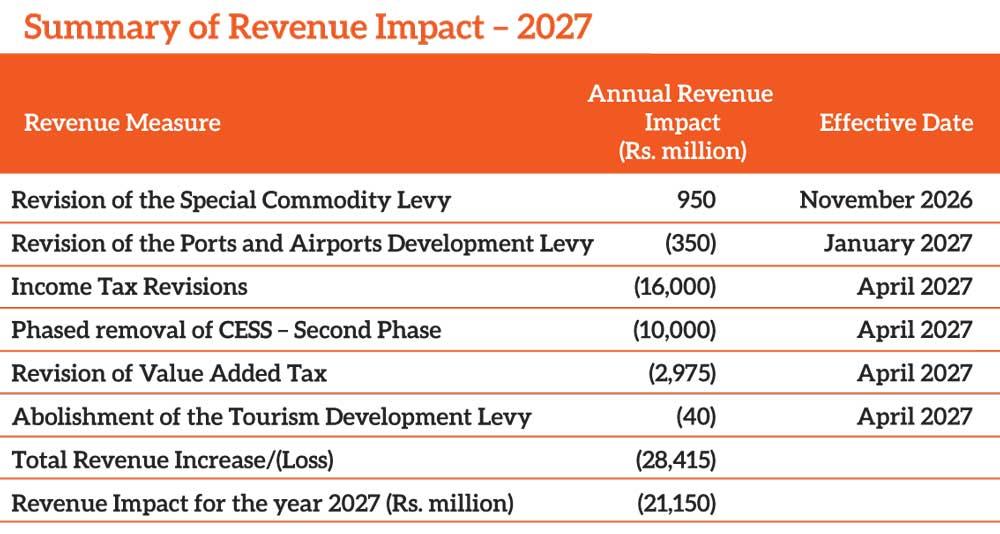
30. National Security
Provisions of Rs. 250 million have been allocated for the establishment of a Defence Development Research Centre, affiliated to the Ministry of Defence, for research carried out by the security forces.
There are teams in the security forces recruited for construction work. It is proposed to provide a special allowance to these personnel when they are deployed in various development programmes of the Government.
As a tribute to the parents of war heroes who joined the Armed Forces before 2009, it is proposed that the Ministry of Defence expeditiously prepare a programme to increase the monthly allowance of Rs. 750 currently paid to the mother and the father, and to implement it from July 2027.
An institution to provide consultancy services for public sector construction will be established by attaching professionals, including engineers, serving in the tri-forces. This institution will function as a consultancy institution in the planning, monitoring and supervision of Government projects.
Steps will be taken to modernize the digital and cyber security systems of the Ministry of Defence, establish a digital forensic laboratory and develop border security technological facilities. It is also expected to improve the communication and technological facilities of the Sri Lanka Army, and to provide new patrol craft, tug boats and modern radar systems to strengthen the maritime security and surveillance capabilities of the Sri Lanka Navy.
31. Cultural and National Heritage
Our national identity has been established through all ethnicities and religions living in harmony as one family. It is one of our foremost responsibilities to formally conserve that heritage in order to bequeath it to future generations.
For this, steps will be taken to digitalize and conserve sacred places, historical artefacts and cultural identities through digital technological innovations such as 3D Laser Scanning used internationally as well as locally. This will make it possible to permanently maintain accurate three-dimensional models of the national heritage even in the face of natural disasters or weather impacts.
Rs. 7,000 million has been allocated in this Budget for the promotion and development of artistic activities associated with various ethnicities and religions.
Anuradhapura is a sacred area of national and international importance in which many unique historical, archaeological, religious and cultural heritages of Sri Lanka are concentrated. It represents the historical heritage of Buddhist civilization. Therefore, we expect to implement a number of development activities, including improving the facilities required by devotees, road rehabilitation and waste management, while safeguarding its archaeological and religious values for future generations. An advisory council, co-chaired by the Acting Chief Prelate of the Atamasthana, has already been established to monitor and guide this programme. For this purpose, Rs. 1,076 million has already been allocated by the Central Cultural Fund for the year 2027. The Urban Development Authority has prepared an estimate of Rs. 8,200 million, and it is proposed to allocate Rs. 500 million for the year 2027.
Funds have been allocated to the Ministry of Housing and Water Supply to implement the ‘Yathiwara’ housing program for parents, which was initiated in 2026, during the year 2027.
The Government has provided provisions of Rs. 722 million for the rehabilitation of 1,328 places of religious worship damaged by the Ditwah disaster, comprising 758 Buddhist temples, 272 Hindu places of worship, 199 Muslim places of worship and 99 Christian places of worship. In addition, among the 1,328 destroyed places of religious worship, Rs. 40 million from the Buddha Sasana Fund for 30 Buddhist temples, and Rs. 523 million from the Central Cultural Fund for archaeological sites, including places of religious worship, are being utilized for rehabilitation, and a temple is also being rehabilitated through the Anagarika Dharmapala Trust with funds donated by the Maha Bodhi Society of India.
32. Mass Media
Provisions have been allocated, amounting to Rs. 400 million to the Sri Lanka Rupavahini Corporation and Rs. 489 million to the Independent Television Network, for implementing digitalization activities, improving broadcasting facilities and purchasing modern equipment and technological tools. Rs. 384 million has been allocated to the Sri Lanka Broadcasting Corporation for recurrent expenditure.
It is proposed to allocate Rs. 100 million to offer higher education scholarships and to provide support for the technological access required in journalism, in order to provide the necessary support for the skills development of journalists in keeping with the advancement in the field of mass media in parallel with modern technology.
33. Clean Sri Lanka
The ‘Clean Sri Lanka’ programme aims to transform Sri Lankan life, extending well beyond mere physical cleanliness, by steering it toward a positive direction in social, environmental and ethical terms. Under its social pillar, the programme seeks to strengthen quality of life, dignity, safety, equal access, inclusivity, community participation and social harmony; under its environmental pillar, it focuses on promoting environmental protection, conservation, stewardship, biodiversity, responsible resource utilization and sustainability; and under its ethical pillar, it seeks to strengthen responsibility, honesty, discipline, fairness, efficiency and accountability regarding public resources. Rs. 6,000 million has been allocated to implement these programmes.
Various programs are being implemented, including: the provision and sustainable maintenance of physical infrastructure, such as Haritha Mawatha,’ ‘Clean Colombo,’ ‘Clean Islands,’ ‘Clean City,’ ‘Clean Sri Lanka-Aththama,’ the modernization of ‘Dream Destination’ railway stations, and the establishment of standardized public sanitation facilities; environmental development projects, including the creation of elephant nourishment zones; and initiatives to promote positive public habits, community participation, and corporate responsibility.
Under the “Pivithuru Purawara” (Clean Cities) National Waste Management Program, the objective is to increase the waste collection rate, currently at 32 percent to 60 percent by 2029, while promoting safe waste management and fostering a healthy, secure environment. It is proposed to allocate Rs. 5,000 million to implement this project across 100 selected local government authorities under the “Clean Sri Lanka” initiative.
The ‘Clean Island’ project, proposed to be implemented with the support of the Ministry of Energy, will develop the islands of Delft, Nainativu, and Analaitivu as ‘model islands’ for integrated development and transformation.
34. Public Administration and Public Services
A four-year project will be implemented to enhance the revenue-generating capacity of Local Government Institutions, utilize existing resources productively and strengthen financial sustainability. Through this, it is expected to continuously maintain the essential services of Local Government Institutions, and provisions of Rs. 1,000 million have been allocated for this purpose.
It is proposed to provide provisions of Rs. 575 million from Provincial Council funds to complete the construction of the Capital Square building, which was commenced by the Kurunegala Municipal Council and abandoned without being completed.
It is proposed to allocate provisions of Rs. 50,000 million, at Rs. 2,000 million per district, to implement the District Development Programme and the Decentralized Budget Programme. Of this, Rs. 47,750 million will be allocated for special development programmes identified at district level, and the remaining Rs. 2,250 million for implementing the Decentralized Budget Programme, at Rs. 10 million per Member of Parliament.
Plans are in place to improve both roads and bridges as part of the development of the rural road network. A sum of Rs. 55,000 million has been allocated for this purpose. In addition, Rs. 5,500 million has been allocated for the improvement of rural bridges including those under the purview of local government authorities while Rs. 20,000 million has been set aside for the maintenance and rehabilitation of Provincial Council roads. Accordingly, when the allocations under the District Development Programme are added to the aforementioned Rs. 80,000 million, a total of approximately Rs. 100,000 million has been earmarked for the development of rural roads.
Rs. 1,100 million has been allocated for the construction of new District Secretariat offices in the Vavuniya, Puttalam and Anuradhapura districts with the aim of providing an efficient and quality public service to the public.
Rs. 265 million has been allocated for the commencement of the construction of new Divisional Secretariat office buildings in Dehiattakandiya and Elapatha to further formalize public services at the regional level.
It is proposed to introduce a fairer and simpler mechanism, effective from the year 2027, to address the difficulties arising from the current system which limits the allocation of funds for salaries in local government institutions to 20% and 40%. Accordingly, it is proposed to cover 100% of the funding required for staff salary expenditures in 46 financially weak local government authorities in 2027. It is also proposed to change these percentages for the other local government institutions. Furthermore, Rs. 1,750 million has been allocated to support capital programmes, based on plans submitted by these institutions.
Provisions of Rs. 1,100 million have been allocated to complete the construction of the Kegalle and Nuwara Eliya District Secretariat offices and the Negombo, Homagama, Kalutara, Pitabeddara, Angunakolapelessa and Deraniyagala Divisional Secretariat offices, work on which has already commenced, in order to enhance the efficiency of public officers and provide a quality service to the public.
Rs. 4,500 million has been allocated to provide a new stock of computers in place of the old stock of computers held by public institutions. It is proposed to provide a further Rs. 2,200 million in addition.
It is proposed to resolve the issues existing within departmental services and other executive services, in alignment with the promotion mechanisms currently in place for island-wide services.
In order to provide adequate human resources for maintaining an efficient and quality public service in public institutions, approval has already been granted by the officials’ committee on staff management appointed by the Cabinet of Ministers and the Department of Management Services for recruitment to 148,940 vacancies, while reviewing the recruitment process of the public service. Of this number, around 40,000 recruitments have been completed so far, and provisions will be allocated to recruit further 110,000 in the future.
The Sethsiripaya Stage III Project in Battaramulla has commenced. This project is expected to be completed in 2028, and Rs. 6,800 million has been allocated for this purpose.
It is proposed to implement the Sethsiripaya Stage IV Project, with a day care centre, at Denzil Kobbekaduwa Mawatha, Battaramulla, by deploying the funds of the Urban Development Authority.
35. Public Sector Salaries and Pensions
Honourable Speaker,
Through our first Budget in 2025, steps were taken to increase the basic salary by increasing the minimum monthly basic salary of the public sector by Rs. 15,750 and by increasing the value of the annual salary increment by 80 percent. Rs. 330 billion is spent on this salary increase. This salary revision has been implemented in 3 phases, and its final phase will be implemented in 2027, for which Rs. 110 billion is allocated in the Budget.
Meanwhile, public servants in various sectors have submitted requests to revise their allowances, considering the increase in the related expenses they have to bear in the performance of their duties. Taking into account those requests as well as the fiscal space currently available to the Government, we expect to increase several allowances on a priority basis through this Budget. Requests to revise other allowances will be considered in phases in future Budgets, taking into account the fiscal capacity of the Government.
Accordingly, it is proposed to revise allowances as follows.
Transport Allowance of Executive Officers in the Public Service
Executive officers who are entitled to an official vehicle under Public Administration Circular No. 05/2016 but use their private vehicles in the performance of official duties are currently paid a monthly transport allowance of Rs. 50,000. Considering the increase in maintenance, repair and other operational costs when private vehicles are used for official duties, and since it is more cost-effective for the Government for officers who own a vehicle to use their private vehicle rather than being provided with a Government vehicle, in order to encourage this, it is proposed to increase the monthly transport allowance currently paid to Rs. 100,000.
With the aim of encouraging the use of electric vehicles, it is proposed to increase by 150 percent, with effect from July 2027, the monthly allowance paid in terms of Public Administration Circular 13/2008(V) to officers entitled to an official vehicle who use fully electric private vehicles.
Allowances in the Health Sector
Considering the important role they play in safeguarding the health and wellbeing of our people, it is proposed to increase the DAT allowance paid to medical officers by Rs. 25,000, from Rs. 70,000 to Rs. 95,000.
To strengthen the national health system, it is proposed to increase the monthly special duty allowance of nursing officers and officers in the paramedical and supplementary medical services from Rs. 6,000 to Rs. 12,000, and the monthly special duty allowance of other health staff from Rs. 2,000 to Rs. 4,000.
It is proposed to pay the above allowance increases proposed for the health sector in two steps. Accordingly, 50 percent of the increase will be paid from July 2027, and the remaining 50 percent in 2028.
Payments to Lecturers in Universities and Vocational Training Institutes
Considering the important role played by university academic staff in improving the quality of higher education, promoting research activities and developing human resources, it is proposed to increase the monthly academic allowance currently paid to such staff by Rs. 25,000. It is expected to pay 50 percent of this increase from July 2027, and the remaining 50 percent from July 2028.
In order to attract external lecturers with specialist knowledge to universities for academic activities, it is proposed to increase the payments made to external lecturers threefold in line with the existing rates. Accordingly, it is proposed to increase the allowance currently paid per hour from Rs. 1,500 to Rs. 4,500. Further, it is proposed to increase the allowance of Rs. 600 paid per hour to external advisers for practical examinations to Rs. 1,800.
In order to attract external lecturers with specialist knowledge to vocational and technical institutions for vocational skills education, it is proposed to increase the payments made to external lecturers by 100 percent in line with the existing rates.
Food Allowance of the Tri-Forces
Considering the increase in the cost incurred for the food of members of the triforces, and with the aim of meeting their nutritional requirements and ensuring their welfare, it is proposed to increase the daily food allowance paid to the tri-forces, with effect from July 2027, by Rs. 315 for officers and by Rs. 332 for other ranks.
Food and Accommodation Allowance of Officers of the Sri Lanka Police
Considering the increase in food and accommodation expenses that police officers have to bear in the performance of their duties, it is proposed to increase the monthly food and accommodation allowance currently paid to meet such expenses by Rs. 10,000 with effect from July 2027.
Risk Allowance for Prison Officers
Taking into account the difficult and high-risk working conditions faced by prison officers in the performance of their duties, steps will be taken to increase the monthly risk allowance currently paid by 100 percent, from Rs. 8,000 to Rs. 16,000.
Likewise, it is proposed to increase the allowance of Rs. 2,250 currently paid to civil officers serving in the Department of Prisons to Rs. 10,000.
It is proposed to pay these proposed allowances of officers serving in the Department of Prisons with effect from July 2027.
Allowances for Field Officers
Considering the role played by field officers in directly providing essential public services to the community, and the increase in the costs associated with their field-based duties, it is proposed to increase the monthly travelling allowance currently paid to Grama Niladharis from Rs. 1,600 to Rs. 4,000, and the monthly office rent allowance from Rs. 3,000 to Rs. 6,000 for Municipal Council and Urban Council areas and from Rs. 2,000 to Rs. 4,000 for Pradeshiya Sabha areas.
The monthly travelling allowance currently paid to Development Officers will be increased from Rs. 300 to Rs. 1,000, and the monthly office rent allowance from Rs. 1,000 to Rs. 2,000 for Municipal Council and Urban Council areas and from Rs. 750 to Rs. 1,500 for Pradeshiya Sabha areas.
The monthly travelling allowance currently paid to Samurdhi Officers will be increased from Rs. 2,000 to Rs. 2,500, and the monthly office rent allowance from Rs. 2,500 to Rs. 5,000 for Municipal Council and Urban Council areas and from Rs. 2,000 to Rs. 4,000 for Pradeshiya Sabha areas.
It is proposed to increase the monthly travelling allowance currently paid to Agriculture Research and Production Assistants from Rs. 400 to Rs. 1,000, and the monthly office rent allowance from Rs. 3,000 to Rs. 6,000 for Municipal Council and Urban Council areas and from Rs. 2,000 to Rs. 4,000 for Pradeshiya Sabha areas.
The above allowances for field officers will be revised from April 2027.
Revision of Allowances in the Judicial Sector
Allowances of High Court Judges and Judicial Officers
Considering the professional responsibilities, the nature of service and the role of officers in the judicial sector, it is proposed to increase by Rs. 25,000 the monthly professional allowance currently paid to High Court Judges, Special Grade Judicial Officers and Judicial Officers of other grades. Steps will be taken to pay 50 percent of this increase from July 2027, and the remaining 50 percent in 2028.
With effect from July 2027, it is proposed to increase by Rs. 50,000 the monthly transport allowance currently paid to officers entitled to official vehicles, to increase the monthly driver allowance paid to entitled officers from Rs. 25,000 to Rs. 50,000, and, considering the increase in the expenses that have to be borne to meet their residential needs in instances where the Government has not provided an official residence, whether owned or obtained on a lease basis, to increase by 100 percent the monthly housing allowance currently paid to High Court Judges and other Judges.
Allowances of the Attorney General’s Department
It is proposed to increase the monthly non-practising allowance by Rs. 25,000 for the posts of Attorney General, Solicitor General and Senior State Counsel, and by Rs. 20,000 for officers in the posts of Senior State Attorney and State Attorney of the Attorney General’s Department. Steps will be taken to pay 50 percent of this increase from July 2027, and the remaining 50 percent in 2028.
With effect from July 2027, it is proposed to increase the monthly transport allowance paid to officers entitled to official vehicles by Rs. 50,000, the monthly driver allowance paid to entitled officers from Rs. 25,000 to Rs. 50,000, and the housing allowance currently paid by 100 percent.
Allowances of the Legal Draftsman’s Department
It is proposed to increase the special allowance of officers in the posts of Legal Draftsman, Additional Legal Draftsman and Deputy Legal Draftsman of the Legal Draftsman’s Department by Rs. 25,000, and the special allowance of Senior Assistant Legal Draftsmen and Assistant Legal Draftsmen by Rs. 20,000. Steps will be taken to pay 50 percent of this increase from July 2027, and the remaining 50 percent in 2028.
With effect from July 2027, the monthly driver allowance paid to entitled officers will be increased from Rs. 10,000 to Rs. 50,000.
Allowances of Judicial Support Staff
Taking into account the role played by judicial support staff in maintaining the efficient functioning of the judicial system, their workload and the responsibilities assigned to them, steps will also be taken to increase the relevant allowances paid to these officers with effect from April 2027.
Monthly Allowances of Independent Commissions, Other Commissions and Statutory Institutions
As the monthly allowances of the Chairpersons and members of Independent Commissions and other Commissions have not been revised since 2018, and the monthly allowances of the Chairpersons, Executive Directors and Working Directors of State Corporations, Statutory Institutions and Government-owned Companies have not been increased since 2015, it is proposed to increase their monthly allowances with effect from July 2027, taking into account the responsibilities they hold.
The monthly allowances paid to the Chairpersons and members of other Commissions will be revised as per the Annexure VI.
Honourable Speaker,
Further details on the revision of the above allowances are included in the Technical Note.
Revision of Public Service Pensions
Honourable Speaker,
Pension Revision and Relief to Pensioners
The Government is implementing a phased pension revision programme with the objective of ensuring a fair and structured pension system for all pensioners by systematically eliminating the disparities that exist among the pensions of retired public servants.
Through the first Budget in 2025, steps were taken to convert, in three phases, the pensions of public servants who retired prior to 2020 to the 2020 basic salary scale, and its first and second phases have already been completed. Its final phase is scheduled to be implemented in 2027.
It is also the objective of the Government to minimize and eliminate in phases, taking into account sustainable public financial management, the disparity that has arisen, due to the new basic salary revision implemented in 2025, between the pensions of public servants who retired before 2025 and those retiring in or after 2025.
It is proposed to provide a monthly interim allowance of Rs. 2,500, with effect from July 01, 2027, as a relief to pensioners who retired during the period from 2020 to 2024, until the pension revision scheduled to be carried out under the new 2025 basic salary structure is implemented.
The forthcoming pension revision based on the new 2025 basic salary structure is planned to commence with the 2028 Budget and to be implemented in several phases. Once this revision is applied to the relevant pensioners and the payment of the revised pension commences, the payment of the above mentioned monthly interim allowance of Rs. 2,500 proposed for those who retired during the period 2020–2024 will cease.
These provisions will also apply to public sector pensioners whose salaries were determined under Department of Management Services Circulars 02/2025, 03/2025, 04/2025 and 05/2025.
The overall objective of all these measures is to provide fair relief to public servants who retired at different times by systematically narrowing the pension disparities among them, and to establish a sustainable pension system in the long term.
36. Tax Policy Proposals
36.1 Increasing the Personal Income Tax Relief and Revising the Progressive Tax Slabs
Honourable Speaker,
Our Government increased the annual personal income tax free threshold from Rs. 1.2 million to Rs. 1.8 million in 2025. Through this measure, individual taxpayers gained a monthly tax relief ranging from a minimum of Rs. 3,500 to a maximum of Rs. 20,500.
To provide further relief to personal income taxpayers, it is proposed to further increase the annual personal income tax free threshold and to revise the personal income tax structure by expanding the taxable income brackets.
We were able to increase the tax-free threshold from Rs. 100,000 per month to Rs. 150,000. Through the proposed revisions, it will be further increased to Rs. 162,500. Accordingly, a person receiving a monthly salary and allowances of up to Rs. 162,500 will not be required to pay tax on his or her salary.
The tax slab to which the 6 percent tax rate applies will be Rs. 70,833 per month, and thereafter the tax slabs will be widened from Rs. 41,667 per month to Rs. 50,000 per month. The tax rates will be set at 6 percent, 12 percent, 18 percent, 24 percent, 30 percent and 36 percent, applying a rate of 12 percent instead of 18 percent after the 6 percent rate.
These revisions will raise the monthly income threshold at which the maximum personal income tax rate applies from Rs. 358,000 to Rs. 433,000. Consequently, each individual taxpayer will receive an additional monthly tax relief ranging from a minimum of Rs. 750 to a maximum of Rs. 15,750.
Accordingly, as a combined result of the tax reforms introduced in 2025 and the revisions proposed for 2027, the total monthly tax relief provided by our Government to each individual taxpayer will increase ranging from a minimum of Rs. 4,250 to a maximum of Rs. 36,250.
36.2 Enhanced Capital Allowances for Export-Oriented Manufacturing and Tourism Businesses Approved by the Board of Investment (BOI)
Honourable Speaker,
With the aim of encouraging private sector investment, promoting export-oriented manufacturing and strengthening the tourism sector, it is proposed to introduce enhanced capital allowances as an investment incentive for enterprises operating under agreements with the Board of Investment of Sri Lanka.
Accordingly, BOI-approved enterprises engaged in export-oriented manufacturing or tourism development activities with a minimum qualifying investment of USD 3 million will be permitted subject to meeting the relevant requirements to opt for an enhanced capital allowance equivalent to 200 percent of qualifying capital expenditure in place of the existing allowance regime.
36.3 Exemption of Exercise Books and Printed Books from Value Added Tax (VAT)
Honourable Speaker,
Printed books and other printed materials became subject to Value Added Tax (VAT) effective from January 2024, while exercise books had been subject to VAT even before that date.
Recognising the importance of education and the necessity of ensuring that essential educational materials are available at an affordable price, and with the objective of promoting access to education, knowledge and reading, we propose to exempt textbooks, dictionaries, encyclopaedias, children’s drawing and colouring books, educational publications and other printed books, as well as exercise books, from Value Added Tax (VAT).
36.4 Revising the Basis for Calculating VAT Liability on Cinema Ticket Revenue
With the aim of ensuring the fair and equitable application of Value Added Tax within the film industry, we propose to revise the basis for calculating the VAT liability arising from the sale of cinema tickets.
Accordingly, the VAT liability of film producers, distributors, the National Film Corporation and cinema hall operators will be determined on the basis of the share of cinema ticket revenue received by or allocated to each party at each stage, rather than calculating VAT on the full ticket value.
36.5 Facilitating Earlier Qualification of Newly VAT Registered Exporters as “Eligible Exporters”
Honourable Speaker,
With the aim of facilitating export-oriented businesses, I propose to revise the criteria under which newly VAT registered Exporters are recognized as Eligible Exporters.
Accordingly, newly VAT registered persons will be recognized as Eligible Exporters where more than 80 percent of their turnover during the preceding six months has been derived from exports, without having to satisfy the existing requirement relating to the preceding Calander year.
36.6 Use of the Indicative Exchange Rate of the Central Bank of Sri Lanka for Value Added Tax on Foreign Currency Supplies
Honourable Speaker,
In order to ensure greater transparency, consistency and fairness in valuing taxable supplies denominated in foreign currencies, it is proposed to use the Indicative Exchange Rate published by the Central Bank of Sri Lanka for the conversion of foreign currencies into Sri Lanka Rupees for VAT purposes. The Commissioner General of Inland Revenue (CGIR) will specify by way of a circular the manner in which such exchange rate is to be applied.
36.7 Social Security Contribution Levy (SSCL) Exemption for Bunker Fuel, Supplied to Ships Engaged in International Transportation
Honourable Speaker,
The supply of bunker fuel to ships engaged in international transport is an important component of Sri Lanka’s maritime services sector. This industry operates in a highly competitive international market.
With the aim of safeguarding the competitiveness of the industry and strengthening Sri Lanka’s position as a regional maritime hub, we propose to exempt the supply of fuel to ships engaged in international transport from the Social Security Contribution Levy.
36.8 Review and Rationalization of the Tax Structure applicable to the Betting and Gaming Industry
Honourable Speaker,
Addressing the long-standing need for an effective regulatory framework for the betting and gaming industry, the Government has established the Gambling Regulatory Authority (GRA) and commenced its operations.
Given that a regulatory framework is now in place, it is proposed to conduct a comprehensive review of the taxes, fees, and charges applicable to this industry with the view to eliminate instances of double taxation and inconsistencies, align the tax structure with international best practices, and ensure a fair and balanced approach that supports the sustainable development of the industry while safeguarding government revenue.
This review aims to establish a simple, transparent, and integrated tax structure that is easy to administer and facilitates compliance.
36.9 Strengthening Tax Administration and Facilitating Taxpayer Compliance
Honourable Speaker,
With the objective of strengthening tax administration, enhancing legal certainty, and facilitating tax compliance for taxpayers, we propose to remove ambiguities present in certain provisions of existing tax laws. Furthermore, we propose to review and amend these provisions to align them with evolving business practices and new forms of transactions.
Additionally, we propose to review certain stringent procedural requirements which could lead to taxpayers denied legitimate tax refunds or input tax credits due technical or procedural noncompliance while ensuring that adequate safeguards remain in place to protect government revenue.
These measures aim to establish a fair, transparent, and efficient tax administration system that encourages voluntary tax compliance, safeguards the taxpayers’ legitimate entitlements, and protects government revenue.
36.10 Revision of the Special Commodity Levy (SCL) on Several Essential Food Items
Honourable Speaker,
With the aim of minimizing the cost-of-living pressure on consumers caused by rising prices of essential food items, it is proposed to reduce the Special Commodity Levy on imported sprats from Rs. 100 to Rs. 10 per kilogram, on Maldive fish from Rs. 302 to Rs. 10 per kilogram, and on powdered and unpowdered dried chillies by Rs. 50 per kilogram.
These tax revisions are scheduled to be implemented with effect from November 13, 2026.
36.11 Phased Reduction of Import Tariffs
Honourable Speaker,
It is proposed to reduce by 25 percent, the existing CESS rates applicable to 800 selected Harmonized System (HS) code lines, under the Government’s programme of phased reduction of import tariffs, with the aim of simplifying the import tax structure, reducing trade-related costs and enhancing the competitiveness of the economy.
It is proposed to remove the 10 percent Ports and Airports Development Levy (PAL) currently charged on the importation of newsprint classified under specified HS codes, with effect from January 1, 2027.
36.12 Supporting the Domestic Sugar Industry to Compete in the Market
To protect the domestic sugar industry, it is also proposed to increase the Special Commodity Levy imposed on imported sugar by Rs. 10 per kilogram, in order to minimize the tax disparity between domestically produced sugar and imported sugar, create equal competitive opportunities and a fair competitive environment for both parties, and ensure a more neutral and equitable tax treatment.
36.13 Abolition of the Tourism Development Levy
Honourable Speaker,
With the aim of reducing the tax burden on the tourism industry, enhancing its competitiveness and ensuring sustainable financing for tourism development, it is proposed to abolish the Tourism Development Levy currently charged on the turnover of tourism establishments.
In order to ensure continued funding for tourism promotion and development, steps will be taken in the future to formulate a suitable financing mechanism. Until then, the required funds will be provided by the Treasury on requests made by the Sri Lanka Tourism Development Authority.
36.14 Amendments to the Excise Ordinance
The 2025 Budget proposed to introduce a new Excise Act in place of the centuryold Excise Ordinance with the aim of improving revenue management.
However, until a new Act is introduced, we propose to bring amendments to the Excise Ordinance by further simplifying this complex process and incorporating amendments into the existing Ordinance itself.
37. Borrowing Limit
The borrowing limit of the Appropriation Bill for the financial year 2027 is presented in Annexure IV. Summary of New Expenditure Proposals Presented in the 2027 Budget is given in Annexure II. Further, the documents to be presented with the second reading of the Budget under the Public Financial Management Act, No. 44 of 2024 have also been tabled.
38. Supplementary Estimate for Ditwah Reconstruction – 2027
It is proposed to allocate as provisions for 2027 the amount that has not been utilized so far, due to reasons including the war situation in the Middle East, out of the Supplementary Estimate of Rs. 500 billion approved by Parliament for the reconstruction of Ditwah damage. Budgetary provisions of Rs. 260 billion have to be secured again for 2027 to properly complete the Ditwah reconstruction activities.
Accordingly, in addition to the 2027 Budget I have presented, it is proposed to present to Parliament a Supplementary Estimate for Ditwah reconstruction expenditure in accordance with the provisions of Section 16 of the Public Financial Management Act.
It is proposed to table that Supplementary Estimate today, following the Budget Speech.
39. Conclusion
Honourable Speaker,
Our Budget proposals are not confined to paper alone. They are proposals that are implemented in practice on the ground. Therefore, every new proposal will have a clearly accountable institution, outcome indicators, national priorities, a cash flow plan and a transparency that can be easily observed by the public. What we are striving to build is a country that safeguards the dignity of the citizen, ensures the safety of the child, gives due value to labour, creates opportunities for knowledge and protects natural resources for future generations.
Having overcome the challenges that prevailed and built stability in the economy, our next target is to commence a forward-looking and transformative era in 2027. For this, the collective strength and contribution of all of you is essential to us.
Honourable Speaker,
In the modern world, Governments are changed through progressive ideological revolutions, through the intelligent decisions of the people and through advanced policies and programmes suited to the future. However, our Opposition is still clinging to superstitious beliefs and has been unable to free itself from regressive thinking.
Politics must be done by going among the people on the ground, not by tying threads in cemeteries at night, nor by wasting the time of Parliament reciting curse verses.
Likewise, read the Kalama Sutta, which the Lord Buddha preached to the Kalamas (the residents of the town of Kesaputta), pointing out that nothing should be accepted blindly but should be examined with wisdom, and understand the revolution the Lord Buddha made against blind faith. Read the Aggañña Sutta, which the Lord Buddha preached against superstition, and the Kevatta Sutta, preached against false incantations, and understand the ideological revolution brought about by the Lord Buddha.
In the Tevijja Sutta, the Lord Buddha asks whether, if a man standing on this bank of a river, wishing to go to the other bank, neither swims nor uses a boat but prays to the far bank, saying “Come here, far bank, come here”, the far bank would come to this side.
Honourable Speaker,
We have a very clear, progressive and proud dream for our motherland. Our hope is to make this country not merely an island, but one of the most advanced countries, not only in Asia but in the whole world, rich in knowledge, skills and modern technology.
Today, we are implementing a strong programme towards that end. We have commenced the transformation of making our younger generation and our children across the country fully skilled, advanced citizens by providing them with modern technology, science and global knowledge.
Honorable Speaker,
What we need is not only to build an economically developed country, but also to build a new image of the Sri Lankan before the world. Our dream is to brand Sri Lanka in the world in such a way that a Sri Lankan is recognized as an educated, intelligent, civilized, respectable and trustworthy citizen. Our expectation is to mark before the world that, though we are a small country, our human resources are endowed with a unique intelligence. We want to prove to the whole world that we have a generation of citizens who fulfil the responsibilities they have undertaken, work with dedication, create new ideas, find solutions in the face of challenges and can move forward shoulder to shoulder with the world. What we are trying to build is not only a new economy for Sri Lanka, but also a new recognition, a new respect and a new pride for the Sri Lankan before the world.
Honourable Speaker,
Criticize the Government. Question our policies. Present a better alternative programme than ours. We fully accept your democratic right to do so. But bring alternative policies instead of curse verses, creative solutions instead of sorcery, and intelligent dialogue instead of yaga and homa rituals into the politics of this country. When the people of our country are moving forward with technology and intelligence, should the politics of the Opposition alone turn upside down and go backwards? I would like to remind at this moment that building a political culture that befits the civilized, enlightened and proud Sri Lankan identity we are trying to build before the world is a fundamental responsibility entrusted not only to the Government, but also to the Opposition. The intelligent people of this country will never again set foot in that old darkness.
Honourable Speaker,
What we must leave behind for future generations is not our party disputes, but a prosperous and just country whose future they can take over with confidence.
Therefore, let us make the name “Sri Lankan” not merely a name we pronounce with pride, but a proud name that the whole world accepts with respect.
Let us prove our pledge towards that, not merely in words, but through action.
Today, we extend an invitation with an open heart to all political parties in this country, to all stakeholders, and to every Sri Lankan living anywhere in the world. Come, let’s become partners in building the future of this country!. We do not need to think along the same lines. We do not need to hold the same opinion. But our country is greater than our differences. The future of our children is more valuable than our individual goals. Therefore, let us bring together our knowledge, our abilities and our strengths. Let us begin from where we can agree. Let us unite, not to get ahead of one another, but to take our motherland ahead of us all!
In the end, what we must leave behind for our children is not the story of how far above one another we stood, but the story of how high we all, together, raised this country.
The victory of that story will not belong to one individual. It will not belong to one party. It will not belong to one generation alone.
That victory will belong to every citizen of this country.
That victory must have only one name – Sri Lanka!
Finally, I express my sincere gratitude to all the officials of the Ministry of Finance and the Secretary to the Treasury, Dr. Harshana Suriyapperuma, who worked with unwavering dedication and perseverance in preparing this Budget. Their professionalism, dedication and sense of duty have been instrumental in the preparation of this comprehensive and forward-looking Budget. As we collectively advance the Government’s economic reform agenda and national development goals, we always look forward to your continued support and commitment as officials of the Ministry of Finance to ensure and implement these proposals in a timely and effective manner.
Thank you.