
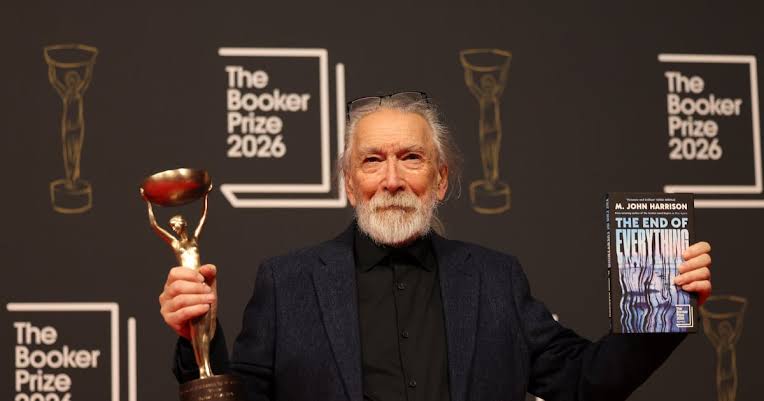
British science fiction author M. John Harrison has won the 2026 Booker Prize for his novel The End of Everything, making history as the oldest writer to receive one of the world’s most prestigious literary awards.
At 81, Harrison’s remarkable achievement represents a defining moment for science fiction, a genre that was once frequently overlooked by the traditional literary establishment.
The award was announced on November 9, 2026, during a ceremony in London, recognising Harrison’s imaginative storytelling and unconventional approach to exploring humanity’s response to an unfamiliar and unsettling world.
A Historic Victory for Science Fiction
Harrison began his writing career in the 1960s, at a time when science fiction was often considered less prestigious than traditional literary fiction.
Throughout his career, he challenged the idea that stories involving futuristic societies, alien encounters and imaginary worlds could not achieve the same literary recognition as other novels.
Six decades later, his Booker Prize victory represents a remarkable milestone.
According to Gaby Wood, Chief Executive of the Booker Prize Foundation, Harrison is the first winner to have emerged directly from the established science fiction literary tradition.
Although previous Booker Prize winners, including Margaret Atwood and Kazuo Ishiguro, have incorporated science fiction elements into their novels, Harrison has spent much of his career writing within the genre.
Despite this distinction, Harrison has emphasised that he prefers to be recognised simply as a writer rather than being confined to any single literary category.
What Is ‘The End of Everything’ About?

The End of Everything is a dystopian science fiction novel set in Britain following the arrival of mysterious alien beings known as the iGhetti.
The story follows a beachcomber who discovers an unusual alien object washed ashore. As the mysterious artefact begins to grow, he travels along the coast, sometimes attempting to abandon it and at other times developing a strange attachment to it.
Meanwhile, the world struggles to understand the alien presence. Nobody knows exactly where the iGhetti came from, what they want or how humanity should respond.
Unlike traditional science fiction novels, Harrison deliberately avoids providing straightforward explanations. Instead, he creates an atmosphere of uncertainty, encouraging readers to question what they know about reality.
The novel explores themes of social collapse, fear, human behaviour and the difficulty of understanding events beyond our control.
Harrison has explained that he wanted to explore society’s inability to find clear explanations during times of crisis.
Why Did ‘The End of Everything’ Win the Booker Prize?

The 2026 Booker Prize judging panel was chaired by British historian and classicist Mary Beard.
The judges praised Harrison’s originality and his ability to blend science fiction with elements of mystery, satire, psychological drama and literary realism.
Beard described the novel as an unusual and thought-provoking work that challenges readers while maintaining moments of humour and unexpected optimism.
Fellow judge and author Patricia Lockwood revealed that she had been unfamiliar with Harrison’s work before reading the novel but was deeply impressed by his writing.
She went on to read the book five times, writing two essays and a poem inspired by the experience.
The judges also highlighted the novel’s versatility, noting that it could be interpreted as a thriller, a mystery, a satire, a dystopian story or a work of literary realism.
An Emotional Moment for the 81-Year-Old Author

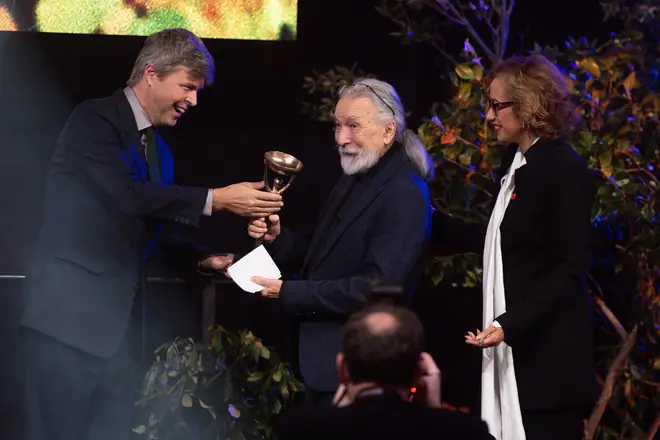


Harrison appeared visibly emotional while accepting the award, admitting that he had not expected to win.
Reflecting on the significance of the moment, he spoke about how unexpectedly life can change, even after decades of professional experience.
He also joked about finally feeling like a legitimate writer despite his continued uncertainty about his own abilities.
His achievement makes him the oldest author ever to win the Booker Prize, surpassing Margaret Atwood, who was 79 when she shared the award in 2019.
Alongside international recognition, Harrison receives a cash prize of £50,000, approximately US$66,700.
Who Is M. John Harrison?

Born in Rugby, England, in 1945, Michael John Harrison developed a passion for literature during his youth, spending considerable time reading books at his local library.
He began publishing science fiction stories in magazines during the 1960s before releasing his debut novel, The Committed Men, in 1971.
Over the following decades, Harrison became known for his experimental writing style and unconventional approach to science fiction and fantasy.
Although he has received considerable critical recognition in Britain, he remains less widely known among mainstream American readers.
His Booker Prize victory is expected to introduce his work to a much larger international audience.
The 2026 Booker Prize Shortlist

Harrison’s novel emerged victorious against five other acclaimed works, including books by two previous Booker Prize winners.
| Author | Nominated novel |
|---|---|
| M. John Harrison | The End of Everything — Winner |
| Marlon James | The Disappearers |
| Douglas Stuart | John of John |
| Elizabeth Strout | The Things We Never Say |
| Luke Kennard | Black Bag |
| Rebecca Perry | May We Feed the King |
The Booker Prize is awarded annually to an outstanding novel written in English and published in the United Kingdom or Ireland.
Previous winners include internationally celebrated writers such as Salman Rushdie, Margaret Atwood, Arundhati Roy and Sri Lanka’s Shehan Karunatilaka, who won in 2022 for The Seven Moons of Maali Almeida.
The 2025 prize was awarded to David Szalay for his novel Flesh.
A New Chapter for Science Fiction in Literature

Harrison’s victory has renewed discussions about the place of science fiction within contemporary literature.
For decades, the genre has explored major questions surrounding technology, political change, humanity and the future of civilisation. Yet science fiction has sometimes struggled to receive the same recognition as traditional literary works.
With The End of Everything, Harrison demonstrates how speculative storytelling can examine complex social issues without following conventional genre expectations.
Interestingly, the author himself remains cautious about labels, arguing that categorising writers can restrict both their creativity and their readership.
His ambition is to create stories that speak to readers regardless of their preferred literary genre.
After more than 60 years of writing, M. John Harrison’s historic Booker Prize victory is a reminder that powerful literature knows no boundaries of age, genre or imagination.
As The End of Everything gains international attention, its success may introduce a new generation of readers to one of Britain’s most distinctive literary voices.
Image Credits and Disclaimer: All photographs, book covers and promotional images accompanying this article remain the property of their respective photographers, publishers and copyright owners. No ownership is claimed. Images are used for editorial reference, and appropriate permission or licensing may be required before publication.