
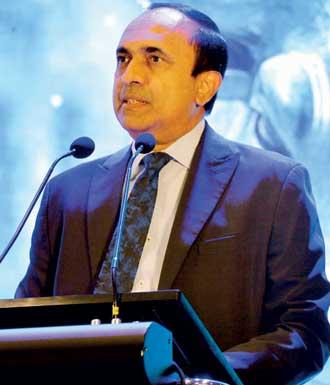
Capital raised through the Colombo Stock Exchange (CSE) could touch Rs.200 billion this year, setting a fresh high for the bourse, as it readies an ESG index, exchange-traded funds (ETFs), a derivatives market and eventual demutualisation, CSE Chief Executive Officer Rajeeva Bandaranaike said yesterday.
The bourse has so far mobilised Rs.160 billion this year through debt, equity and rights issues, which is already about 30 percent higher than the Rs.123 billion raised during the whole of 2025. The amount now stands just Rs.15 billion short of the record Rs.175 billion raised in 2024, while a Rs.200 billion outcome by the year-end would exceed that figure by roughly 14 percent.
Delivering the welcome address at the Institutional Investor Forum, jointly organised by the Securities and Exchange Commission of Sri Lanka (SEC) and the CSE in Colombo, Bandaranaike described the transformation under way at the exchange as more ambitious than anything it had undertaken before.
The forum was attended by Labour Minister and Deputy Minister of Finance and Planning Prof. Anil Jayantha Fernando, Central Bank Governor Dr. Nandalal Weerasinghe, SEC Chairman Senior Professor Hareendra Dissabandara and CSE Chairman Dimuthu Abeyesekera.
“Our objective is not simply to improve the stock exchange, but rather to build the capital market that Sri Lanka will need tomorrow,” he stressed.
However, he acknowledged that exchanges globally are struggling to attract new listings amid competition from alternative sources of financing. The CSE has therefore set up a commercial division solely tasked with courting prospective issuers, and the division is currently working with a base of around 800 companies.
“This represents a very important shift in our approach, from a relatively passive approach a few years back to a far more proactive and aggressive approach,” Bandaranaike pointed out, calling on investment banks, stockbrokers, financial advisors, accountants and legal professionals to support the drive.
Noting that a modern capital market cannot be built around equities alone, he revealed that green, blue, social, sustainability and other thematic bonds, collectively known as GSS+ bonds, accounted for nearly 40 percent of all debt capital raised last year. As per CSE data, debt IPOs raised Rs.113 billion through 22 debenture issues in 2025, up 19 percent from a year earlier. Seven of those issues were made under the GSS+ framework, placing GSS+ issuance at over Rs.40 billion.
The CSE plans to launch an ESG index before the end of this year, while ETFs are slated for launch early next year. Bandaranaike also invited market participants to make use of the frameworks already in place for real estate investment trusts (REITs), stock borrowing and lending, and regulated short selling.
“For stockbrokers, these developments represent more than just new products. They represent the opportunity to develop new client segments, advisory capabilities and, of course, revenue streams,” he added.
On the infrastructure front, he outlined the implementation of XBRL for corporate disclosures, a central counterparty (CCP) system to minimise post-trade risk, new surveillance systems at the CSE and the SEC, the modernisation of the Central Depository Systems (CDS) platform and a shift towards API-based services.
Responding to industry complaints over delays in client onboarding, Bandaranaike reminded brokers that the CDS decentralised account opening a few years ago and developed a mobile app that allows them to onboard new clients instantly. He remarked that the CDS “really can do very little here”, urging stockbroking firms to expedite onboarding while working within the confines of Financial Intelligence Unit (FIU) regulations.
Pointing to innovation already emerging, he highlighted that some firms have built their own apps, while one recently partnered with one of the country’s largest commercial banks to offer stock market access through the bank’s app via a direct API connection to the CDS. Digitalisation, he explained, should free brokers from routine administrative work so that they can focus on client relationships and investment advice.
Meanwhile, Bandaranaike stated that the exchange is ready to establish a derivatives market subject to regulatory approvals and is exploring multi-currency trading and new market segments through Port City Colombo. The CSE has also partnered with India’s National Commodity and Derivatives Exchange (NCDEX) to jointly respond to an SEC-enabled request for proposals to set up a multi-asset class exchange.
The CDS has submitted a proposal to the Public Debt Management Office (PDMO) at the Ministry of Finance to provide depository services for government debt securities, he disclosed. Having strengthened its institutional structure and governance framework, the CSE is also ready for eventual demutualisation, Bandaranaike asserted, noting that a model has already been identified and a commercialisation drive is under way.
Turning to investor participation, he observed that it remains concentrated within a relatively narrow segment of the population. The CSE, together with the SEC and stockbrokers, conducted a record number of investor education programmes this year, directly targeting 49,000 people as of September, which works out to roughly 5,400 a month. A broader branding campaign will commence in January 2027.
“The campaigns can create interest, educational programmes can develop understanding and the digital platforms can facilitate access. But it is the stockbroker who ultimately converts that initial interest into a long-term investment relationship,” Bandaranaike told the gathering.
He noted that the initiatives form part of a larger strategy to build a deeper and more liquid market, and many of them will require consultation, investment and operational adjustments by intermediaries. As participation broadens, he cautioned, the industry shares a collective responsibility to ensure that investors are treated fairly and understand the risks of their investments.