
Hemas Holdings PLC reported a weaker start to the 2026/27 financial year as a sharp increase in operating costs, driven by the Middle East conflict, a weaker rupee and rising inflation, weighed on earnings despite continued growth in revenue across most of its core businesses.
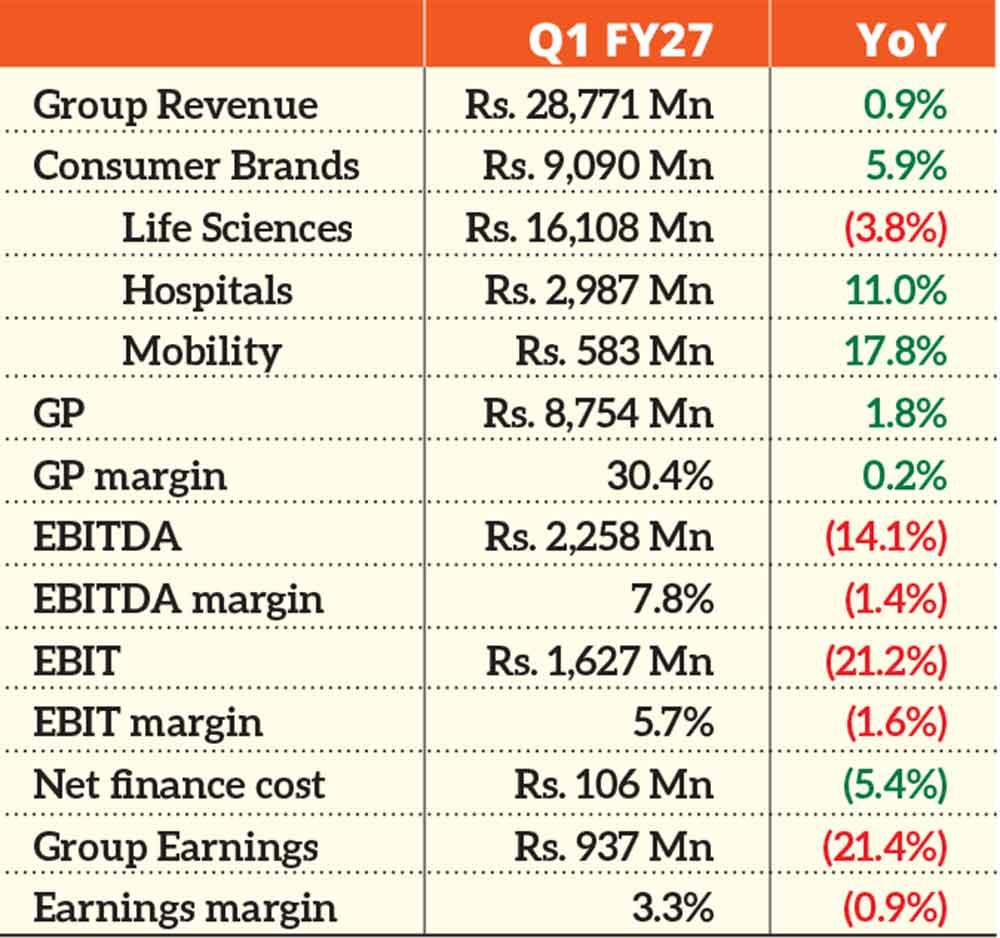
The diversified conglomerate posted revenue of Rs. 28.77 billion for the three months ended June 30, up 0.9 percent from a year earlier. However, profit attributable to equity holders fell 21.4 percent to Rs. 937 million, while EBITDA declined 14.1 percent to Rs. 2.26 billion as higher logistics, freight, fuel and financing costs compressed margins across the business.
The performance reflected a widening gap between revenue and profitability, with the group saying it had been unable to immediately pass through higher costs to customers, particularly in its regulated pharmaceutical business.
Group gross profit rose 1.8 percent to Rs. 8.75 billion, lifting the gross margin slightly to 30.4 percent from 30.2 percent a year earlier. However, operating profit fell 21.2 percent to Rs. 1.63 billion as net operating costs climbed 9 percent, while selling and distribution expenses surged 12.3 percent, accounting for more than half of the increase in operating costs.
Hemas said the escalation of geopolitical tensions in the Middle East significantly disrupted its cost base
during the quarter.
Fuel prices in Sri Lanka were more than 40 percent higher than a year earlier, petroleum-based raw material prices rose sharply, freight and insurance costs increased and the rupee depreciated by an average 8 percent year-on-year. Inflation, which averaged 5.9 percent during the quarter and accelerated to 6.8 percent in June, also added to both direct and indirect operating expenses.
While pricing actions and an improved product mix supported gross margins, the group deliberately absorbed part of the increase in raw material costs in selected consumer categories to protect sales volumes where management believed the cost escalation would be temporary.
The impact was more severe in the Life Sciences business because pharmaceutical prices are regulated by the National Medicines Regulatory Authority (NMRA), delaying the recovery of higher import costs caused by the weaker rupee. At the same time, the group’s leisure joint venture incurred higher finance costs on its US dollar borrowings following the currency depreciation.
Among the operating segments, Consumer Brands revenue increased 5.9 percent to Rs. 9.09 billion while Hospitals grew 11 percent to Rs. 2.99 billion. Mobility continued to be the standout performer, with revenue rising 17.8 percent and earnings more than doubling, helped by stronger cargo throughput and higher freight rates linked to shipping disruptions in the Middle East.
Life Sciences, however, remained the group’s weakest performer, with revenue declining 3.8 percent to Rs. 16.11 billion and earnings falling 21.5 percent, reflecting the lag between rising import costs and regulatory approval for price revisions.
Despite the earnings pressure, the group maintained supply continuity throughout the quarter while benefiting partially from stronger profitability in its Mobility business and higher finance income arising from its net cash position.
Group Chief Executive Officer Ashish Chandra said management’s immediate focus was on restoring margins while maintaining growth momentum.
“While the near-term operating environment remains volatile, our priorities are clear: restore margins in Consumer Brands and Life Sciences, sustain growth momentum in Hospitals and Mobility, and execute our growth investments with discipline,” Chandra said.
“Our diversified portfolio and net cash position provide resilience, while actions on pricing, cost recovery and productivity will strengthen performance. We remain firmly focused on delivering our long-term growth ambitions and creating sustainable value for our shareholders and stakeholders.”
Looking ahead, Hemas expects profitability in Life Sciences to improve gradually as approved pharmaceutical price increases begin flowing through its financials. The group also plans to accelerate productivity initiatives, strengthen pricing discipline and continue investing in growth while navigating what it expects to remain a volatile operating environment.