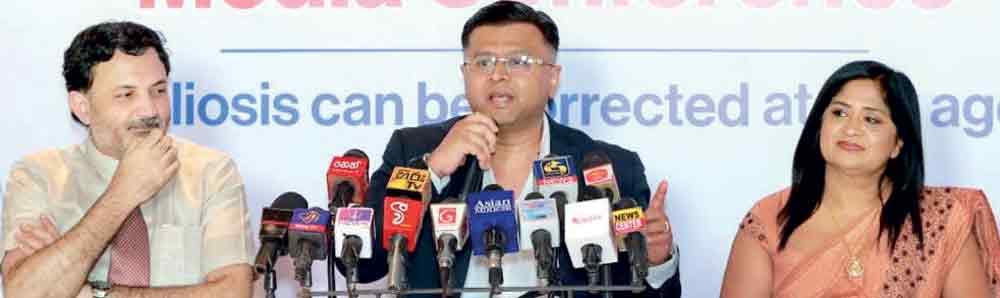
Doctors from Baby Memorial Hospital (BMH) India said scoliosis surgery has become significantly safer and more predictable in recent years, citing advances in real-time neuromonitoring, surgical navigation, and multidisciplinary treatment approaches, at a press briefing held at the Granbell Hotel recently.
The event, titled ‘Recent Advancements in Spine Surgery,’ featured Dr. Ananth Pai, Cluster CEO of BMH Hospital, and Dr. Easwar Ramani, Lead Surgeon for Scoliosis and Surgical Care.
Dr. Ramani said scoliosis, a condition characterised by a bend in the spine, is often more complex than it appears, noting that many children presenting with the condition suffer from associated health problems involving other systems, including the heart, lungs, legs or hip joints.
He said this complexity is why BMH follows a multidisciplinary team approach rather than relying on a single surgeon.
“It needs not a single surgeon; it needs many doctors and specialists to treat scoliosis,” he said, adding that procedures are coordinated across specialists when, for instance, a child requires hip surgery to balance the body before spinal intervention.
Addressing parental concerns over risks such as nerve damage or paralysis, Dr. Ramani said the hospital uses neuromonitoring technology that tracks nerve function throughout surgery and alerts doctors to potential risks to the spinal cord.
“Navigation systems, which he compared to GPS, allow surgeons to track the exact placement of titanium screws and implants in real time, while intraoperative X-rays confirm correct implant positioning before surgery concludes. These technologies, combined with the hospital’s experience treating thousands of cases, have made complex spine surgeries considerably safer.”
For younger patients, Dr. Ramani said the hospital uses growing rods for children as young as four and a half years old, which are adjusted through small incisions as the child grows until a permanent procedure is performed around age 12.
Dr. Pai, speaking on the hospital’s four-decade history and its ties to the Sri Lankan community, framed BMH’s approach around the concept of service, which he said is a term shared across several regional languages. It means we stand for providing service to anybody, he said.
“BMH is a 650-bed institution equipped for procedures ranging from advanced transplants to specialized paediatric spine surgery. We have invested very heavily on the latest technology, which you will find in any of the large metropolitan hospitals, or even in Europe or in the US.”
Dr. Pai also outlined financial and logistical support measures for Sri Lankan patients travelling for treatment, saying the hospital’s costs are lower than comparable care elsewhere.