
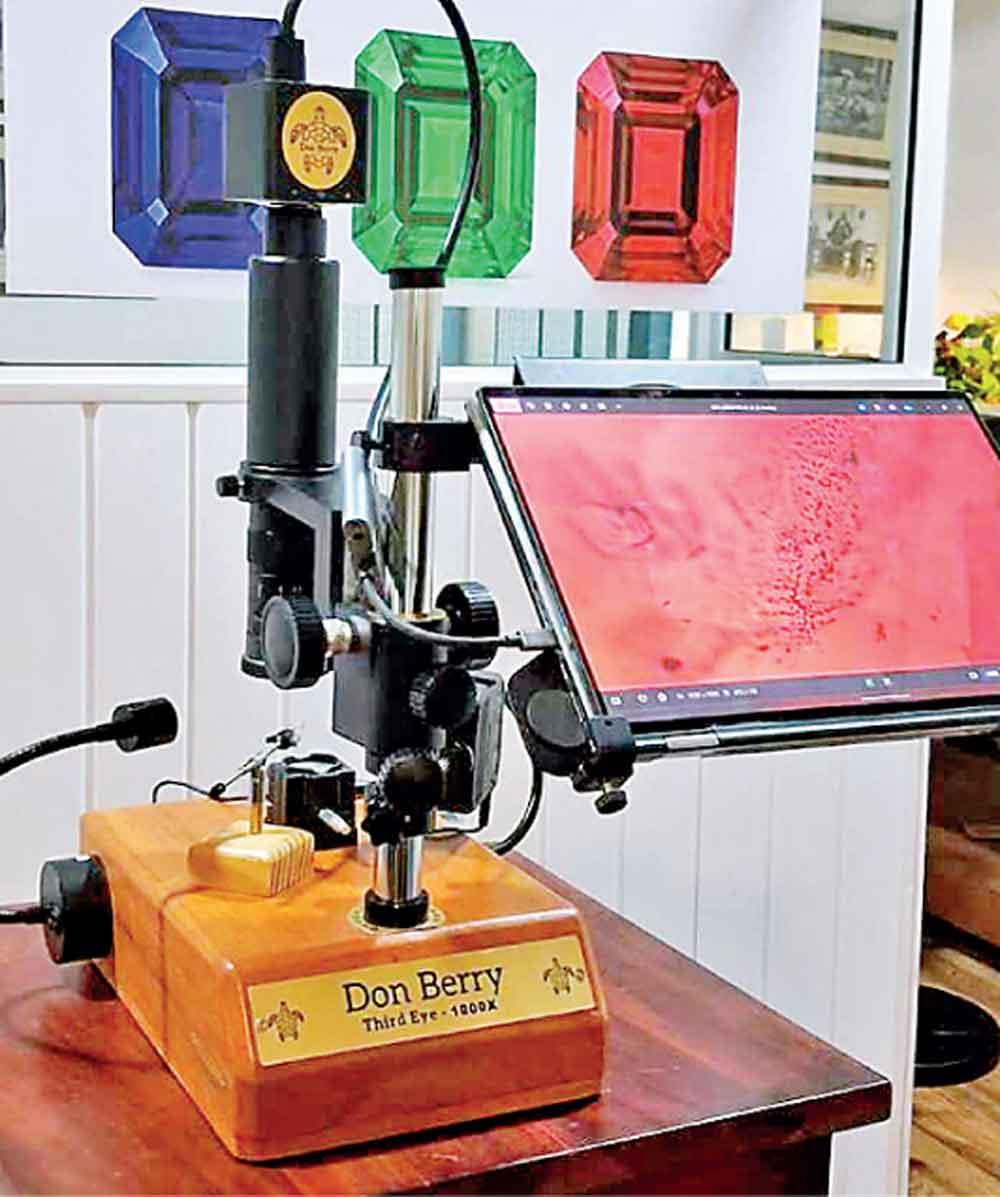
A Sri Lankan gemological scientist has developed an ultra-high magnification digital microscope capable of revealing microscopic features inside gemstones with a level of clarity rarely achieved through conventional gemological equipment. The innovation, created after nearly two years of research and experimentation, is expected to improve the speed, accuracy and transparency of gemstone testing.
The new microscope was designed by Milinda Edirisinghe, founder of the Gemological Report of Ceylon (GRC) laboratory in Colombo, who says the project began with a simple question: How much more could gemologists see if the limitations of traditional microscopes were removed?
“Every gem tells its own story through the tiny features hidden inside it,” Edirisinghe said. “The challenge has always been seeing those details clearly enough to interpret them with confidence.”
Gemological laboratories have long depended on optical microscopes to study inclusions, the microscopic crystals, fractures and growth patterns trapped within gemstones. These natural characteristics help experts determine a stone’s identity, origin and whether it has undergone any treatment.
However, even high-quality conventional microscopes have optical limitations, particularly when examining extremely fine internal structures.
To address this, Edirisinghe developed a series of four digital microscope models capable of magnifications of 450x, 600x, 1000x and 1440x. The systems have been named the Don Berry 450x, Don Berry 600x, Don Berry 3rd Eye 1000x, and Don Berry 3rd Eye 1440x.
Through these microscopes, the interior of gemstones, which was previously studied with great difficulty can now be explored easily and accurately. This opens up a whole new realm of intricate details that had hitherto remained beyond the reach of gemology.
Another most noticeable advantages of the new system is the time it takes to examine a gemstone.
Under conventional methods, analysing the internal characteristics of a stone may take anywhere from several minutes to a few hours, particularly when inclusions are
difficult to identify.
The new microscope, Edirisinghe says, allows many stones to be fully examined in less than a minute because the internal features are displayed with far greater clarity.
The improvement could significantly increase efficiency in gemological laboratories that process large numbers of stones every day.
Beyond magnification, the microscope also functions as a high-resolution imaging system capable of recording photographs and videos of internal gemstone features.
These digital records can be permanently archived and incorporated into laboratory certificates, providing an additional level of documentation for gemstone buyers, dealers and insurers.
Edirisinghe believes this could strengthen confidence throughout the gem trade by allowing customers to view the microscopic characteristics that support a laboratory’s findings rather than relying solely on written descriptions.
Permanent image archives could also assist laboratories when re-examining stones years later, offering an objective visual record for comparison.
Another feature under development is artificial intelligence-assisted image analysis.
The microscope captures ultra-high-resolution images of inclusions, which are then analysed using AI software designed to compare them against an expanding database of known inclusion patterns.
Rather than replacing the gemologist, the technology is intended to support professional judgement by helping identify mineral inclusions and geological characteristics associated with specific gemstone varieties and possible origins.
Modern gemological laboratories already employ sophisticated analytical tools such as Fourier Transform Infrared (FTIR) spectroscopy, Raman spectroscopy and other spectroscopic techniques to identify gemstones and detect treatments.
Edirisinghe emphasises that the new microscope is not intended to replace those technologies but to complement them by providing significantly improved visual examination of internal structures before or alongside advanced laboratory testing.
The clearer images, he says, can often provide valuable information at the earliest stage of analysis and help direct further testing where necessary.
Sri Lanka’s gem and jewellery sector remains one of the country’s most valuable export industries, supplying sapphires, rubies, cat’s eyes and numerous other precious stones to international markets.
Industry observers believe technologies that improve documentation and laboratory transparency could enhance confidence among international buyers, particularly in the premium gemstone market where certification plays a critical role.
Edirisinghe says jewellery manufacturers, gemstone traders and laboratories may all benefit from more detailed visual evidence of a stone’s internal characteristics, supporting quality assurance and more transparent pricing.
For consumers purchasing high-value gemstones and diamonds, comprehensive digital documentation may also provide additional reassurance that the certification accurately reflects the gemstone they are buying.